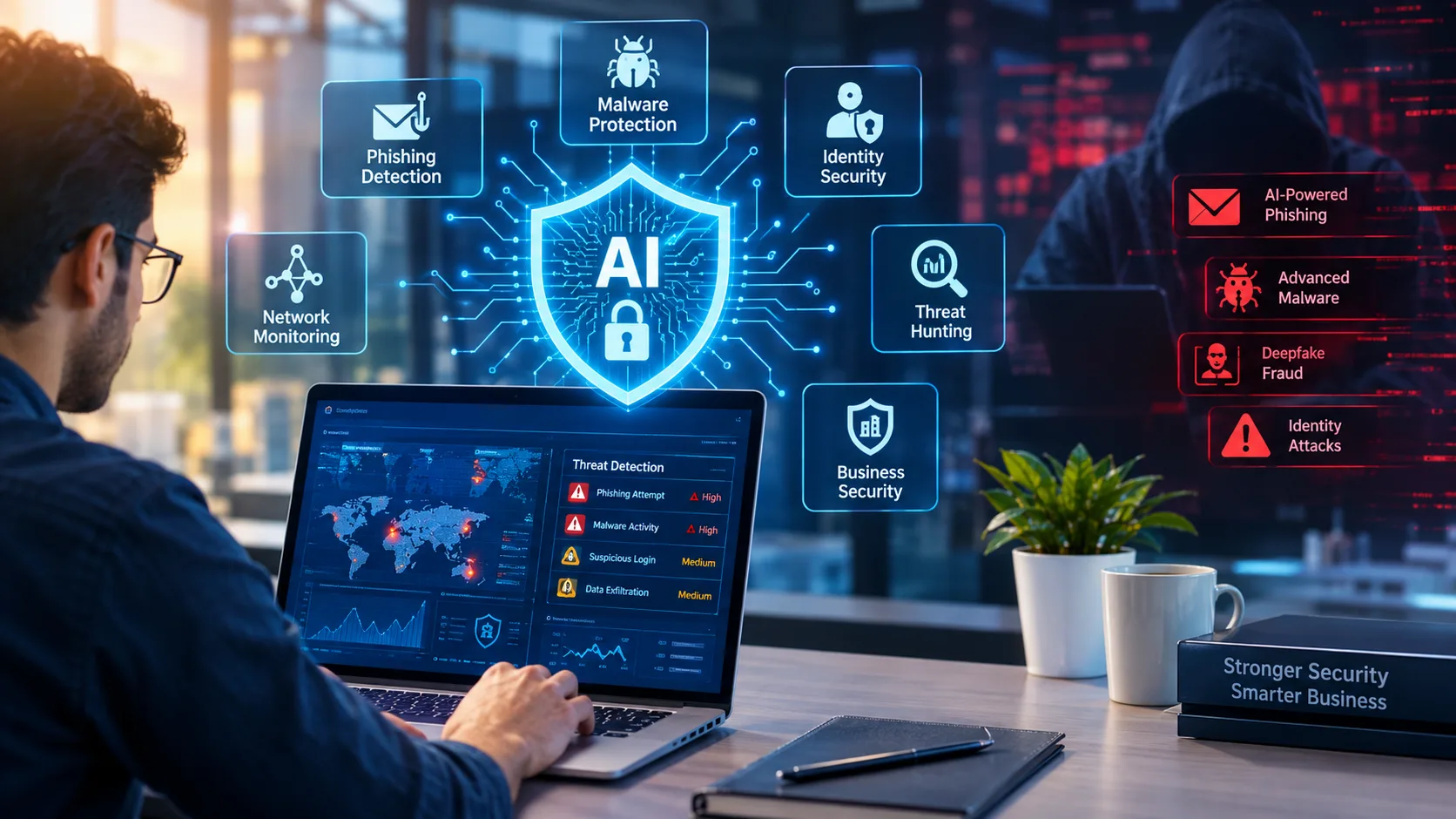
How Does AI Improve Cybersecurity?
AI cybersecurity systems can analyze large amounts of security data, detect unusual behavior and identify potential threats faster. They can help businesses spot phishing, malware, suspicious logins and other risks while supporting security teams in investigating and responding to attacks.
What Is AI Cybersecurity and How Does It Work?
AI in cyber security means using artificial intelligence and machine learning to support the protection of computers, networks, applications, identities and business data.
Traditional security systems often depend on predefined rules or known threat signatures. AI-based systems can look for patterns that may not exactly match an old threat.
How AI Analyses Security Data
A business can generate thousands or millions of security events from:
- Login attempts
- Emails
- Network traffic
- Cloud applications
- User activity
- Devices and endpoints
- Application logs
- Security alerts
AI can help process this information and highlight activity that deserves attention.
An AI security system can identify this unusual combination of behavior and flag it for investigation.
AI Does Not Replace Security Teams
AI is a security assistant, not a complete replacement for cybersecurity professionals.
Human experts still need to investigate important alerts, understand business context, confirm incidents and make decisions about containment and recovery.
The strongest approach combines AI automation, security tools and human expertise.
How AI Helps Detect and Stop Cyber Threats
One of the biggest benefits of AI threat detection is the ability to process security information quickly. AI can help security teams detect unusual patterns priorities alerts and respond to certain events automatically.
Faster Threat Detection
AI threat detection Security teams can receive a large number of alerts every day. Looking at every alert manually can take significant time.
AI can help group related alerts and identify which events may represent a serious threat.
For example, several failed logins followed by a successful login, unusual file access and suspicious network activity may together indicate a compromised account.
AI-Powered Threat Detection
AI-based threat detection can examine behavior rather than relying only on known attack signatures. This can be useful when attackers change their techniques or use previously unseen patterns.
- Anomaly detection
- Malware analysis
- Email security
- Network monitoring
- Endpoint protection
- Identity monitoring
- Vulnerability analysis
- Security alert prioritization
IBM's 2025 research found that organizations using AI extensively in security reported significant cost savings compared with organizations that did not use these solutions. IBM
Automated Security Response
Some AI-enabled security platforms can trigger predefined actions after detecting suspicious activity.
For example, a system may:
- Detect unusual account behaviors.
- Assign a risk level.
- Alert the security team.
- Temporarily restrict an account.
- Start an investigation.
The exact response depends on the organization's security policies and the tools it uses.
How Attackers Use AI for Phishing, Malware and Fraud
AI is not only helping defenders. Attackers are also adopting it. This is one of the most important parts of AI Cybersecurity Explained because businesses need to understand both sides of the technology. Read More
AI-Generated Phishing
Traditional phishing messages can sometimes be recognized because of poor grammar, strange wording or obvious mistakes. AI can make scam messages more polished and personalized.
Attackers may use publicly available information to create messages that appear relevant to a particular person or organization. AI can also help create phishing content in different languages, making social engineering campaigns easier to scale.
AI security works best when your website, app and digital systems have a strong foundation. TZAP Marketing helps build websites, apps and digital solutions with security and growth in mind. Explore TZAP Marketing digital solutions to discuss your next project.
AI and Malware
AI can help attackers automate parts of their workflow analyze targets and adapt their techniques.
CERT-In's 2026 blueprint notes that threat actors can use AI to accelerate vulnerability discovery and develop more adaptive malware. CERT-In
This does not mean every AI system can independently create a successful cyberattack. Attack success still depends on vulnerabilities, access, infrastructure and many other factors.
AI-Powered Fraud and Deepfakes
AI-generated voices, images and videos can make impersonation more convincing. An attacker may attempt to imitate an employee, executive, customer or business partner. For businesses, this means that identity verification should not depend only on recognizing someone's voice, image or writing style.
A second verification step can be important for sensitive actions such as payments, password changes or access to confidential information.
How AI Protects Identity, Devices and Business Data
Modern businesses are connected across websites, cloud platforms, mobile apps, employee devices and third-party services. This creates many points that attackers may try to exploit.
Identity and Access Protection
AI can monitor login behavior and identify unusual activity.
For example, it can flag:
- Multiple failed login attempts
- Unusual login locations
- Abnormal access times
- Sudden privilege changes
- Large downloads
- Suspicious account behavior
However, AI should work alongside strong identity controls such as multi-factor authentication, least-privilege access and regular access reviews.
Protecting Business Devices
If an employee's computer suddenly runs an unusual process, connects to a suspicious destination or starts modifying many files, an AI-enabled security system can investigate the behavior.
This can help security teams identify possible malware or ransomware activity earlier.
Protecting Sensitive Data
Businesses store customer information, financial records, employee details and intellectual property. AI can help identify unusual data movement and potentially risky behavior.
But AI itself also needs protection. IBM's 2026 India findings show that many organizations still have limited or no use of AI and security automation, while AI-generated attacks are already appearing in the threat landscape. IBM India News Room
AI Threat Hunting and the Future of Cybersecurity
Threat hunting means proactively searching for suspicious activity instead of waiting for a security alert. AI can make this process faster by analyzing large datasets and connecting information from different security sources.
Why AI-Enabled Threat Hunting Matters
In India's 2026 Global Digital Trust Insights survey, PwC reported that AI was the top cyber investment priority among surveyed Indian organizations, while AI-enabled threat hunting was the top AI security capability being prioritized by security leaders. The India findings were based on responses from 138 organizations. PwC
- Suspicious account behavior
- Unusual network connections
- Malware indicators
- Abnormal data transfers
- Repeated failed authentication
- Possible compromised devices
The Future of Cybersecurity
The future of cybersecurity is likely to involve more automation, stronger identity protection AI-assisted investigations and continuous monitoring. At the same time, businesses will need to secure their own AI systems.
CERT-In's 2026 blueprint recommends an approach covering governance, exposure reduction, technical controls, AI-aware security operations, vulnerability management, supply-chain security and incident response. CERT-In
So the future is not simply AI versus hackers. It is an environment where both defenders and attackers increasingly use AI.
How Businesses Can Build a Strong AI Security Strategy
Businesses do not need to adopt every new AI security tool immediately. A better approach is to first understand their biggest risks and then introduce appropriate technology.
Start With Basic Cybersecurity
AI works best when the basic security foundation is already strong. Businesses should focus on-
- Multi-factor authentication
- Regular software updates
- Secure backups
- Strong passwords
- Access controls
- Endpoint protection
- Employee security training
- Vulnerability management
- Incident response planning
Use AI Where It Adds Real Value
A business can start with practical areas such as suspicious login detection, email security, malware detection, vulnerability monitoring or security alert prioritisation.
The goal should be to solve a real security problem rather than adopting AI simply because it is a trend.
Keep Humans in the Loop
High-impact security decisions should have appropriate human oversight. AI can identify patterns and recommend actions, but organizations should define when human approval is required.
Secure the AI Itself
Companies using AI applications should also consider:
- Who can access the AI system?
- What data can it process?
- Where is that data stored?
- Can sensitive information be exposed?
- Are third-party AI tools approved?
- Are AI actions logged and monitored?
This is becoming increasingly important as businesses add AI tools to everyday operations.
Conclusion
AI Cybersecurity Explained comes down to one important idea: AI is changing both sides of cybersecurity. Defenders can use it to analyze threats, detect unusual behavior and support faster response, while attackers can use AI to make phishing, impersonation and other attacks more scalable.
For businesses, the practical answer is not to rely on AI alone. Strong identity controls, regular updates, employee awareness, secure applications, monitoring and incident-response planning should work together with AI-based security tools.
As AI becomes part of everyday business technology, AI in cyber security will become increasingly connected with how organizations protect their customers, employees, applications and data.
Planning a secure website app or digital solution? Contact TZAP Marketing to discuss your project and build security into your digital journey from the start.
Frequently asked questions
What is AI cybersecurity?
AI cybersecurity is the use of artificial intelligence and machine learning to help detect, investigate and respond to cyber threats.
How does AI help protect businesses?
AI can analyse security data, identify unusual behaviour, detect potential threats and support faster investigation and response.
Can hackers use AI for cyberattacks?
Yes. Attackers can use AI to support phishing, impersonation, reconnaissance, vulnerability discovery and other parts of cyberattack workflows.
Can AI stop every cyberattack?
No. AI can improve security detection and response, but businesses still need strong access controls, updates, backups, employee training and human oversight.
What is AI threat hunting?
AI threat hunting uses AI-assisted analysis to proactively search security data for suspicious activity that may not have triggered a traditional security alert.
What is the future of cybersecurity?
The future of cybersecurity is expected to include greater AI-assisted threat detection, automated response, threat hunting, identity protection and stronger controls for AI systems.