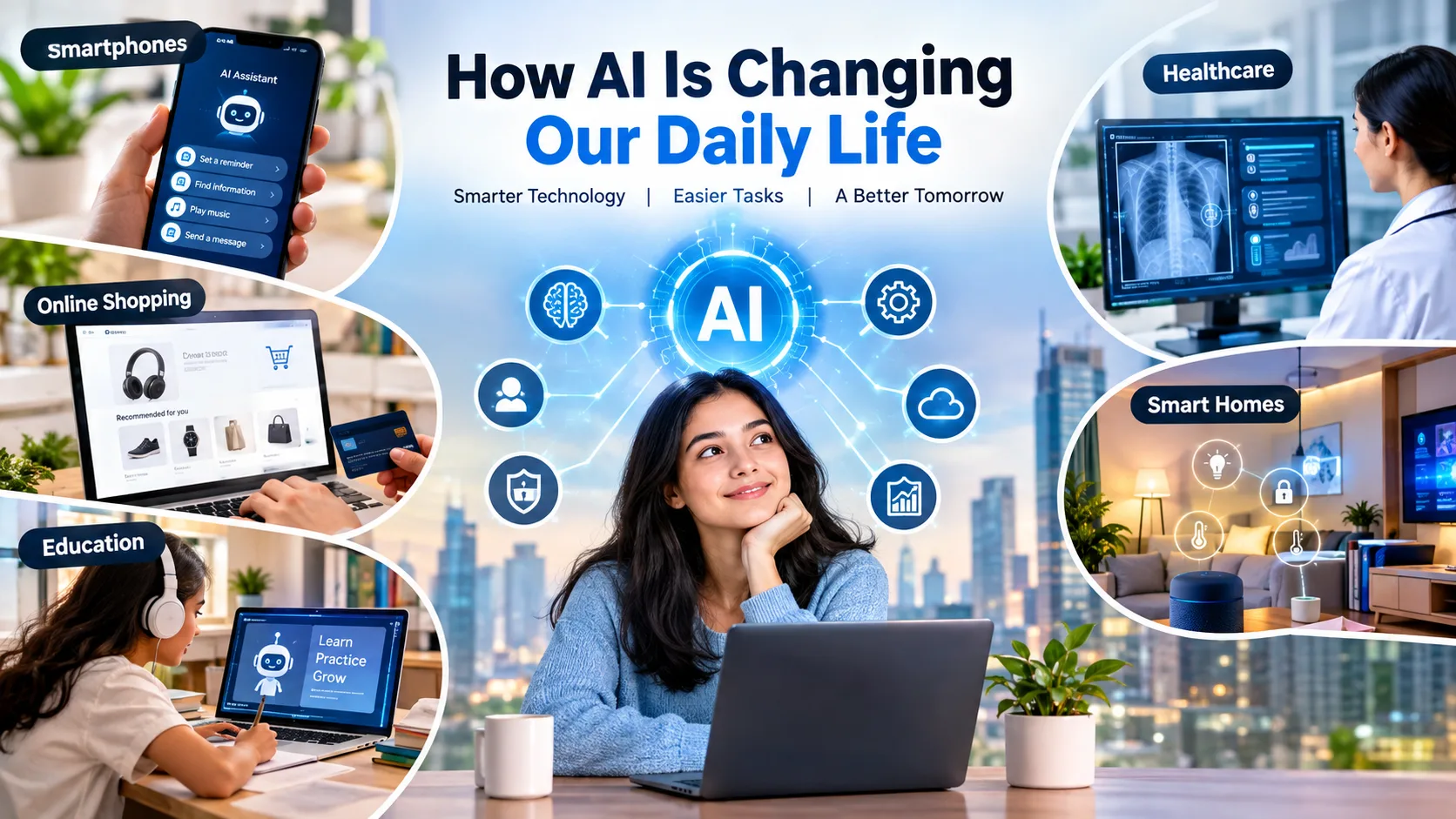
1. How AI Is Becoming Part of Everyday Life
AI is no longer limited to advanced laboratories or large technology companies. It is now included in many digital products and services that people use every day. AI systems can analyze information, recognize patterns, and provide useful responses based on user needs.
AI in Smartphones
Modern smartphones use AI in several everyday features. AI can improve camera quality, recognize faces, organize photos, predict text, and suggest useful actions. Smartphone keyboards can learn common typing patterns and provide word or sentence suggestions.AI can also help smartphones understand user behavior. For example, a phone may suggest frequently used apps, identify spam calls, or improve battery management based on usage patterns.
Smartphones are one of the clearest examples of How AI Is Changing Our Daily Life through everyday digital features.
AI in Virtual Assistants
Virtual assistants use AI to understand spoken or written commands. People can ask assistants to set reminders, check information, play music, send messages, or manage simple tasks.
These assistants make technology easier to use because users can interact with devices using natural language instead of manually searching through menus.
AI for Personalized Experiences
Many digital platforms use AI to understand what users may find useful or interesting. Based on previous activity, AI can help personalize search results, content suggestions, and other digital experiences.
2. AI in Recommendations and Online Shopping
AI has changed how people discover products, services, and online content. E-commerce platforms and digital services can analyze browsing activity, previous purchases, searches, and preferences to provide personalized recommendations.
Personalized Product Recommendations
Online shopping platforms use AI to suggest products that may match a customer's interests. For example, after viewing or purchasing certain products, shoppers may receive recommendations for similar or related items.
This can make product discovery easier because customers do not always need to search through thousands of products manually.
Smarter Search and Shopping
AI can improve online search by understanding what a customer is looking for rather than depending only on exact keywords. It can help identify relevant products and organize search results.
AI can also support chat-based shopping experiences where customers ask questions about products and receive automated responses.
Better Customer Experience
Businesses can use AI to understand customer behavior and provide more personalized experiences. AI-powered systems can help answer common questions, recommend products, and support customers at different stages of the buying process.
3. AI in Education and Learning
AI is also becoming useful in education by supporting students, teachers, and online learning platforms. It can help provide personalized learning experiences and make educational resources easier to access.
The use of AI in education also shows How AI Is Changing Our Daily Life by making learning more personalized and accessible.
Personalized Learning
Different students learn at different speeds. AI can analyze learning activity and identify areas where a student may need additional practice.
Some educational platforms can recommend lessons, exercises, or learning materials based on a student's progress. This can make learning more personalized and flexible.
AI Learning Assistants
AI-powered learning assistants can help students understand concepts, generate practice questions, explain difficult topics, and provide basic guidance.
However, students should use AI as a learning support tool rather than depending on it to complete all academic work. Understanding the subject remains important for long-term learning.
Support for Teachers
AI can also help teachers with repetitive tasks such as creating basic learning materials, organizing information, or generating practice activities.
This can give teachers more time to focus on classroom interaction, student support, and other important educational responsibilities.
4. AI in Healthcare and Personal Well-Being
AI is increasingly being used in healthcare to support professionals, manage information, and improve certain processes. It can process large amounts of data quickly and help identify patterns that may be difficult to notice manually.
Supporting Medical Professionals
Healthcare organizations can use AI systems to analyze medical information and assist professionals with certain tasks. AI may support image analysis, documentation, information management, and other healthcare processes.
AI is designed to support professional decision-making, not replace qualified medical professionals.
Health and Fitness Applications
Many smartphones and wearable devices use AI or machine learning to analyze activity, sleep, heart-rate patterns, and other measurements.
These tools can help users understand their daily activity and maintain healthier routines. However, information from consumer devices should not automatically be treated as a medical diagnosis.
Faster Healthcare Services
AI can also help healthcare organizations manage administrative tasks and organize information. Automating repetitive processes may save time and allow staff to focus on patient-related responsibilities.
5. AI in Smart Homes and Connected Devices
Smart devices are another common example of AI becoming part of everyday life. Smart speakers, security systems, televisions, appliances, and other connected devices can use AI to respond to users and learn from patterns.
Smart Home Assistants
AI-powered smart speakers can respond to voice commands, answer simple questions, set reminders, play content, and control compatible devices.
This allows users to perform certain tasks without physically interacting with each device.
Smart Security Systems
Some smart security cameras can use AI to identify movement or distinguish between different types of activity. These features can help users monitor their homes more efficiently.
AI-based alerts can reduce unnecessary notifications by focusing on activity that may require attention.
Automated Home Devices
Smart appliances can use data and automation to provide more convenient experiences. For example, some devices can adjust settings based on usage patterns or scheduled routines.
These features can save time and make everyday household activities easier.
6. Benefits and Challenges of AI in Daily Life
AI provides several practical benefits, but its increasing use also creates challenges. Understanding both sides is important because AI systems can affect how people work, learn, shop, and communicate.
These benefits help explain How AI Is Changing Our Daily Life while also showing why responsible use is important.
Key Benefits of AI
One major benefit of AI is convenience. AI can automate repetitive tasks and help users find information faster. Personalized recommendations can make digital services easier to navigate, while smart devices can simplify everyday activities.
AI can also help businesses process information more efficiently and provide faster customer support. In education and healthcare, it can support professionals and users by organizing information and identifying useful patterns.
Privacy and Data Concerns
Many AI systems require data to provide personalized services. This can include search activity, shopping behavior, location-related information, or device usage.
As AI becomes more common, users need to understand what information they share and how services use that data. Businesses also need to handle user information responsibly and maintain appropriate security measures.
Accuracy and Overdependence
AI does not always provide correct information. AI systems can make mistakes, misunderstand instructions, or produce inaccurate results.
People should therefore review important AI-generated information instead of accepting every result automatically. Overdependence on AI can also reduce the habit of thinking, checking information, and making decisions independently.
7. How AI Is Changing Our Daily Life and What to Expect Next
AI is continuing to develop, and its role in everyday life is likely to expand across smartphones, online services, education, healthcare, shopping, and smart devices. The technology can make many activities faster and more convenient, but responsible use remains important.
More Personalized Technology
Future AI systems may provide more personalized experiences by understanding user preferences and patterns more effectively. Smartphones, applications, and smart devices may become better at predicting what users need.
Greater Automation
AI may automate more repetitive everyday tasks. This could include organizing information, managing digital services, assisting with routine work, and controlling connected devices.
However, automation should be used carefully, especially when decisions involve personal information, finances, education, or healthcare.
Responsible Use of AI
The growing use of AI makes digital awareness increasingly important. Users should understand the benefits and limitations of AI, protect their personal information, and verify important information before acting on it.
Businesses and technology developers also have a responsibility to focus on security, transparency, accuracy, and responsible data use.
8. Conclusion: How AI Is Changing Our Daily Life
How AI Is Changing Our Daily Life can be seen through the many technologies people already use. AI supports smartphones, virtual assistants, recommendations, online shopping, education, healthcare, and smart devices. It can save time, personalize experiences, automate repetitive tasks, and make many digital services easier to use.
At the same time, AI brings challenges related to privacy, security, accuracy, and overdependence. The best way to use AI is to understand both its benefits and limitations. As AI continues to develop, responsible and informed use will become increasingly important in everyday life.
Frequently asked questions
How is AI changing our daily life?
AI is becoming part of everyday life through smartphones, virtual assistants, online shopping, education, healthcare, and smart home devices. It can automate tasks, provide recommendations, and make digital services more convenient.
How is AI used in smartphones?
AI is used in smartphones for features such as camera improvements, face recognition, photo organization, predictive text, spam call detection, app suggestions, and battery management.
How does AI help in education?
AI can support personalized learning by analyzing student activity and recommending lessons, exercises, and learning materials. AI learning assistants can also help explain concepts and create practice questions.
What are the benefits of AI in daily life?
AI can save time, automate repetitive tasks, provide personalized recommendations, improve convenience, and help people access information and digital services more efficiently.
What are the challenges of using AI in daily life?
Common challenges include privacy concerns, data security, inaccurate information, and overdependence on technology. Users should verify important AI-generated information and understand how their data is being used.