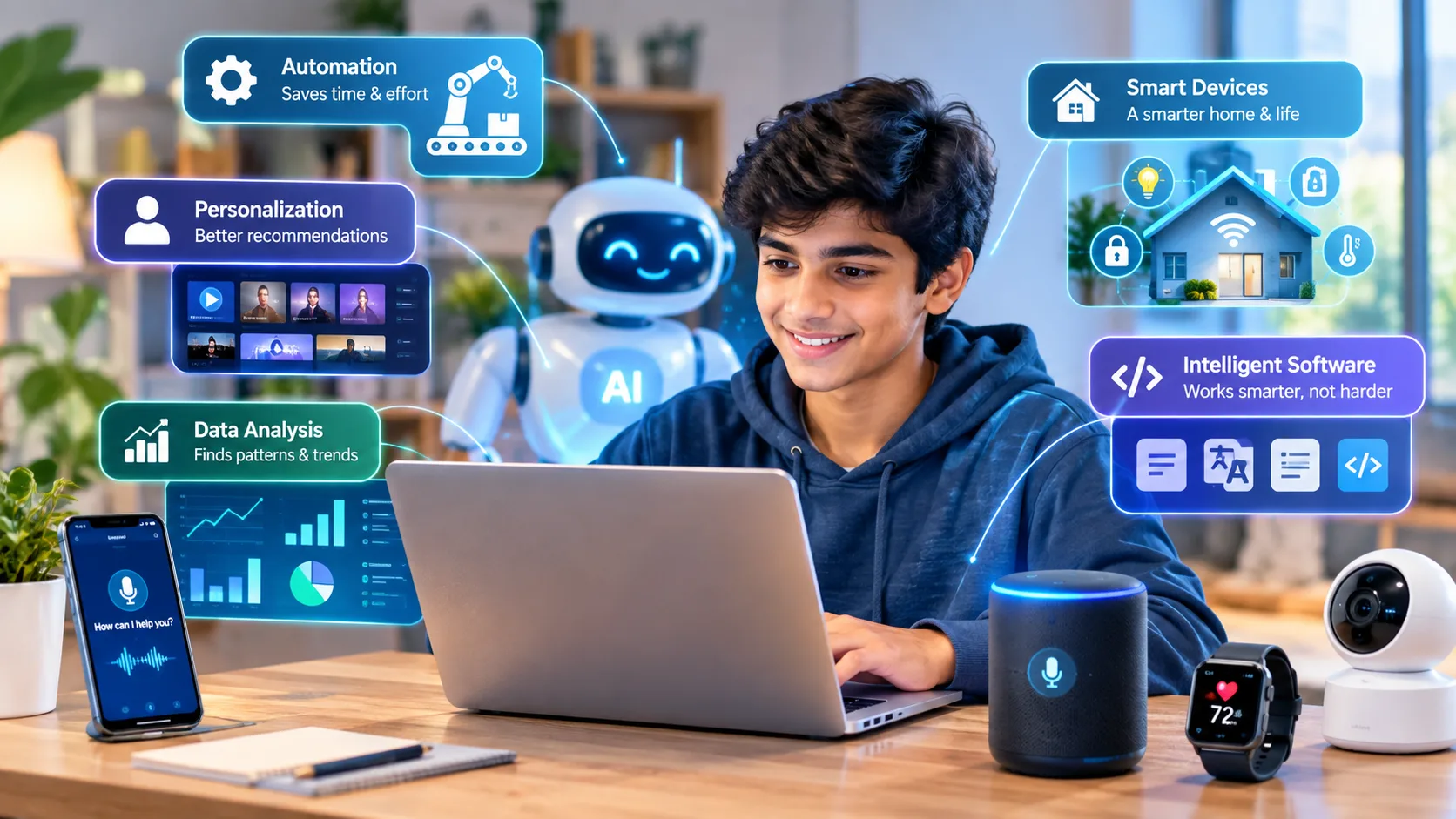
How AI Helps Businesses Automate Everyday Tasks
One of the biggest ways AI is changing technology is through automation. Automation means using technology to complete tasks with little or no human effort. Traditional software usually follows fixed instructions, while AI-powered systems can learn from data and patterns to handle different situations more intelligently.
Businesses can use AI automation for:
Answering common customer questions
Sorting emails and documents
Detecting unusual transactions
Creating reports from data
Scheduling tasks
Handling repetitive work
For example, a company may receive thousands of customer messages every month. An AI chatbot can answer simple questions instantly, while employees can focus on more complex problems. This can save time, reduce repetitive work, and help teams use their time more effectively.
AI Automation in Everyday Life
Automation is not limited to large companies. Smartphones can automatically organize photos, keyboards can predict words, and navigation apps can suggest faster routes. These small features may seem simple, but they show how AI can make everyday technology more helpful.
Personalization Makes Technology More Useful
Another important benefit of AI is personalization. AI can study a person's activity and preferences to provide more relevant suggestions.
For example, YouTube may recommend videos based on what someone has watched before. Online shopping websites can suggest products related to previous searches or purchases.
Music applications can also create recommendations based on listening habits.
This is possible because AI analyzes user behavior and identifies patterns.
- Online shopping
- Entertainment
- Education
- Digital advertising
- Fitness applications
- News platforms
- Customer support
For students, an AI-powered learning platform could identify topics they find difficult and suggest additional practice. For shoppers, an online store can show products that match their interests.
The goal is to make technology feel more relevant instead of showing exactly the same information to everyone.
However, personalization also requires responsible handling of user data. Companies need to protect personal information and clearly explain how data is being used.
AI Can Understand and Analyze Huge Amounts of Data
Modern technology produces enormous amounts of data every day. Humans cannot manually study all of it quickly. AI can help by processing large datasets and finding patterns.
This is called AI data analysis.
For example, a business may have information about thousands of customers. AI can analyze this information to identify common buying patterns, popular products, or changes in customer behavior.
AI data analysis is useful for:
- Finding trends
- Detecting unusual activity
- Predicting demand
- Understanding customers
- Improving business decisions
- Identifying potential problems
A Simple Business Example
Suppose a clothing store notices that sales of jackets increase when temperatures fall. AI can analyze previous sales and weather-related information to identify this pattern.
The business could then prepare more stock before colder weather arrives.
Similarly, banks can use AI systems to identify unusual transaction patterns that may require additional checking.
AI does not automatically make every decision correctly. The quality of its results depends on the quality of the data, the system design, and human oversight.
Smart Devices Are Becoming More Intelligent
AI is also changing physical devices. Smartphones, smart speakers, security cameras, watches, cars, and home appliances can use AI to understand information and respond to users. A smartphone camera, for example, can automatically recognize different scenes and adjust settings. Face recognition can help organize photos or unlock supported devices. Smart home devices can also respond to voice commands. A user might say Turn off the lights and a connected device can perform the task. Read More
Other examples include:
- Smart thermostats that learn temperature preferences
- Security cameras that can identify movement
- Smartwatches that analyze activity
- Voice assistants that understand spoken commands
- Cars that use sensors and software to assist drivers
These technologies combine AI, sensors, software, and connected devices to create smarter systems.
The important point is that the device is not simply following one fixed command. It can use information from its environment to provide a more useful response.
Intelligent Software Is Changing How We Work
AI is also making software more intelligent. Modern applications can help people write, translate, summarize, search, design, code, and organize information.
Businesses that want to use AI in websites, apps, chatbots, automation, or digital marketing can work with experts to build practical AI solutions. TZAP Marketing helps businesses create smarter websites, AI-powered applications, chatbots, and digital strategies that improve customer experience and business growth.
For example, an AI writing assistant can suggest improvements to a sentence. A translation system can convert text from one language to another. AI-powered coding tools can help developers understand or generate code.
Businesses can use intelligent software for:
- Content creation
- Customer service
- Data reporting
- Document analysis
- Marketing
- Software development
- Cybersecurity
This does not mean AI should replace human judgment. Instead, AI can work as a tool that helps people complete certain tasks faster.
A designer may use AI to generate ideas, while the designer makes the final creative decisions. A business analyst may use AI to find patterns in data, while a human reviews the findings before taking action.
This combination of human skills and AI technology can make many workflows more efficient.
For businesses looking to build smarter digital products, technologies such as AI-powered websites, applications, chatbots, and data systems can create new opportunities.
Internal link opportunity: Add a relevant internal link here to your website's AI, app development, or digital marketing service page.
What Are the Key Benefits of Smarter Technology?
AI-powered technology can provide several practical benefits for individuals and businesses.
Faster Work
AI can complete repetitive tasks quickly. This gives people more time to focus on creative or important work.
Better Personal Experiences
AI can understand patterns in user behavior and provide more relevant recommendations and services.
Improved Decision Support
AI can process large amounts of information and identify patterns that may be difficult to notice manually.
Greater Efficiency
Automating repetitive processes can help organizations save time and use resources more efficiently.
24/7 Support
AI-powered chatbots and digital systems can provide basic assistance at any time, including outside normal business hours.
Better Accessibility
Speech recognition, text-to-speech, translation, and other AI tools can make technology easier for more people to use.
However, smarter technology also brings challenges. AI systems can produce incorrect results, depend on biased or incomplete data, and create privacy or security concerns. Human review, good data practices, security controls, and responsible AI development remain important.
External authority link opportunity: For an authoritative explanation of AI concepts and responsible AI practices, link to NIST Artificial Intelligence Resource Center.
The Future of AI and Smarter Technology
AI is likely to become even more connected with the technology people use every day. Future systems may become better at understanding language, recognizing patterns, adapting to individual needs, and working across different devices.
We may see more intelligent applications in areas such as education, healthcare, transportation, manufacturing, customer service, and business management.
For example, future software could help a small business analyze sales data, identify customer trends, answer routine questions, and automate selected administrative tasks from one platform.
Smart homes may also become more connected. Instead of controlling individual devices separately, AI could help coordinate lights, appliances, security systems, and energy use based on user preferences.
But the future of AI should not only focus on making machines smarter. It should also focus on making them safe, transparent, reliable, and useful for people.
As AI becomes more common, people will need to understand both its benefits and its limitations.
Conclusion
How AI Is Making Technology Smarter is not only about robots or futuristic machines. AI is already improving everyday technology through automation, personalization, data analysis, smart devices, and intelligent software. From a smartphone suggesting the next word to a business analyzing customer data, AI is helping technology respond more intelligently to human needs.
The most useful AI systems are those that combine technology with human judgment. As AI continues to develop, learning how these systems work will help people use smarter technology responsibly and effectively.
Looking to make your business smarter with AI-powered websites, apps, automation, or digital marketing? Contact TZAP Marketing to explore practical AI solutions for your business.
- Digital Marketing
- Website Development
- App Development
Frequently asked questions
How is AI making technology smarter?
AI makes technology smarter by helping systems learn from data, recognize patterns, automate tasks, understand users, and provide more relevant responses.
How does AI help businesses?
AI can help businesses automate repetitive work, analyze customer data, improve customer support, personalize marketing, and support decision-making.
What are examples of AI in everyday life?
Smartphone assistants, recommendation systems, navigation apps, spam filters, smart cameras, voice assistants, and AI-powered search tools are common examples.
Can AI replace human workers?
AI can automate some tasks, especially repetitive ones, but many jobs still require human creativity, judgment, communication, responsibility, and decision-making.
Is AI technology safe?
AI can be useful, but it also has risks involving privacy, security, inaccurate information, and biased data. Responsible development and human oversight are important.
What is the future of AI technology?
AI is expected to become more integrated into software, smart devices, business systems, education, transportation, healthcare, and other areas of daily life.