Humanoid Robots in India: How Close Are We to AI Robots in Daily Life?
Humanoid robots in India are moving from science-fiction ideas toward real-world testing. These robots are designed to look and move somewhat like humans and use AI cameras sensors and robotic hands to understand their surroundings and perform tasks. In 2026, India is seeing growing activity in physical AI and robotics, especially for factories, warehouses and other controlled environments.
But this does not mean that every Indian home will soon have a human-like robot. The technology is still developing. Cost, safety, movement, hand control and AI intelligence are some of the biggest challenges.
So, how close are we really to seeing AI robots in everyday life?
What Are Humanoid Robots?
A humanoid robot is a machine designed to work in spaces made for people. It may have a human-like body, two arms, sensors, cameras and sometimes two legs or wheels.
How Do AI Robots Work?
Humanoid robots combine hardware with AI software. Cameras and sensors help the robot understand objects and people around it. AI helps it decide what to do, while motors and robotic hands allow it to perform physical actions.
This is often called embodied AI or physical AI because the intelligence is connected to a physical machine.
For example, instead of simply answering a question like a chatbot, a physical AI robot could potentially understand an instruction such as pick up this box and then move toward the box, identify it and try to lift it.
However, doing this reliably in a real environment is much harder than giving an answer on a computer.
Humanoid Robots in India in 2026
India's robotics sector is growing beyond traditional factory automation. The government has also been discussing the country's robotics ecosystem and a strategic roadmap for advanced robotic technologies. Press Information Bureau
India's Move Toward Physical AI
One example is an Indian robotics and automation company developing its Elixis humanoid platform. In early 2026, the company introduced Elixis-W, a wheeled humanoid designed for industrial environments such as warehouses and factories. The company says it is intended for repetitive, physically demanding or higher-risk tasks and is being introduced through supervised proof-of-concept deployments.
This is important because it shows that humanoid robotics in India is not only about demonstrations. Companies are beginning to explore how physical AI can solve specific business problems.
At the same time, global humanoid robot sales are still small compared with traditional industrial robots. The International Federation of Robotics reported around 7,000 humanoid robots sold globally in 2025, showing that the technology is still at an early stage. Reuters
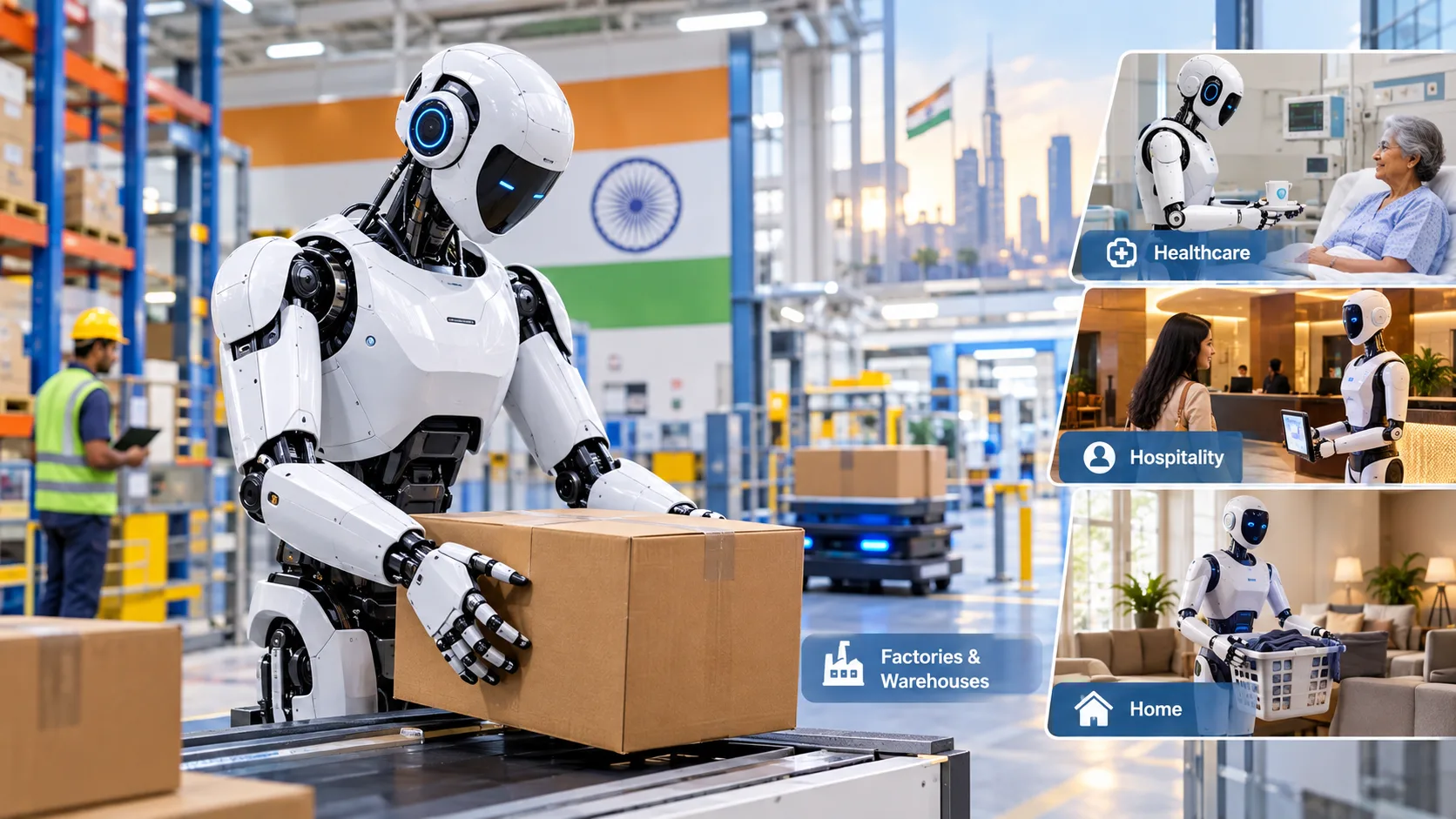
Where Could Humanoid Robots Be Used?
The first useful applications are likely to appear in places where robots can perform repetitive or physically difficult work.
1. Factories
Factories could use humanoid robots to move materials, handle repetitive tasks, inspect areas or support workers.
A robot may be useful where a task is tiring, repetitive or involves some physical risk. The goal does not necessarily have to be replacing workers. It can be about helping people with difficult jobs.
2. Warehouses
Warehouses are another natural area for AI robots.
A humanoid robot could potentially pick up items, move objects, arrange products or perform basic inventory tasks. India's growing logistics and e-commerce sectors could create demand for this type of automation.
Indian robotics companies are already expanding from warehouse automation toward more flexible physical AI systems.
3. Healthcare
Healthcare is a more difficult but interesting area.
Humanoid robots could eventually help move supplies, carry items, support basic hospital tasks or assist elderly people. However, healthcare robots need extremely strong safety systems because mistakes can directly affect people.
India's robotics ecosystem is already exploring applications across sectors including healthcare.
4. Hospitality
Hotels, airports and large public spaces could use service robots to guide visitors, answer simple questions, deliver items or provide information.
These tasks are attractive because they can be clearly defined and repeated. But a robot still needs to understand unexpected situations, crowded spaces and different languages.
5. Homes
Home robots are probably the most exciting idea for ordinary people.
Imagine telling a robot to bring a bottle of water, pick up clothes or help organize a room.
The problem is that homes are much less predictable than factories. Every home has different furniture, objects, floors, people and pets. A robot that works well in a controlled warehouse may struggle in a normal Indian home.
What Is Stopping Humanoid Robots?
The biggest question is not whether robots can move. Modern robots can already walk, roll, lift objects and perform impressive movements. The bigger challenge is doing useful tasks safely, cheaply and reliably.
Cost Is Still a Major Problem
Humanoid robots need expensive motors, batteries, sensors, computing hardware and AI systems. Businesses must also pay for maintenance, software and training. For a company, buying a robot only makes sense when it can provide enough value compared with existing machines or human workers.
Dexterity Is Difficult
Human hands are extremely flexible. We can pick up a glass, open a packet, use a screwdriver and handle small objects without thinking much about it. Robotic hands still struggle with many delicate or unpredictable tasks.
Safety Matters
A powerful robot working near humans must understand its surroundings and react quickly. It needs to know when a person is nearby, how much force to use and what to do if something unexpected happens. This is one reason early industrial deployments are being tested under controlled and supervised conditions.
AI Intelligence Is Still Developing the Future of Humanoid Robots in India
A robot needs more than a powerful body. It needs a reliable brain. Future robots will need to understand speech, objects, space, movement and changing situations. Researchers and companies are working toward AI systems that can connect language and vision with physical actions. That is one reason embodied AI is becoming an important next step after software-based AI.
When Will AI Robots Enter Daily Life?
There is no fixed date when humanoid robots will become common in Indian homes. The more realistic path is industry first, public spaces next, and homes later. Read More
What Could Happen First?
Factories and warehouses are easier because their environments are more controlled. Hospitality, healthcare and public services may follow as robots become safer and more reliable. Home robots will require a much higher level of flexibility.
For example, a factory robot may only need to perform five or ten predictable tasks. A home robot may face hundreds of different situations every day.
The Future Robots India Could See
The future may not look like a robot replacing every human job. Instead, people may work together with AI robots. Humans could handle communication, decisions and creative work while robots handle repetitive, heavy or risky physical tasks. India already has a growing robotics ecosystem, and companies are working on physical AI systems designed for real-world environments.
Conclusion
Humanoid robots in India are no longer only a science-fiction idea, but they are not yet ready to become an everyday household product. In 2026, the strongest progress is happening around factories, warehouses and other controlled environments. As AI, sensors, robotic hands and safety systems improve, these machines could gradually move into healthcare, hospitality and eventually homes.
Humanoid robots in India are gradually moving from research and testing toward practical applications in factories, warehouses and other controlled environments.
As AI and robotics reshape the future of business, TZAP Marketing can help your brand stay digitally ready with modern websites, apps, SEO, digital marketing and AI-powered solutions designed for growth.
Frequently asked questions
Are humanoid robots available in India in 2026?
Yes, humanoid robotics projects and industrial prototypes are being developed and tested in India, but widespread consumer use has not arrived yet.
What are humanoid robots used for?
Early applications focus on factories, warehouses, logistics, maintenance and other repetitive or physically demanding tasks.
Can humanoid robots work in Indian homes?
Technically, robots can perform some household tasks, but reliable general-purpose home robots still face major challenges involving cost, safety and dexterity.
Will AI robots replace human workers?
Their effect will depend on how companies deploy them. Robots may automate some repetitive tasks while also creating demand for people who operate, maintain and develop robotic systems.
Why are humanoid robots important?
Their human-like form can allow them to work in environments already designed for people, potentially reducing the need to redesign workplaces.
What is the future of humanoid robots in India?
The near-term focus is likely to remain on industrial and commercial applications, while broader home use will depend on improvements in cost, safety, reliability and AI intelligence.