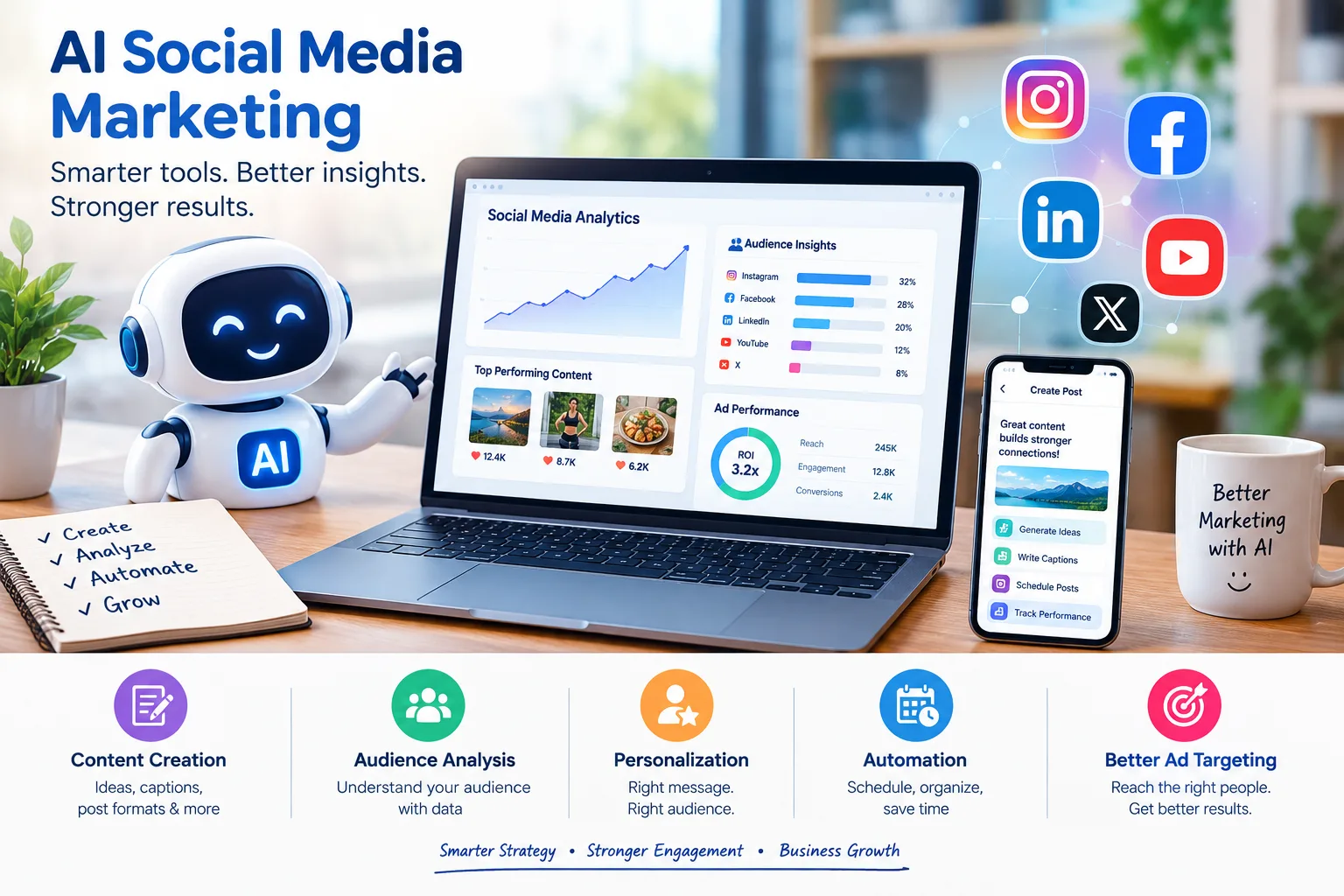
How AI Social Media Marketing Works
There are several areas where businesses can use AI social media marketing in their daily activities.
1. Content Creation
Creating fresh content regularly is one of the biggest challenges for social media teams. Smart content tools can help generate post ideas, captions, headlines, content outlines, and creative concepts.
For example, a digital marketing agency could enter a topic such as “SEO tips for small businesses.” The system may suggest several social media post ideas based on that topic.
Businesses can also use these tools to repurpose existing content. A blog article could become a LinkedIn post, Instagram caption, short video script, or carousel idea.
Human review is still important because businesses need to maintain their own voice, accuracy, and brand identity.
2. Audience Analysis
Understanding an audience is essential for successful social media marketing. Businesses need to know what their customers like, what content they interact with, and when they are most active.
AI-powered analytics tools can process engagement data and identify patterns. They may help marketers understand which posts receive more clicks, comments, shares, or views.
For example, a fitness business may discover that its audience interacts more with short workout videos than long educational posts. The business can use this information when planning its content calendar.
This makes AI social media marketing useful for data-driven decision-making. readmore
3. Personalization
Not every customer has the same interests. Personalization allows businesses to provide more relevant content to different audience groups.
For example, an online store selling shoes may have customers interested in running shoes, formal shoes, or casual footwear. Marketing systems can help businesses organize these audiences and deliver content that matches their interests.
A customer who regularly views running products could receive content related to running shoes, training tips, or new sports products.
Personalization can make social media communication feel more relevant instead of sending exactly the same message to everyone.
4. Social Media Automation
Managing social media manually can become difficult when a business publishes content across several platforms.
Automation tools can help schedule posts, organize content calendars, monitor selected keywords, and manage repetitive tasks.
For example, a company can prepare a week's worth of content and schedule posts for different days and times. This allows the marketing team to maintain a consistent publishing schedule.
However, automation should not remove human interaction. Customer questions, complaints, and sensitive conversations often require personal attention. readmore
5. Better Ad Targeting
Paid social media advertising depends heavily on reaching the right audience. Businesses can use data-based systems to understand audience behavior and improve their advertising campaigns.
For example, an e-commerce company selling skincare products may create different audience groups based on interests or previous interactions. It can then test different advertisements to understand which messages generate better results.
This approach can help marketers make more informed decisions about their advertising budgets.
The technology does not guarantee successful advertising. Businesses still need strong offers, good creative content, accurate audience selection, and regular testing.
6. Performance Tracking
One of the most useful parts of AI social media marketing is performance analysis.
Social media campaigns generate large amounts of data, including impressions, reach, clicks, engagement, conversions, and audience activity. Analytics systems can help organize this information and highlight important patterns.
For example, a business may discover that video posts receive more engagement than image posts. It may also find that certain topics generate more website visits.
Marketers can use these insights to adjust their content strategy rather than relying only on assumptions.
Simple Example of AI Social Media Marketing
Imagine a small restaurant that wants to improve its social media presence.
The restaurant could use smart tools to:
Generate ideas for weekly posts
Create caption drafts
Identify popular content topics
Schedule posts
Analyze customer engagement
Track advertisement results
Group audiences based on interests
Monitor important comments or messages
Suppose the restaurant discovers that food videos receive more engagement than static images. The marketing team could then create more short food videos while continuing to test other formats.
This example shows how AI social media marketing can support different parts of a social media strategy without removing human decision-making. readmore
Key Benefits of AI Social Media Marketing
Businesses can gain several practical benefits by using intelligent tools in their social media activities.
Saves Time
Automating repetitive tasks can reduce the amount of manual work required to manage social accounts.
Supports Better Decisions
Data analysis can help marketers understand what is working and where improvements may be needed.
Improves Personalization
Audience data can help businesses create more relevant content for different customer groups.
Supports Consistent Content
Scheduling and planning tools can make it easier to maintain a regular posting routine.
Helps Manage Multiple Platforms
Businesses managing several social channels can organize content and performance data more efficiently.
Makes Testing Easier
Marketers can test different content formats, messages, audiences, and advertisements and compare the results.
Challenges to Consider
Although AI social media marketing offers useful advantages, businesses should also understand its limitations.
First, automatically generated content may not always match a company's tone or audience. Human editing is important before publishing.
Second, data quality matters. If the information being analyzed is incomplete or inaccurate, the resulting suggestions may also be less useful.
Privacy is another important consideration. Businesses should handle customer information responsibly and follow applicable privacy requirements.
Finally, businesses should not depend completely on automation. Social media is still about communication between people. Creativity, empathy, brand understanding, and human judgment remain important.
How Businesses Can Get Started
Businesses do not need to automate their entire social media strategy at once.
A simple approach is to start with one task. For example, a small business could begin by using a scheduling tool to organize its weekly posts.
After that, it could introduce analytics tools to understand content performance. Later, it could explore personalization, audience research, or advertising optimization.
A useful process is:
Identify a repetitive social media task.
Choose a suitable tool for that task.
Test it with a small amount of content.
Review the results manually.
Measure whether it saves time or improves performance.
Expand its use when the results are useful.
This gradual approach allows businesses to understand what works for their specific audience.
Future of AI Social Media Marketing
Social media marketing is becoming increasingly data-driven. As technology improves, businesses are likely to have more tools for content planning, audience research, personalization, automation, and performance analysis.
However, technology alone will not create a successful social media presence. Businesses still need clear goals, useful content, strong branding, and genuine customer communication.
The most effective approach is likely to combine smart technology with human creativity and judgment.
How can TZAP Marketing help with social media marketing?
TZAP Marketing can help businesses create and manage an effective social media strategy.
It can support content planning, post creation, scheduling, and audience engagement.
The team can help businesses understand social media performance and engagement data.
TZAP Marketing can also support paid social media campaigns and audience targeting.
Regular performance tracking can help identify what content works better for the audience.
Businesses can use these services to maintain a consistent and professional online presence.
The goal is to combine smart tools, creative content, and marketing strategy for better social media management.
Conclusion
AI social media marketing gives businesses practical ways to manage social media more efficiently and make decisions using data. From content creation and audience analysis to personalization, automation, ad targeting, and performance tracking, these tools can support many parts of a modern social media strategy.
For businesses, the key is to use technology as a support system rather than depending on it completely. With the right balance of automation, data, creativity, and human interaction, AI social media marketing can become a useful part of a long-term digital marketing strategy.
Frequently asked questions
What is AI social media marketing?
AI social media marketing means using intelligent software and data-based systems to support social media activities such as content creation, audience analysis, personalization, automation, advertising, and performance tracking.
How can AI help with social media content creation?
AI tools can generate post ideas, captions, headlines, content outlines, and creative concepts. They can also help repurpose existing content into formats such as social posts, captions, video scripts, and carousel ideas.
Can AI analyze social media audiences?
Yes. AI-powered analytics tools can process engagement data and identify patterns, helping businesses understand what content their audiences interact with and when they are most active.
What is personalization in AI social media marketing?
Personalization means providing more relevant content to different audience groups based on their interests and interactions. For example, a shoe store can show different content to customers interested in running, formal, or casual shoes.