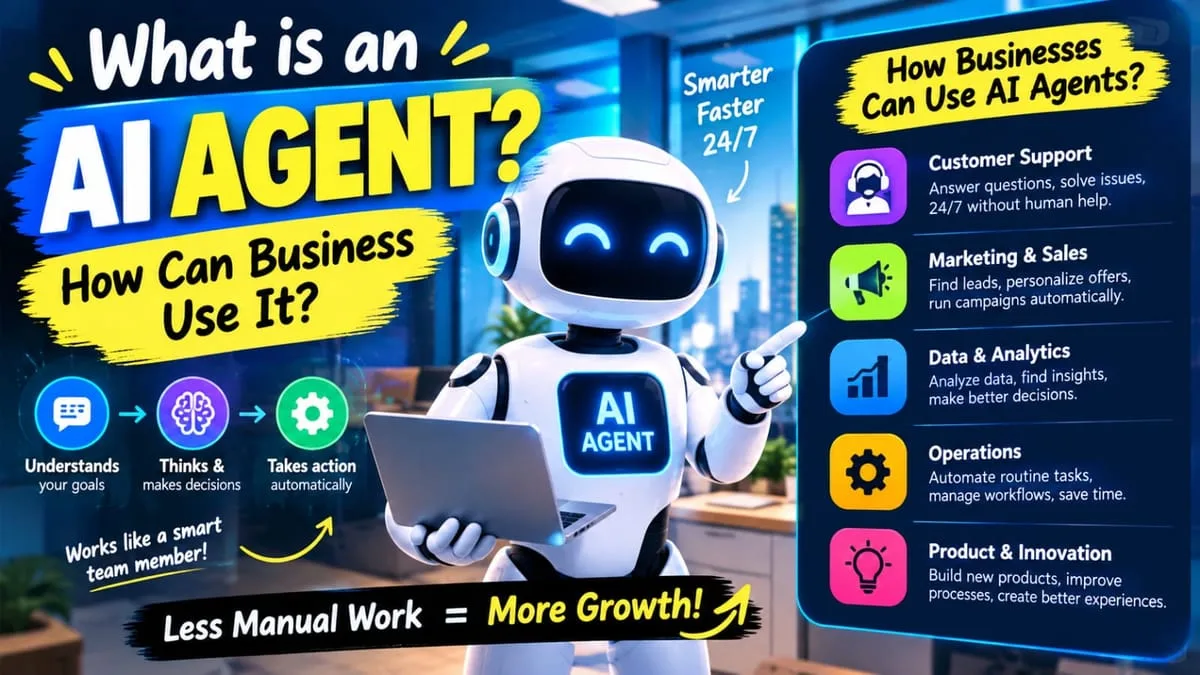
What Is an AI Agent?
What is an AI agent and how can businesses use it? An AI agent is a software system designed for a specific goal. It can understand information, choose the next step, use connected tools, and perform actions according to the situation.
Traditional software mostly works according to fixed instructions. An AI agent can work with flexible instructions and natural language.
Depending on its design, an AI agent can connect to a CRM, database, calendar, website, customer-support platform, or any other business system.
For example, a customer of an online store sends a message:
"My order has not arrived yet. Can you check it?"
A basic chatbot can only show general delivery information. However, a connected AI agent can check relevant information from the order system and provide an appropriate response to the customer.
How Does an AI Agent Work?
The basic process of an AI agent can be understood in four simple steps:
Understand → Decide → Act → Check
First the agent understands the user's request or business task. Then, it decides what to do next.
If needed, the agent can retrieve information from connected tools or perform an action.
After that, it checks the result and can continue with the next step if necessary.
For example, a sales AI agent receives a new lead from a website. It can read the customer's information, understand their requirements, update the CRM and send a notification to the sales team.
AI Agent vs Traditional Chatbot
AI agents and chatbots may look similar because both can communicate with users However their capabilities can be different.
The main purpose of a traditional chatbot is to answer questions provide information or guide through predefined options.
An AI agent can be connected with business tools to complete certain workflow actions.
For example:
Chatbot:
Appointments are available on Monday, Tuesday, and Wednesday.
AI Agent:
Tuesday at 3 PM is available I can help schedule the appointment through the connected calendar.
Not every AI agent can automatically complete every task. Its capability depends on its design, tools, data, and permissions.
How Can Businesses Use AI Agents?
Businesses can use AI agents in areas where repetitive digital work, frequent requests, or moving information between multiple systems is required.
Here are some practical examples that help easily understand What is an AI agent and how can businesses use it?
Customer Support -
Customer support is a practical use case for AI agents Businesses receive daily questions related to orders returns delivery status, product details appointments, and services.
An AI agent can handle routine requests and forward complicated cases to a human employee.
For example, a customer of an online clothing store asks about an order.
The agent can identify the order number, check the available order information, and provide the relevant status.
If the issue requires human assistance the agent can transfer the conversation to the support team.
Sales and Lead Management -
Sales teams spend a lot of time checking new leads collecting basic information and updating the CRM.
An AI agent can help with these repetitive steps.
For example, a web development company receives inquiries for websites mobile apps e-commerce platforms and custom software.
An AI agent can read the inquiry identify the customer's requirements organize the information and send it to the relevant sales team.
The salesperson gets the basic context before starting the conversation.
This is a simple business example of What is an AI agent and how can businesses use it?
Appointment Scheduling -
Consulting firms, clinics, salons, agencies, and service providers regularly handle appointment requests.
An AI agent can understand the customer's preferred timing, check availability in the connected calendar, and help with the scheduling process.
For example, a customer asks:
"Is Friday afternoon available?"
If the agent is given calendar access, it can check available slots and inform the customer about the next step.
If special approval is needed for the appointment, the request can be transferred to a human employee.
Internal Employee Support -
AI agents can be useful not only for customers but also for employees.
A company can build an internal AI agent that works with approved company documents and information.
Employees can use it to find answers regarding internal processes project information, or common workplace questions.
For example, a new employee asks:
What is the process to request company equipment?
The internal AI agent can provide relevant information from the approved knowledge base.
Marketing Tasks -
Marketing teams also handle daily repetitive work.
An AI agent can help organize customer feedback, prepare information for content briefs, categorize inquiries, or assist in selected campaign workflows.
For example, a business receives feedback from websites, social media, and customer support.
An AI agent can organize the feedback into categories such as:
* Product issue
* Service complaint
* Feature request
* General feedback
The marketing or product team can review the organized information to decide what action to take next.
6. Finance and Administrative Work -
Finance and administration also involve quite a few structured digital tasks.
An AI agent can help identify missing information in documents, organize incoming requests, categorize information, or send reminders according to predefined rules.
For example, during invoice processing the agent can flag invoices that have missing information.
The finance team can then review those specific invoices.
A Real Example: AI Agent in an Online Store
A customer places an order on an online store and later asks:
"Can I change my delivery address?"
The AI agent can first identify the order. Then, it can check the order status from the connected system.
If the order has not been shipped yet, the agent can guide the customer according to the approved address-change process.
If the order has already been shipped, the agent can inform the customer that the request will be handled by the human support team.
Here, the practical answer to "What is an AI agent and how can businesses use it?" is clearly visible.
A Real Example: AI Agent for a Service Company
Suppose a digital marketing agency regularly receives leads from its website.
A potential customer submits a form:
"I need SEO and social media services for my local business."
The AI agent can collect basic information, such as business type location, website, and required services.
Then, it can organize that information and send it to the sales team.
The sales executive receives a structured inquiry instead of just a short message.
The team can review that information and start the next conversation with the customer.
What Are the Benefits of AI Agents?
The real value of an AI agent comes when it helps solve an actual business problem.
Businesses use AI agents according to their workflows to:
- Handle repetitive digital tasks
- Respond to routine requests
- Organize customer information
- Connect different software tools
- Help employees find internal information
- Support lead management
- Reduce unnecessary manual steps
- Make routine workflows more consistent
However, simply adding AI does not automatically improve a business process. It is essential to first understand the complete workflow.
What Should Businesses Check Before Using an AI Agent?
Before developing an AI agent, a business should clearly define what exact work the agent needs to do.
Goal -
What exact problem does the agent need to solve?
Data -
What information will the agent need?
Tools -
Does the agent need to connect to a CRM, database, calendar, website, or any other software?
Permissions -
Which actions can the agent perform on its own, and for which actions is human approval required?
Human Support -
In which situations should the agent transfer the task to a human employee?
Monitoring -
How will the business check that the agent is working properly?
It is important to clear the answers to these questions beforehand This helps design the AI agent around actual business requirements.
Should Every Business Use an AI Agent?
No. An AI agent is not necessary for every business and every task.
If a process takes only a few minutes a week, building a complex AI system for it may not be practical.
AI agents are more useful in situations where repetitive tasks happen regularly, customer requests are frequent, the volume of information is high, or multiple digital tools are involved in the workflow.
The simple approach is -
Identify the problem first, then choose the technology.
Therefore, the best way to understand "What is an AI agent and how can businesses use it?" is to connect the technology with a real business workflow.
Final Thoughts
AI agents can help businesses move beyond simple question-answer systems. They can understand requests, work with approved information, use connected tools, and complete selected tasks within a defined workflow.
If you ask in simple language What is an AI agent and how can businesses use it? the answer is: An AI agent is a software system that understands goals, makes decisions based on available information, and helps complete tasks by performing approved actions.
Ready to Explore AI for Your Business?
If your business has repetitive customer requests lead management, manual digital processes, or workflows involving multiple software tools exploring AI agent development and AI integration can be very useful.
TZAP Marketing provides AI development, AI integration, automation, web and app development, and digital growth solutions based on specific business requirements.
Contact TZAP Marketing to discuss how an AI agent can be used in your business workflow.
Frequently asked questions
What is an AI agent?
An AI agent is a software system designed to understand a specific goal, analyze available information, decide the next step, and perform approved actions using connected tools.
How can businesses use AI agents?
Businesses can use AI agents for customer support, sales and lead management, appointment scheduling, internal employee support, marketing tasks, and administrative work.
What is the difference between an AI agent and a chatbot?
A traditional chatbot mainly responds to user questions, while an AI agent can understand a goal, make decisions, use connected tools, and complete specific tasks.
. Can AI agents automate repetitive business tasks?
Yes. AI agents can help automate suitable repetitive tasks such as handling customer queries, organizing information, scheduling appointments, and managing routine workflows.
Are AI agents suitable for every business?
Not necessarily. Businesses should first identify their specific needs, workflows, data requirements, budget, and the type of tasks that are suitable for AI automation.