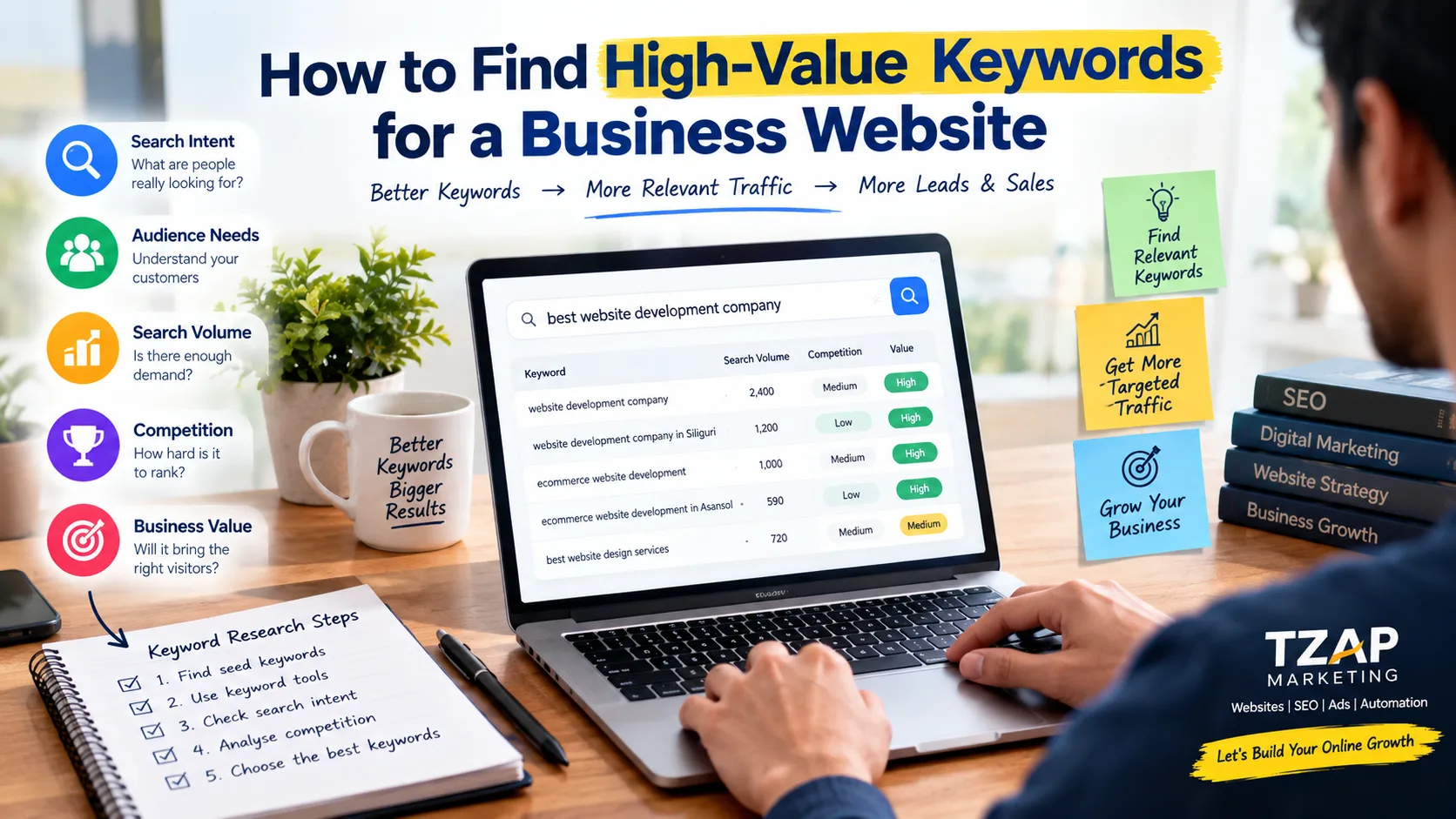
What Makes a Keyword Valuable for a Business?
A valuable keyword is not always the one with the highest search volume.
It should match what your business offers and what your customers are looking for.
For example, an ecommerce website company may target these keywords:
✅ Ecommerce website development shows that the person may need the service.
✅ Ecommerce website development in Asansol shows both the service and location.
👉 So, when choosing keywords, relevance is just as important as search volume.
1. Start With Your Audience
Before using a keyword research tool, understand your customers first. 🎯
Ask these simple questions:
✅ Who is your customer?
✅ What problem do they have?
✅ What product or service do they need?
✅ What questions might they ask?
✅ What would they search on Google?
✅ Are they looking for information, a product or a service?
For example, a local restaurant may target:
- Restaurant near me
- Best restaurant in Asansol
- Family restaurant in Asansol
- Restaurant for birthday party
- Restaurant menu in Asansol
These keywords show what customers want and how they search.
👉 Start keyword research with your customer, not with the tool.
2. Understand Search Intent
Search intent means why someone searches for something on Google.
Understanding this helps you choose the right keyword for the right page.
(i) Informational Intent 📚
The person wants to learn something.
- What is SEO?
- How does SEO work?
- How to improve website speed?
(ii) Commercial Intent 🔎
The person is comparing options before making a decision.
- Best website development company
- Ecommerce website cost
- SEO agency pricing
(iii) Transactional Intent 🛒
The person is ready to take action.
- Hire SEO company
- Buy website hosting
- Ecommerce website development service
(iv) Local Intent 📍
The person wants a product or service in a specific location.
- Website development company in Siliguri
- Digital marketing agency in Asansol
- SEO company near me
👉 Always match the keyword with the searcher's intent. This helps your page give people the information or service they are actually looking for.
3. Build a List of Seed Keywords
A seed keyword is a simple word or phrase that helps you find more keyword ideas. 🌱
For a website development company, seed keywords could be:
✅ Website development
✅ Web design
✅ Ecommerce website
✅ Business website
✅ Website developer
✅ Website cost
Now expand these keywords to find more specific searches.
For example, from “ecommerce website”
you can find:
- Ecommerce website development
- Ecommerce website cost
- Ecommerce website for small business
- Ecommerce website development in Asansol
- Ecommerce website features
- Ecommerce website design
👉 Start with simple keywords, then make them more specific.
4. Use Keyword Research Tools
After creating your seed keywords, use a keyword research tool to find more ideas.
Popular tools include:
✅ Google Keyword Planner
✅ Google Search Console
✅ Google Trends
✅ Ahrefs
✅ Semrush
✅ Ubersuggest
You do not need all of them. Start with one or two tools and learn how they work.
Check important data such as:
✅ Search volume
✅ Keyword difficulty
✅ Competition
✅ Related keywords
✅ Search trends
✅ Search intent
👉 Do not choose a keyword just because it has high search volume. Make sure it is relevant to your business and customers.
5. Check Search Volume, But Do Not Depend on It
Search volume shows approximately how often people search for a keyword.
It can help you compare different keyword ideas.
For example:
Keyword A: 50,000 searches
Keyword B: 2,000 searches
Keyword A looks better at first. But what if it is very general?
Keyword B may have fewer searches, but the people searching for it may be looking for your exact service.
👉 So, do not ask only:
“Which keyword has more searches?”
Ask:
“Which keyword can bring the right visitors to my website?”
Relevant traffic is often more useful than high search volume.
6. Study the Competition
Before choosing a keyword, check who is already ranking for it on Google.
Look at:
✅ What type of pages are ranking?
✅ Blog posts or service pages?
✅ Are big websites dominating?
✅ Are local businesses ranking?
✅ What questions do they answer?
✅ Is their content basic or detailed?
For example, a small business may find it difficult to compete for a very broad keyword.
A more specific keyword can sometimes help you target a clearer audience.
👉 But do not choose a keyword only because it has low competition. It must also be relevant and useful for your customers.
7. Find Keywords With Business Intent
Not every keyword brings the right customers. 🎯
For example:
“What is a website?”
→ Mainly informational.
“Website development company in India”
→ The person may be looking for a service.
For a business website, look for keywords related to:
✅ Products
✅ Services
✅ Pricing
✅ Comparisons
✅ Locations
✅ Problems and solutions
✅ Features
✅ Service providers
👉 Choose keywords that can bring both relevant visitors and potential customers.
8. Create Separate Keywords for Different Pages
Do not try to target every keyword on one page. ❌
Give each keyword group the right page.
🏠 Homepage: Main business and brand keywords
🛠️ Service Page: Specific service keywords
📍 Location Page: Local service keywords
📝 Blog: Informational keywords and questions
🛍️ Product Page: Product-related keywords
💰 Pricing Page: Cost and pricing keywords
👉 A clear keyword-to-page structure makes your website easier to understand for both users and search engines.
9.Use Long-Tail Keywords
Long-tail keywords are longer and more specific search phrases. 🎯
For example:
- Short keyword: website development
- Long-tail keyword: website development company for small businesses
Another example:
- Short keyword: SEO
- Long-tail keyword: SEO services for small businesses in India
Long-tail keywords can show exactly what the person is looking for.
They can also help smaller websites create focused content for specific needs.
👉 Do not create a separate page for every small keyword variation. Focus on useful content that answers the user's actual needs.
10. Check Your Existing Website Data
If your website already gets Google traffic, use your own data first.
Google Search Console can show:
✅ Search queries getting impressions
✅ Queries getting clicks
✅ Pages getting search traffic
✅ Keywords where your page already appears
✅ New topics people are searching for
This data can help you find new opportunities and improve existing pages.
For example, your service page may already appear for a keyword you did not target.
👉 Before creating a new page, check if your existing page can better answer that search.
How to Find High-Value Keywords for a Business Website: A Simple Process
Follow these 10 steps when doing keyword research:
Step 1: Understand the Business
✅ List the main products or services you offer.
Step 2: Understand the Customer
✅ Think about what your target customers need and search for.
Step 3: Create Seed Keywords
✅ Write simple keywords related to your products or services.
Step 4: Expand Your List
✅ Use keyword tools and Google search suggestions to find more ideas.
Step 5: Check Search Intent
✅ Understand why people are searching for each keyword.
Step 6: Check Search Volume
✅ Look for demand, but do not choose keywords based on volume alone.
Step 7: Study the Competition
✅ Check which pages are already ranking on Google.
Step 8: Check Business Value
✅ Ask whether the keyword can bring people who may need your product or service.
Step 9: Assign Keywords to Pages
✅ Match keyword groups with the right homepage, service, product or blog page.
Step 10: Track the Results
✅ Use Google Search Console and analytics data to see how your pages perform.
👉 The goal is not to find the most searched keywords. It is to find keywords that match your business and bring the right visitors.
What About Keywords With Zero or Low Search Volume?
Do not remove a keyword just because it shows low or zero search volume.
Some specific keywords may have a small audience but still match an important customer need.
For example, a niche B2B service may have few searches but could still be valuable for the right business.
But do not create a separate page for every small keyword variation.
Instead:
✅ Focus on real customer needs
✅ Create useful content
✅ Avoid repeating keywords unnaturally
✅ Do not create pages only to get search traffic
👉 A keyword with low search volume can still be useful if it matches your business and helps your customers.
Common Keyword Research Mistakes
Avoid these common mistakes when doing keyword research. ⚠️
(i) Choosing Only High-Volume Keywords
✅ High search volume does not always mean high business value.
(ii) Ignoring Search Intent
✅ Make sure the keyword matches what the searcher actually wants.
(iii) Targeting Too Many Keywords on One Page
✅ Keep each page focused on one clear topic or purpose.
(iv) Creating a Page for Every Keyword Variation
✅ Similar searches may not need separate pages.
(v) Ignoring Local Keywords
📍 Local businesses should use location-based keywords when relevant.
(vi) Forgetting Existing Data
✅ Check Google Search Console for keywords your website already appears for.
(vii) Writing Only for Search Engines
✅ Write for people first. Make the content useful, clear and easy to read.
👉 Good keyword research is about relevance, intent and customer needs—not just search volume.
Final Keyword Research Checklist
Before choosing a keyword, ask yourself:
✅ Is it relevant to my business?
✅ Does it match my target audience?
✅ What is the search intent?
✅ Is there enough search demand?
✅ How competitive is it?
✅ Can it bring relevant visitors?
✅ Does it have business value?
✅ Which page should target it?
✅ Can I create useful content around it?
✅ Can I link it naturally with other pages?
👉 If most answers are yes, the keyword may be a good fit for your content plan.
How TZAP Marketing Can Help
Keyword research is only one part of SEO. A business also needs a useful website, clear content and an easy way for visitors to contact the company.
works with businesses in India on:
✅ SEO
✅ Google Ads
✅ Meta Ads
✅ Social media
✅ Website development
✅ Ecommerce
✅ AI and automation
The process should start with the business and customer.
Ask:
✅ What are you selling?
✅ Who needs it?
✅ What are they searching for?
✅ Which page should answer their search?
✅ What should they do next?
👉 Good keyword research is not about collecting hundreds of keywords. It is about finding the right keywords for the right customers and pages.
Conclusion
How to Find High-Value Keywords for a Business Website is not about collecting hundreds of keywords.
It is about finding the searches that match your customers, business and content.
Start with your audience, understand search intent, and check search volume and competition. Then choose keywords that have real business value.
Most importantly, do not force keywords into your content.
👉 Create useful pages that answer real questions and bring the right visitors to your website—not just more visitors.
Frequently asked questions
What is Generative AI?
Generative AI is a type of artificial intelligence that can create content such as text, images, audio, video and code from user instructions.
How is Generative AI changing businesses?
It can help businesses with content creation, customer support, research, software development, marketing and other repetitive tasks.
Will Generative AI replace jobs?
Some tasks may become automated, while other jobs may change and new roles may appear. The impact will depend on the industry, job and level of AI adoption.
Can Generative AI help with cybersecurity?
It can support some security tasks, but it can also create new risks. AI should be used as part of a wider cybersecurity strategy rather than as the only security measure.
What is the future of Generative AI?
Generative AI could become more common in business, education, software, creative work, customer service and other areas. The exact impact remains uncertain.