SEO Marketing: How to Grow Your Business with Search Engines is the process of improving a website so people can find a business through search engines. It helps businesses reach users who are searching for products, services, or useful information. SEO includes keyword research, on-page SEO, quality content, technical SEO, backlinks, and measuring results. A good strategy focuses on relevant visitors who may become customers or leads. With regular SEO work, businesses can improve online visibility and build organic traffic over time.
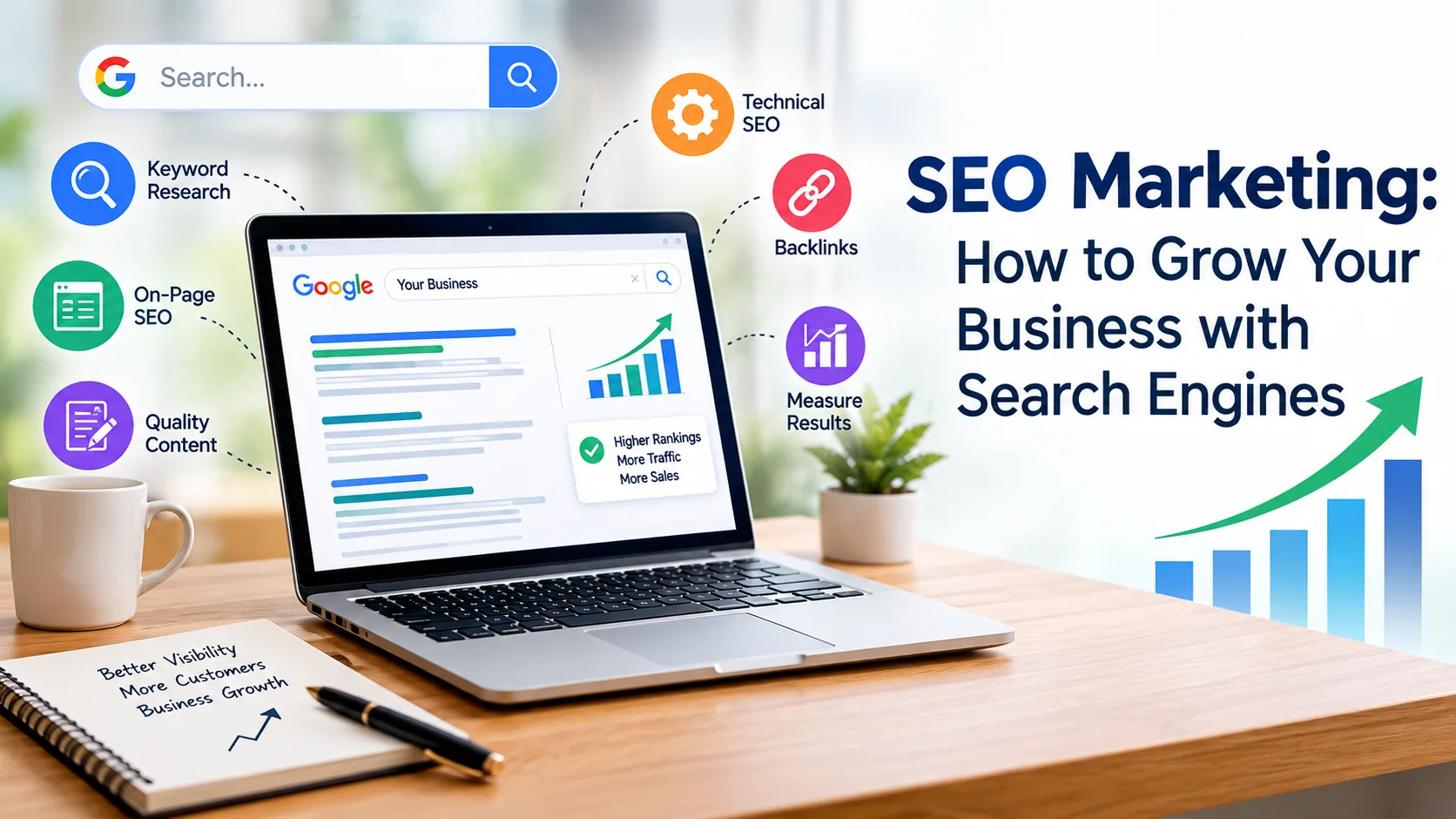
1. Understand SEO Marketing: How to Grow Your Business with Search Engines
SEO helps businesses improve their visibility when people search online. Search engines try to show pages that are useful and relevant to a user's search. SEO helps search engines understand what a website offers and helps users find the right pages.
For example, if a business provides website development services, it may want to appear when people search for website development companies. A clear SEO Marketing: How to Grow Your Business with Search Engines strategy can help connect the website with people who are looking for those services.
SEO is not only about getting a higher position in search results. It is also about creating useful pages that answer user needs and provide a simple website experience.
Attract Relevant Website Visitors
The goal is to attract visitors who are interested in what a business offers. A large amount of traffic is not useful if visitors have no interest in the products or services.
For example, a digital marketing company should reach people searching for SEO, content marketing, or other related services. Relevant traffic has a better chance of becoming a lead or customer.
Build Online Visibility
A website with useful content can appear for different relevant searches. This gives more people a chance to discover the business.
Better visibility can help a business reach new users without depending only on paid advertising. SEO usually takes time, so businesses need to follow a consistent approach.
2. Start With Proper Keyword Research
Keyword research is an important first step in SEO. Keywords are the words and phrases people type into search engines. Understanding these terms helps businesses create pages that match what their audience is looking for.
Good keyword research is not only about finding keywords with high search volume. Keywords should also be relevant to the business, its services, and the needs of its audience.
Find Relevant Search Terms
Start by listing words related to your products, services, industry, and customer questions.
For example, an app development company may target terms such as “mobile app developers,” “app development services,” or “custom mobile app development.”
Longer and more specific phrases can also be useful because they may show a clearer user need. Choose keywords that have a direct connection with the page you are creating.
Understand Search Intent
Search intent means understanding why someone searches for a particular term.
A person searching “what is SEO” is likely looking for information. Someone searching “SEO marketing company” may be looking for a service provider.
The content should match the purpose of the search. When content answers the right need, it becomes more useful to both users and search engines.
Use Keywords Naturally
Once keywords are selected, use them naturally in the title, introduction, headings, body text, and other relevant areas.
Do not repeat the same phrase in every sentence. The content should sound natural and remain easy to read.
The main purpose of SEO Marketing: How to Grow Your Business with Search Engines is to connect useful content with relevant searches, not to repeat a keyword only to increase its frequency.
3. Improve On-Page SEO for Better Visibility
On-page SEO means improving the content and elements on individual website pages. It helps search engines understand the topic of a page and helps users find information easily.
A strong on-page structure should make the page clear, useful, and simple to navigate.
Create Clear Titles and Headings
The page title should clearly explain the main topic. Headings should divide the content into logical sections.
Clear headings help readers scan an article and find the information they need. Keywords can be included when they fit naturally, but they should not be forced into every heading.
Write Useful Meta Descriptions
A meta description gives search users a short summary of a webpage. It should clearly explain what the page contains.
A useful description should be relevant to the page and written for users. It should not simply contain a list of keywords.
Improve Internal Linking
Internal links connect one page of a website to another page on the same website. They help users discover related information and help search engines find other pages.
For example, an article about SEO can link naturally to a related page about keyword research or technical SEO. Good internal linking also makes website navigation easier.
4. Create Quality Content That Answers User Needs
Quality content is an important part of SEO because people use search engines to find answers and information.
Content should be useful, clear, and focused on the searcher's needs. SEO Marketing: How to Grow Your Business with Search Engines works better when SEO techniques are combined with content that gives real value to readers.
Focus on Helpful Information
Before creating a page, think about what the audience wants to know.
If users search for how SEO can help a business, the content should explain relevant benefits and processes instead of adding unrelated information.
Every section should provide useful information connected to the main topic. This keeps the page focused and easier to understand.
Keep Content Easy to Read
Use simple words, short sentences, and small paragraphs. Headings and subheadings can break large sections into smaller parts.
Avoid unnecessary technical terms. When a technical word is needed, explain it in simple language.
Easy-to-read content helps visitors understand information quickly and makes the page more useful.
Update Important Content
Some information can become outdated over time. Businesses should review important pages and update information when necessary.
Updated content can remain useful for visitors and can better match current searches. Regular review also helps businesses find missing or outdated information.
5. Strengthen Your Website With Technical SEO
Technical SEO focuses on the technical parts of a website that help search engines crawl, understand, and access its pages.
A website may have useful content, but technical problems can make it harder for search engines and users to access that content. Technical work is therefore an important part of SEO Marketing: How to Grow Your Business with Search Engines.
Improve Website Speed
Website speed affects how quickly users can open and use a page. Slow pages can create a poor experience, especially on mobile devices.
Businesses can optimize large images, remove unnecessary elements, and use suitable website technologies to improve loading performance.
A faster website can make it easier for users to access information and move between pages.
Make Your Website Mobile-Friendly
Many people use smartphones to browse websites. A website should work properly on different screen sizes.
Text should be readable, buttons should be easy to use, and users should not need to zoom or scroll sideways.
Responsive design helps a website adjust to different devices and provides a more consistent experience.
Fix Technical Problems
Businesses should regularly check for broken links, incorrect redirects, duplicate pages, and crawling problems.
A clean website structure helps search engines discover important pages more easily. Fixing technical issues also helps users move through the website without unnecessary problems.
6. Build Authority With Quality Backlinks
Backlinks are links from other websites to your website. They can help search engines understand that other websites find your content useful or relevant.
However, getting a large number of backlinks should not be the main goal. Relevance and quality are more important.
Earn Relevant Links
Try to earn links from websites that are related to your industry, topic, or audience.
For example, a technology business may benefit from links from relevant technology or business websites.
Useful guides, original information, and helpful resources can give other websites a reason to link to your content.
Avoid Low-Quality Link Building
Large numbers of unrelated or unnatural links can create problems. Businesses should focus on earning useful and relevant links instead of trying to collect links from any available website.
Quality link building should support the content and provide value to users.
Create Content People Want to Reference
Useful content can naturally attract links. Detailed guides, practical explanations, original information, and helpful resources may give other websites a reason to reference a page.
This makes backlink building more natural and can support long-term website authority.
7. Measure SEO Results and Improve Your Strategy
SEO is an ongoing process. After making changes, businesses need to measure results and understand what is working.
Regular measurement is an important part of SEO Marketing: How to Grow Your Business with Search Engines because it helps businesses understand traffic, keyword performance, and business actions.
Track Organic Traffic
Organic traffic means visitors who come through unpaid search results.
Businesses should check how much organic traffic their website receives and which pages attract the most visitors.
If a page receives little traffic, review its content, keywords, search intent, and on-page SEO to find areas that may need improvement.
Monitor Keyword Performance
Keyword tracking helps businesses understand how important search terms perform over time.
Check changes in rankings and see whether pages receive visitors for relevant searches. Do not focus only on rankings because a keyword may bring traffic without providing useful business value.
The main focus should be relevant searches and useful visitors.
Check Leads and Conversions
Traffic is useful, but businesses should also measure actions that matter to them.
These actions can include contact form submissions, phone calls, purchases, registrations, or downloads.
Tracking these actions helps businesses understand whether their SEO work is bringing valuable visitors rather than only increasing traffic numbers.
Conclusion
SEO Marketing: How to Grow Your Business with Search Engines requires a clear and consistent approach. Businesses should begin with keyword research to understand what their audience searches for. They can then improve on-page SEO, create quality content, strengthen technical SEO, and earn relevant backlinks.
After making these improvements, businesses should measure organic traffic, keyword performance, leads, and conversions. This helps them understand what is working and where changes may be needed.
SEO does not depend on one single technique. Keyword research, useful content, on-page SEO, technical performance, backlinks, and regular measurement work together to improve search visibility. By focusing on relevance and user needs, businesses can build a stronger website and create a better foundation for long-term organic traffic and growth.
Frequently asked questions
What is SEO Marketing?
SEO Marketing is the process of improving a website so it can appear in relevant search results. It helps businesses attract people who are searching for their products, services, or information.
How does SEO Marketing help a business grow?
SEO Marketing can help a business increase search visibility, attract relevant organic traffic, reach potential customers, and build a stronger online presence over time.
Why is keyword research important for SEO?
Keyword research helps businesses understand what people search for online. It allows them to create content that matches user needs and targets relevant search terms.
What is the role of backlinks in SEO?
Backlinks are links from other websites to your website. Relevant and quality backlinks can help search engines understand that your content is useful and trustworthy.
How can businesses measure SEO results?
Businesses can measure SEO results by tracking organic traffic, keyword performance, website engagement, leads, conversions, and other important website goals.