Digital Marketing vs Traditional Marketing: Key Differences
Businesses today have more marketing options than ever before. Understanding Digital Marketing vs Traditional Marketing can help businesses choose the right marketing channels based on their audience, budget and goals.
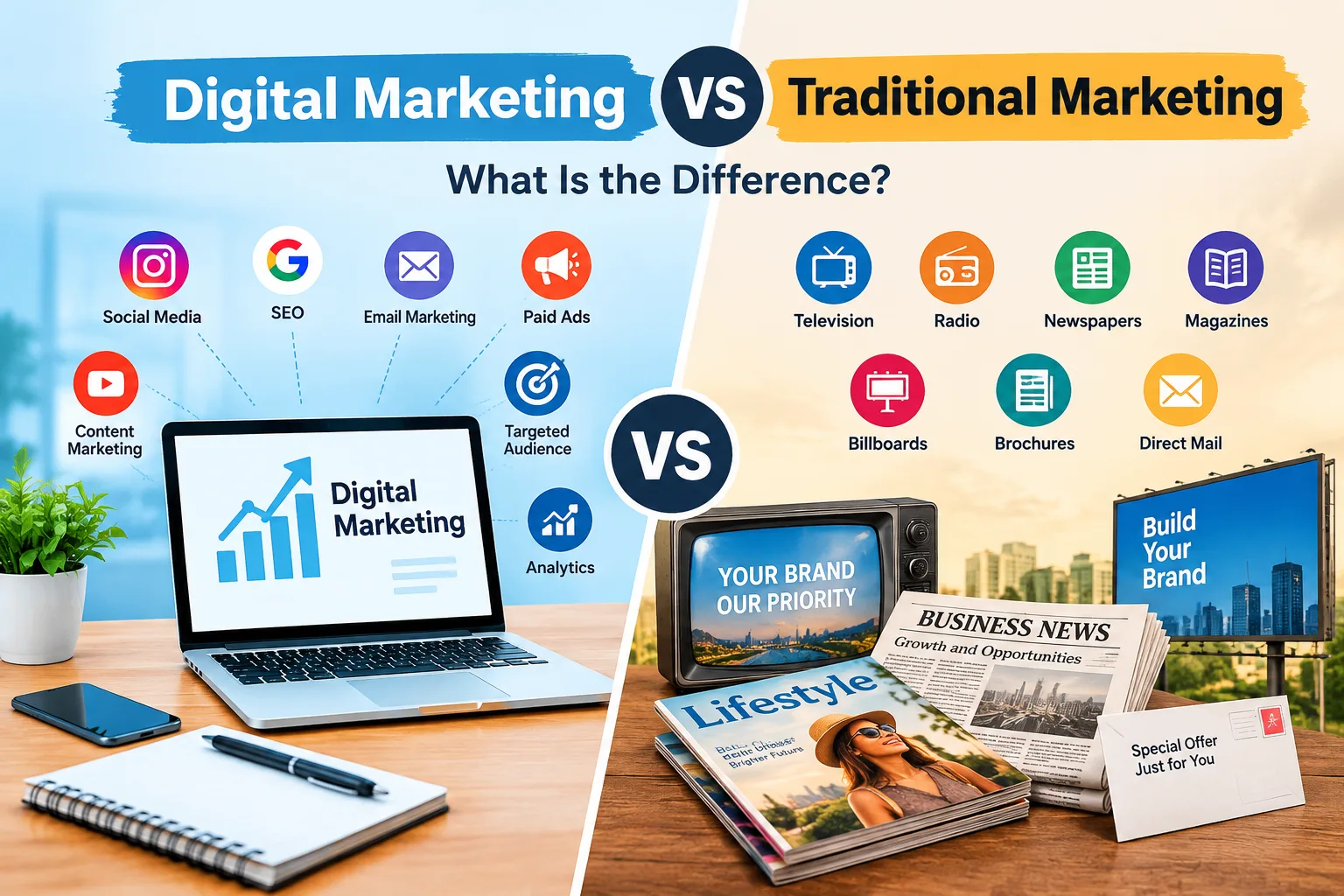
Common traditional marketing channels include:
- Television advertisements
- Radio advertisements
- Newspapers
- Magazines
- Billboards
- Posters
- Brochures
- Flyers
- Direct mail
- Events and trade shows
For example, a local restaurant may place an advertisement in a newspaper or distribute flyers around the neighbourhood to promote a new menu.
Traditional marketing can be particularly useful when businesses want to reach people in a specific geographic area or target audiences that regularly consume offline media.
However, traditional campaigns can sometimes make it difficult to determine exactly how many people interacted with an advertisement or eventually became customers.
What Is Digital Marketing?
Digital marketing involves promoting products, services or brands through internet-connected platforms and digital channels.
Some common digital marketing channels include:
- Search engine optimization (SEO)
- Search engine advertising
- Social media marketing
- Email marketing
- Content marketing
- Display advertising
- Video marketing
- Influencer marketing
- Websites and landing pages
For example, an online clothing store can use Instagram advertisements to promote a new collection and send interested users directly to a product page.
A business can also publish useful blog content to appear in search results when potential customers search for related information.
Digital marketing provides businesses with multiple ways to reach, engage and convert their audiences online.
Reach and Audience
Traditional marketing can reach a large audience through television, radio, newspapers and outdoor advertising. However, the audience is often broader and less specific.
Digital marketing can potentially reach audiences across different cities, countries and regions through online platforms.
For example, Digital Marketing vs Traditional Marketing a local furniture shop could put up a billboard near its showroom. This may reach many people travelling through that area.
The same business could use online advertising to show its promotion specifically to people within a selected location who are interested in furniture or home improvement.
The best approach depends on whether the business wants broad offline exposure or more controlled online audience targeting.
1. Cost
Marketing costs vary significantly depending on the channel, campaign size, location and audience.
Traditional advertising can involve expenses for television slots, newspaper placements, printing, billboard space and physical distribution.
Digital marketing can provide businesses with flexible budget options. For example, a small business can start a social media advertising campaign with a limited budget and increase spending based on performance.
This does not mean digital marketing is always cheaper. Professional content creation, SEO, paid advertising, website development and social media management can also require significant investment.
The important difference is that digital campaigns often provide more flexibility in adjusting budgets during a campaign.
2. Targeting
Audience targeting is one of the major differences between digital and traditional marketing.
Traditional advertising usually targets audiences based on the publication, location, program or media channel.
For example, a sports brand advertising during a popular sports program may reach many sports viewers. However, not everyone watching the program will necessarily be interested in purchasing sports products.
Digital platforms can offer more detailed targeting options depending on the platform and campaign type. Businesses may be able to target audiences based on factors such as location, interests, online behavior or search activity.
For example, a digital campaign for a wedding photography service could be designed to reach people in a particular city who are searching for wedding-related services.
3. Customer Engagement
Traditional marketing is generally more one-directional. A company creates an advertisement and distributes it through a selected channel.
Digital marketing allows customers to interact with businesses more directly.
People can:
- Comment on social media posts
- Send direct messages
- Share content
- Submit online forms
- Write reviews
- Respond to emails
- Visit websites
- Chat with businesses
For example, a customer watching a brand's Instagram video can comment on the post and receive a response from the company.
This creates opportunities for businesses to communicate with their audiences and understand customer feedback more quickly.
4. Measurement and Analytics
Measurement is another important difference.
Traditional campaigns can use methods such as surveys, coupon codes, customer feedback and sales comparisons to estimate campaign performance. However, some offline advertising results can be difficult to measure precisely.
Digital marketing provides access to various analytics and reporting tools.
Businesses can monitor metrics such as:
- Website traffic
- Ad impressions
- Click-through rates
- Conversion rates
- Leads
- Cost per lead
- Email opens
- Social media engagement
- Online sales
For example, if a company runs an online advertisement that receives 10,000 impressions and generates 500 clicks, marketers can analyze those results and compare them with other campaigns.
This data can help businesses make informed decisions about future marketing activities.
Differences in Marketing Channels
The channels used by each approach are different.
Traditional marketing relies mainly on physical or broadcast media, while digital marketing uses internet-based platforms.
| Traditional Marketing | Digital Marketing |
|---|---|
| Television | Search engines |
| Radio | Social media |
| Newspapers | Websites |
| Magazines | |
| Billboards | Search advertising |
| Flyers | Display advertising |
| Brochures | Video platforms |
| Direct mail | Content marketing |
Businesses do not necessarily have to choose only one category. A company can combine both approaches to reach customers through multiple touchpoints.
Which One Provides Better Flexibility?
Digital campaigns can generally be modified quickly.
Suppose a company launches an online advertisement and discovers that one version is generating more clicks than another. The business can adjust the campaign, change the creative or modify the budget.
Traditional advertisements are usually less flexible after publication or distribution. A printed newspaper advertisement, billboard or brochure cannot always be changed once it has been produced.
This makes digital channels useful for businesses that want to test different messages and adjust campaigns based on performance.
Simple Example: A Local Clothing Store
Consider a clothing store launching a new festive collection.
Using traditional marketing, the store might:
- Print flyers
- Place newspaper advertisements
- Put up local banners
- Advertise on local radio
Using digital marketing, the same store could:
- Post product videos on Instagram
- Run location-based advertisements
- Create a website landing page
- Send promotional emails
- Publish short videos
- Use search advertising
- Encourage customers to visit the online store
The store could also combine both strategies.
For example, a billboard could create local awareness while a QR code directs people to an online offer. This connects an offline campaign with a digital conversion opportunity.
Brand Awareness and Trust
Traditional marketing can still play an important role in building brand awareness. Seeing a company repeatedly on television, radio, newspapers or billboards can increase familiarity with the brand.
Digital marketing can also build awareness through consistent content, social media activity, search visibility, videos and online advertising.
Trust can be developed through both approaches.
For example, a company may use a newspaper advertisement to announce its services while using its website to provide detailed information, customer reviews and case studies.
The combination of offline visibility and online information can create multiple opportunities for customers to learn about a business.
Speed of Communication
Digital marketing allows businesses to communicate information quickly.
A company can publish an announcement on its website or social media account within minutes. Email campaigns can also be sent to subscribers almost instantly.
Traditional marketing often requires additional production and distribution time.
For example, changing a message in a printed brochure requires a new version to be designed, printed and distributed. Changing information on a website can usually be done much faster.
This speed can be useful for promotions, announcements, product launches and time-sensitive campaigns.
Local vs Global Marketing
Traditional marketing can be highly effective for local businesses.
A restaurant, retail store or local service provider may use newspapers, local radio, flyers or outdoor advertising to reach nearby customers.
Digital marketing can support both local and global strategies.
A small business can use local SEO, location-based advertising and social media to attract customers from its surrounding area. At the same time, an online business can use digital channels to reach customers across different regions or countries.
Therefore, digital marketing does not automatically mean global marketing. It can also be used for highly localized campaigns.
Can Businesses Use Both?
A balanced Digital Marketing vs Traditional Marketing strategy can help businesses connect with customers through both online and offline channels.
For example, a new restaurant could launch a newspaper advertisement, put up outdoor signage and simultaneously run social media advertisements.
The offline campaign creates awareness, while the digital campaign can encourage people to visit the website, view the menu, make a reservation or contact the restaurant.
Another example is a college promoting a new course. It may use newspaper advertisements and outdoor banners for awareness while using search ads, social media and landing pages to collect student enquiries.
Combining channels can help businesses reach customers at different stages of the buying journey.
Businesses can combine Digital Marketing vs Traditional Marketing to create a wider customer journey across online and offline channels.
How to Choose the Right Marketing Approach
When choosing between Digital Marketing vs Traditional Marketing , businesses should consider their target audience, budget, goals and available resources.
Target Audience
Understand where your customers spend their time and how they make purchasing decisions.
Marketing Objective
Decide whether the main goal is brand awareness, website traffic, lead generation, sales, customer engagement or local visibility.
Budget
Consider the total campaign cost as well as the resources required to create and manage it.
Measurement
Choose channels that allow you to measure the results that matter to your business.
Product or Service
Some products may benefit from visual digital campaigns, while others may perform well through local offline advertising or industry events.
Customer Journey
Think about how customers discover your business, research their options and eventually make a purchase.
Common Misunderstandings
One common mistake is assuming that digital marketing has completely replaced traditional marketing.
In reality, both approaches continue to have a place in different marketing strategies.
Another misconception is that digital marketing is always inexpensive. While businesses can start with small budgets, successful digital campaigns may require investment in strategy, creative production, technology, content and advertising.
Similarly, traditional marketing is not automatically ineffective. Its usefulness depends on the audience, campaign objective and execution.
The most important consideration is not simply whether a channel is digital or traditional, but whether it can effectively reach the intended audience and support the business objective.
Conclusion
Understanding Digital Marketing vs Traditional Marketing helps businesses make better-informed decisions about their marketing strategy. Traditional marketing uses channels such as television, radio, newspapers, billboards and print materials, while digital marketing uses websites, search engines, social media, email and online advertising.
| Heading 1 | Heading 2 | Heading 3 |
|---|---|---|
Digital channels generally offer more flexible targeting, faster communication and detailed performance tracking, while traditional channels can provide strong offline visibility and broad local or mass-market exposure.
Businesses do not always need to choose one approach. Depending on their audience, goals and budget, combining digital and traditional marketing can create a broader and more connected customer experience. The most suitable strategy is the one that reaches the right audience through the channels that best support the business objective.
Frequently asked questions
What is the main difference between digital and traditional marketing?
Traditional marketing uses offline channels such as television, radio, newspapers and billboards, while digital marketing uses online channels such as search engines, websites, social media and email.
Is digital marketing cheaper than traditional marketing?
The cost depends on the channel, campaign and business goals. Digital marketing can offer flexible budgets, while traditional marketing costs vary depending on media placement and campaign size.
Which marketing method offers better targeting?
Digital marketing generally provides more detailed targeting options through online advertising platforms, while traditional marketing usually targets audiences through media, location or publication choices.
Can businesses use digital and traditional marketing together?
Yes. Businesses can combine offline advertising with SEO, social media, email marketing and paid advertising to reach customers through multiple channels.
How can businesses measure digital marketing results?
Businesses can track website traffic, clicks, leads, conversions, advertising costs, engagement and online sales using digital analytics tools.