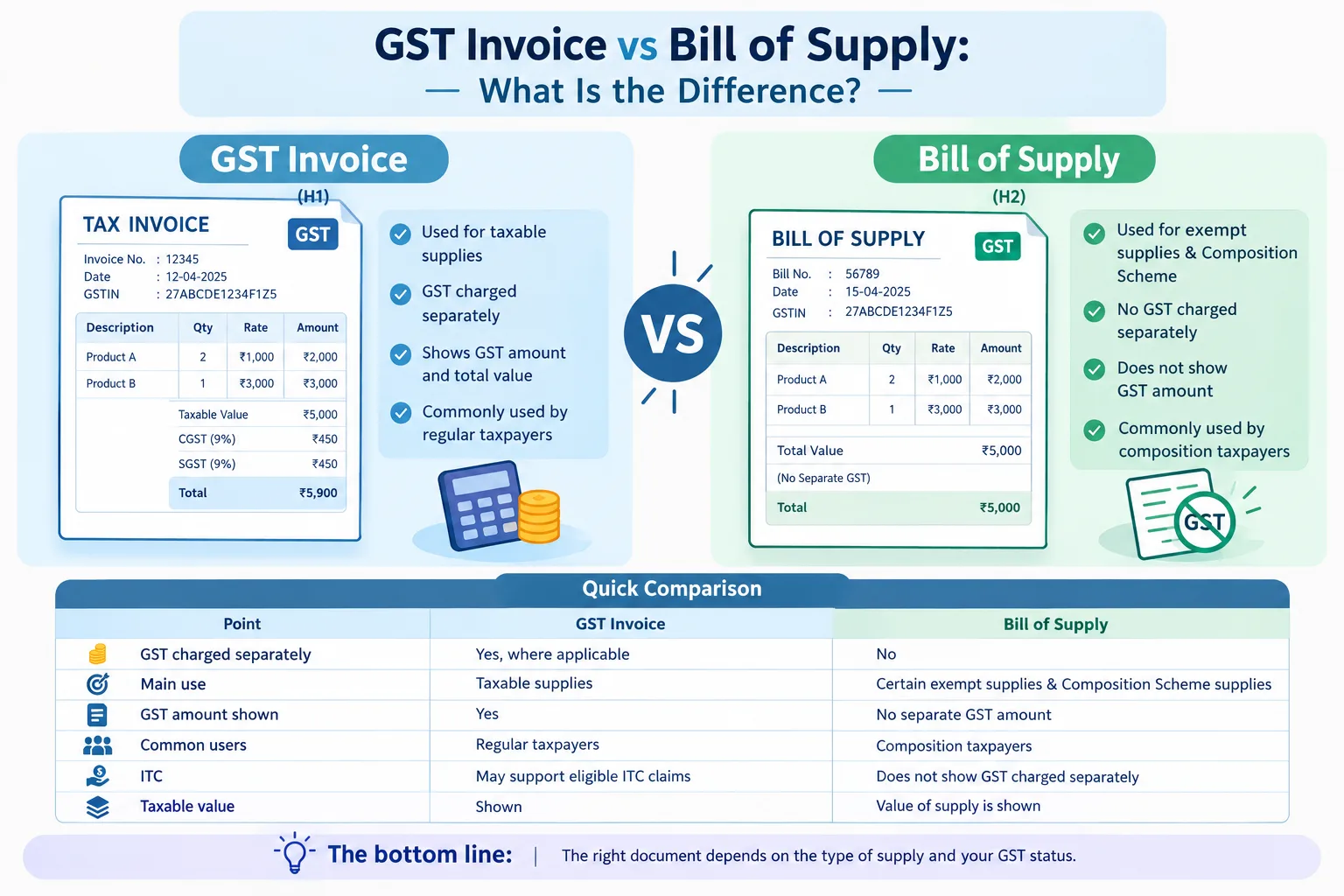
What Is a GST Invoice?
A GST invoice, also called a tax invoice, is a document issued by a registered person for a taxable supply of goods or services when GST is applicable.
It normally contains details such as the seller's GSTIN, invoice number, date, customer information, description of goods or services, taxable value, GST rate, GST amount, and total value.
A tax invoice gives both the seller and buyer a clear record of the transaction
When Is a GST Invoice Used?
A tax invoice is generally used when a registered business makes a taxable supply on which GST is applicable.
For example, if a business sells taxable products for ₹20,000 and GST applies, the invoice can show the product value, applicable GST, and final amount payable by the customer.
Internal Link 1: [Add internal link here — GST Invoice / GST Registration Guide]
What Is a Bill of Supply?
A Bill of Supply is a document used in specific GST situations where GST is not being charged separately.
It can be used for certain exempt supplies and by taxpayers covered under the Composition Scheme, subject to the applicable GST rules.
Unlike a tax invoice, a Bill of Supply does not show GST as a separate tax amount charged to the customer.
When Is a Bill of Supply Used?
A Bill of Supply may be used when the supply is exempt from GST or when a taxpayer is operating under the Composition Scheme and the applicable rules require this document.
For example, a composition taxpayer generally cannot collect GST separately from customers in the same way as a regular taxpayer. Therefore, a Bill of Supply is used for applicable supplies.
GST Invoice vs Bill of Supply: Main Differences
The easiest way to understand GST Invoice vs Bill of Supply is to compare their purpose and tax treatment.
| Point | GST Invoice | Bill of Supply |
|---|---|---|
Point | GST Invoice | Bill of Supply |
GST charged separately | Yes, where applicable | No |
Main use | Taxable supplies | Certain exempt supplies and Composition Scheme supplies |
GST amount shown | Yes | No separate GST amount |
Common users | Regular taxpayers making taxable supplies | Composition taxpayers and businesses making specified exempt supplies |
ITC | May support eligible ITC claims | Does not show GST charged separately |
Taxable value | Shown | Value of supply is shown |
The most important point is that the correct document depends on the type of supply and the taxpayer's GST status.
GST Invoice vs Bill of Supply: How to Choose the Right One
If you are confused about GST Invoice vs Bill of Supply, start with three simple questions.
Is the Supply Taxable?
First, check whether the goods or services you are selling are taxable under GST.
If GST applies to the taxable supply, a tax invoice may generally be required.
If the supply is exempt or falls under a situation where a Bill of Supply is applicable, you may need to use that document instead.
Are You Charging GST?
Next, check whether GST is being charged separately from the customer.
If GST is being charged on a taxable supply, the appropriate tax invoice should generally show the applicable tax details.
If GST is not being charged because of the applicable GST treatment, a Bill of Supply may be appropriate.
What Is Your GST Status?
Your GST status can also affect the document you issue.
For example, businesses under the Composition Scheme have different invoicing requirements from regular taxpayers.
This is why businesses should not simply copy another company's invoice format. The document should match the business's own GST status and transaction.
What Details Should a GST Invoice Include?
A GST invoice generally contains important information required under GST rules.
These details can include:
Supplier's legal name
Business address
GSTIN
Invoice number
Invoice date
Customer details
Customer GSTIN, where applicable
HSN code or Accounting Code
Description of goods or services
Quantity, where applicable
Taxable value
GST rate
GST amount
Total invoice value
Place of supply, where applicable
Reverse charge details, where applicable
Signature or digital signature where required
The exact requirements can depend on the type and value of the transaction.
What Details Should a Bill of Supply Include?
A Bill of Supply also needs relevant information so that the transaction can be properly identified.
Common details include:
Supplier's name and address
GSTIN, where applicable
Bill of Supply number
Date
Customer details, where required
HSN code or Accounting Code
Description of goods or services
Value of supply
Signature or digital signature where required
The main difference is that GST is not shown as a separately charged amount on the document.
GST Invoice vs Bill of Supply and Input Tax Credit
Another important difference between GST Invoice vs Bill of Supply is the way the document relates to Input Tax Credit.
Eligible businesses can claim Input Tax Credit when the applicable GST conditions are satisfied and the required documents are available.
A tax invoice can support an eligible ITC claim because it shows the GST charged on the purchase.
A Bill of Supply is different because it does not separately show GST charged to the customer.
For example, if a business purchases goods and receives a valid tax invoice showing GST, the business may be able to claim eligible ITC if all applicable conditions are met.
However, businesses should not assume that every invoice automatically gives them an ITC benefit. GST rules and eligibility conditions must be checked.
Simple Examples of GST Invoice and Bill of Supply
Let's understand the difference with simple examples.
Example 1: Taxable Sale
A registered business sells a product for ₹10,000 and GST of 18% applies.
The calculation could be:
Product value: ₹10,000
GST: ₹1,800
Total: ₹11,800
Because GST is being charged on the taxable supply, a tax invoice would generally be used.
Example 2: Composition Scheme
Suppose a business is registered under the Composition Scheme and makes a supply covered by the scheme.
The business does not normally collect GST separately from the customer in the same way as a regular taxpayer.
For the applicable transaction, the business can issue a Bill of Supply according to the relevant GST requirements.
Example 3: Exempt Supply
Suppose a business provides a supply that is exempt from GST.
Since GST is not payable on that particular supply, a Bill of Supply may be applicable depending on the GST rules.
These are simple examples. The actual treatment can depend on the nature of the goods or services and the taxpayer's circumstances.
Can a Business Use Both Documents?
Yes, A business can have different types of transactions, and the correct document can depend on the transaction.
For example, a business may make taxable supplies as well as supplies that are exempt or covered by another GST provision.
The same document should not automatically be used for every transaction.
Instead, the business should check the GST treatment of each supply and issue the appropriate document.
What Is an Invoice-Cum-Bill of Supply?
In certain situations, a registered person can issue an invoice-cum-bill of supply when taxable and exempt supplies are made to an unregistered person, subject to the applicable GST rules.
This can be useful where both types of supplies are part of the same transaction.
Businesses should check the relevant GST requirements before using this type of document.
Common GST Billing Mistakes to Avoid
Correct billing is important, but small mistakes can happen easily.
Here are some common problems businesses should watch for:
Adding GST to a Bill of Supply
A Bill of Supply is not meant to show GST as a separately charged amount.
If GST is applicable and being charged, check whether a tax invoice is required.
Using the Wrong Document
Do not choose a document simply because it looks easier.
Always consider the GST status of the business and the nature of the supply.
Incorrect Invoice Numbers
Keep invoice and Bill of Supply numbers organized and follow the applicable numbering requirements.
Wrong GST Rate
Using an incorrect GST rate can affect the total amount and create accounting issues.
Always verify the applicable rate for the particular goods or services.
Missing Business Details
Make sure important information such as GSTIN, invoice number, date, customer details, and supply information is entered correctly.
How Digital Tools Can Help With GST Billing
Preparing invoices manually can take more time when a business has many customers and regular transactions.
Digital billing tools can make the process easier by helping users enter business information, customer details, product or service details, prices, and tax information in one place.
They can also make it easier to prepare documents for printing or PDF use.
However, businesses should remember that a software tool does not automatically make a transaction GST-compliant. The information entered into the system still needs to be accurate.
GST Tools by TZAP Marketing
TZAP Marketing provides practical digital tools that can help businesses with everyday billing and business calculations.
Its GST Invoice Maker can help users prepare GST invoices by entering business, customer, product, service, and pricing details. The invoice can then be prepared for printing or PDF use.
TZAP Marketing also offers useful business tools such as Profit Margin Calculator, Markup Calculator, and Break-even Calculator. These tools can help business owners understand pricing, margins, and basic calculations.
For businesses looking to simplify routine digital tasks, these tools can be a useful starting point.
How to Keep GST Billing Organized
Good GST billing is not only about creating one correct document. It is also about keeping records organized over time.
Here are some simple habits that can help:
Use a consistent numbering system.
Keep customer information updated.
Check GST rates before sending invoices.
Review the taxable value and total amount.
Save digital copies of documents.
Keep taxable and exempt transactions properly organized.
Review your billing process regularly.
Take professional tax advice when a transaction is unclear.
These simple steps can make everyday billing easier and reduce avoidable mistakes.
Quick GST Billing Checklist
Before sending a document to your customer, check:
Is the supply taxable or exempt?
Is GST being charged?
What is the business's GST status?
Is a tax invoice or Bill of Supply required?
Is the customer information correct?
Is the document number correct?
Is the taxable value correct?
Is the GST rate correct?
Is the GST amount correct?
Has a copy been saved for your records?
Following this checklist can help businesses catch simple billing errors before sending the document.
Why Correct GST Billing Matters
Correct billing creates a clear record of business transactions and makes accounting easier.
It helps businesses track sales, customer information, taxable values, and taxes in an organized way.
For customers, a clear document makes it easier to understand what they purchased and how much they paid.
For growing businesses, using a digital billing tool can also reduce repetitive work and make invoice preparation faster.
However, businesses should always ensure that the information entered into the software is correct and follows the GST requirements applicable to their transactions.
Conclusion
The easiest way to remember GST Invoice vs Bill of Supply is that a tax invoice is generally used for taxable supplies where GST is charged, while a Bill of Supply is used in specified situations where GST is not charged separately.
The correct document depends on the nature of the supply, the GST status of the taxpayer, and the applicable GST rules.
For businesses, proper billing is about more than creating a document. It is about recording the transaction correctly, keeping useful records, and making sure the tax information is accurate.
Digital tools such as a GST Invoice Maker can make routine billing easier, while proper record-keeping can help keep business operations organized.
If you are unsure about a particular GST transaction, check the applicable GST rules or speak with a qualified tax professional before issuing the document.
Frequently asked questions
What is the difference between a GST Invoice and a Bill of Supply?
A GST Invoice is generally used for taxable supplies where GST is charged separately. A Bill of Supply is used in specific situations where GST is not charged separately, such as certain exempt supplies or applicable Composition Scheme transactions.
Can a Bill of Supply include GST
No. A Bill of Supply does not show GST as a separately charged amount. If GST is applicable and being charged, a tax invoice may generally be required
Who can issue a Bill of Supply?
A Bill of Supply may be issued in situations such as certain exempt supplies and by taxpayers covered under the Composition Scheme, subject to applicable GST rules.
Can a business use both a GST Invoice and a Bill of Supply?
Yes. A business may have different types of transactions, so the correct document depends on the nature of each supply and the applicable GST treatment.
Does a GST Invoice help with Input Tax Credit?
A valid tax invoice can support an eligible Input Tax Credit claim because it shows the GST charged on the purchase. However, ITC eligibility depends on applicable GST conditions and should not be assumed automatically.