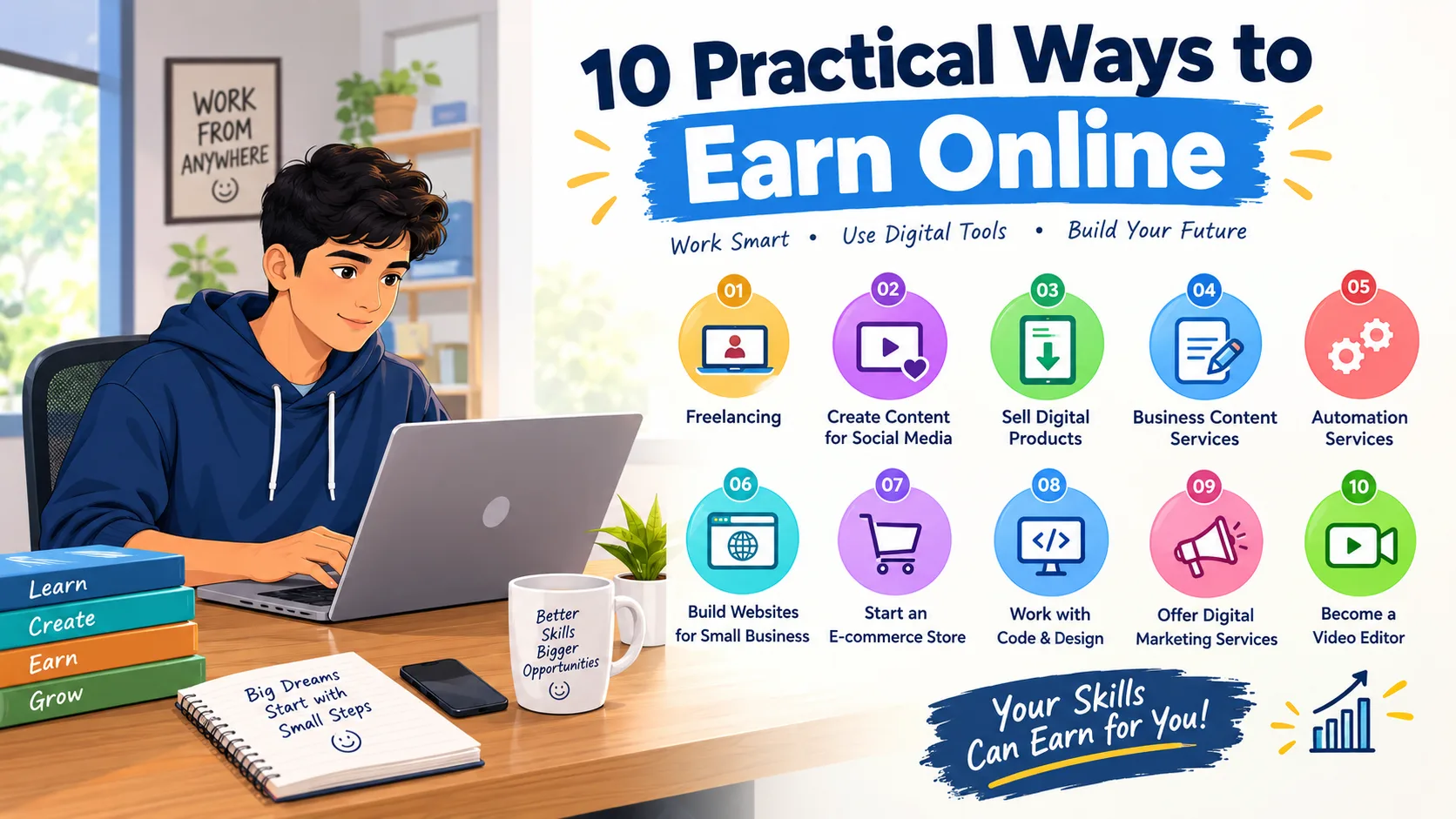
What You Need Before You Start
Before choosing an online earning method, understand one simple thing: technology is a helper, not a replacement for your work.
You should learn how to give clear instructions, check information, improve the final result, and communicate with customers. Basic skills in writing, design, marketing, video editing, research, or business can make your work much more valuable.
You also need a laptop or smartphone, a stable internet connection, and enough time to practice.
Now, let us look at 10 practical ways to earn online.
1. Start Freelancing
Freelancing is one of the easiest ways for beginners to start earning online.
You can offer services such as:
Blog writing
Social media captions
Product descriptions
Graphic design
Video editing
Presentation design
Research
Website content
Email writing
Digital tools can help you complete research, create first drafts, organize ideas, and save time. But you should always review the work before sending it to a client.
For example, a client may ask for five social media posts. You can use a writing tool to create ideas, then improve the language, add the client's brand style, and prepare the final posts.
You can find clients through freelance websites, social media, LinkedIn, local businesses, and your own network.
Tip: Start with one service instead of offering everything. A clear service is easier for customers to understand.
2. Create Content for Social Media
You can also earn money by creating content for platforms such as YouTube, Instagram, Facebook, LinkedIn, and short-video platforms.
You do not always need expensive equipment. A smartphone, basic editing skills, and useful ideas can be enough to start.
You can create:
Educational videos
Business tips
Tutorials
Short videos
Product reviews
News explainers
Career content
Finance education
Digital tools can help you create topic ideas, write outlines, prepare captions, generate thumbnails, and organize your content plan.
However, simply creating content does not guarantee income. You need regular posting and content that people actually want to watch.
Money can come from ads, sponsorships, affiliate marketing, digital products, or services.
3. Sell Digital Products
Digital products can be created once and sold many times.
Examples include:
E-books
Checklists
Templates
Planners
Study notes
Social media calendars
Business worksheets
Presentation templates
Resume templates
For example, someone who understands social media marketing could create a 30-day content calendar for small businesses.
You can use digital tools to research topics, organize information, create drafts, and improve the layout. But the product should contain useful information and your own ideas.
You can sell digital products through your website, online marketplaces, social platforms, or direct messages.
Tip: Solve one small problem instead of creating a product that tries to solve everything.
4. Offer Business Content Services
Many small businesses need regular content but do not have enough time to create it.
This creates an opportunity for freelancers.
You can offer a monthly content package that includes:
Blog ideas
Social media posts
Captions
Email content
Product descriptions
Basic content planning
For example, a local restaurant may need 20 social media posts every month. You can prepare the content plan, create the first drafts, add business-specific information, and send the final version for approval.
The important part is understanding the business. Generic content is easy to create, but useful content requires research and a clear understanding of customers.
5. Build Simple Automation Services
Automation means making repeated tasks happen with less manual work.
Small businesses often repeat the same tasks every day. Examples include collecting leads, sending follow-up emails, organising customer information, creating reports, and moving information between different software tools.
If you learn basic automation platforms, you can create simple systems for businesses.
For example:
Customer fills a form → information goes to a spreadsheet → business receives an alert → follow-up message is prepared.
You do not need to become a professional programmer to start learning basic automation. Many platforms use simple visual systems.
Start with small projects and test everything carefully before giving it to a client.
6. Create Websites for Small Businesses
Website development is another useful online service.
Many small businesses need simple websites for their services, contact details, products, or booking information.
You can learn basic HTML, CSS, website builders, or other beginner-friendly development tools.
Digital assistants can help you understand code, find errors, create page ideas, and organize website content. But you should understand what the code does before using it.
A beginner can start with simple websites such as:
Restaurant websites
Portfolio websites
Local business websites
Service websites
Landing pages
Personal websites
You can charge for creating the website and also offer monthly maintenance, updates, or content services.
7. Start an Online Research Service
Research is another service that can be offered online.
Businesses, creators, and freelancers often need information about competitors, customers, products, keywords, or market trends.
You can offer services such as:
Competitor research
Keyword research
Product research
Business research
Content research
Customer research
Digital tools can help you collect and organize information faster. Still, you should check important facts from reliable sources.
Your value comes from turning large amounts of information into a simple and useful report.
For example, instead of giving a client 50 pages of random information, you can prepare a short report showing competitors, pricing, common customer questions, and possible content topics. readmore
8. Provide Social Media Management
Many business owners know they need social media but do not have time to manage it every day.
You can offer social media management as a monthly service.
Your work may include:
Content planning
Caption writing
Post scheduling
Hashtag research
Basic graphic creation
Comment monitoring
Monthly reports
You can use digital tools to create content ideas and organize your work. However, the final content should match the company's voice and audience.
Start with one or two platforms. Once you understand the process, you can expand your services.
This can become a recurring income source because businesses may need content every month.
9. Offer Consulting and Training
If you become skilled in a particular area, you can teach other people.
You do not need to know everything. You only need to understand one topic well enough to help beginners.
For example, you could teach:
Content creation
Social media basics
Website setup
Online marketing
Productivity
Freelancing
Basic automation
Business research
You can provide one-to-one sessions, group classes, recorded lessons, or simple workshops.
A good consultant does not simply show people tools. They understand the customer's problem and explain a practical solution.
If you are new, build experience first. Create small projects, collect feedback, and improve your knowledge before charging higher fees.
10. Build a Small Online Service Business
The final idea is to combine your skills and create a small service business.
For example, you could offer a package for local businesses that includes:
Website + SEO content + social media + monthly reporting
You can use different digital tools to speed up parts of your work while you focus on planning, quality, customer communication, and final delivery.
This approach can be useful because you are not depending on only one service.
For example, a website client may later need blog content or social media management. One project can therefore lead to additional work.
But do not try to build a large agency immediately. Start with one service, get a few customers, learn from them, and slowly add more services. readmore
How to Start Making Money with AI on a Small Budget
You do not need a huge budget to start. A beginner can start with skills that are already available, such as writing, editing, research, design, or marketing. The main investment is your time.
A simple starting plan can look like this:
Step 1: Choose one skill.
Step 2: Learn the basics.
Step 3: Practice by creating sample work.
Step 4: Build a small portfolio.
Step 5: Find potential customers.
Step 6: Offer a simple service.
Step 7: Collect feedback.
Step 8: Improve your service.
Do not expect instant income. The first few weeks may be about learning and building examples rather than making large amounts of money.
Common Mistakes Beginners Should Avoid
Many people make mistakes when starting an online business.
Expecting Quick Money
Online income usually takes time. Avoid anyone promising guaranteed income without effort.
Using Tools Without Checking the Result
Never send unedited work to a customer. Check facts, spelling, grammar, numbers, and important details.
Offering Too Many Services
Starting with ten services can make your business confusing. Pick one or two services first.
Copying Other People's Work
Do not copy articles, designs, videos, or business ideas word for word. Create your own work and add your own value.
Ignoring Customers
Good communication is important. Ask questions, understand the customer's needs, and provide updates.
Learning Only Tools
Tools change quickly. Skills such as writing, marketing, research, communication, design, and problem-solving remain useful for much longer. readmore
How Tisha Marketing Can Help
Businesses that want to grow online need more than just content. They may also need a good website, search visibility, social media management, advertising, and regular content.
Tisha Marketing can be mentioned naturally in your digital marketing strategy and business growth content as a brand focused on online marketing and digital services.
If you are building an online business, focus on solving real customer problems. A strong service, clear communication, and consistent work can help you build long-term relationships with clients.
Conclusion
There are many ways to earn online, but none of them should be treated as an instant-money method. Freelancing, content creation, digital products, automation, website services, research, social media management, and consulting can all become useful income paths when you build real skills.
The key to how to make money with AI in 2026 is not simply using a tool. It is learning a skill, using technology to work faster, checking your results, and providing something people are willing to pay for.
Start small. Pick one idea, practice it, create a few examples, and look for your first customer. As your skills and experience grow, you can slowly increase your services and income.
Frequently asked questions
How can beginners make money with AI in 2026?
Beginners can start with freelancing, content creation, digital products, research, website services, or social media management while building practical skills
What are the easiest ways to make money with AI?
Freelancing, content creation, digital products, and business content services are some of the methods covered in the article
Can I make money with AI without a big investment?
Yes. The article explains that beginners can start with existing skills and mainly invest their time in learning, practising, and finding customers.
What skills can help me make money with AI?
Writing, design, marketing, video editing, research, communication, and business skills can increase the value of your work