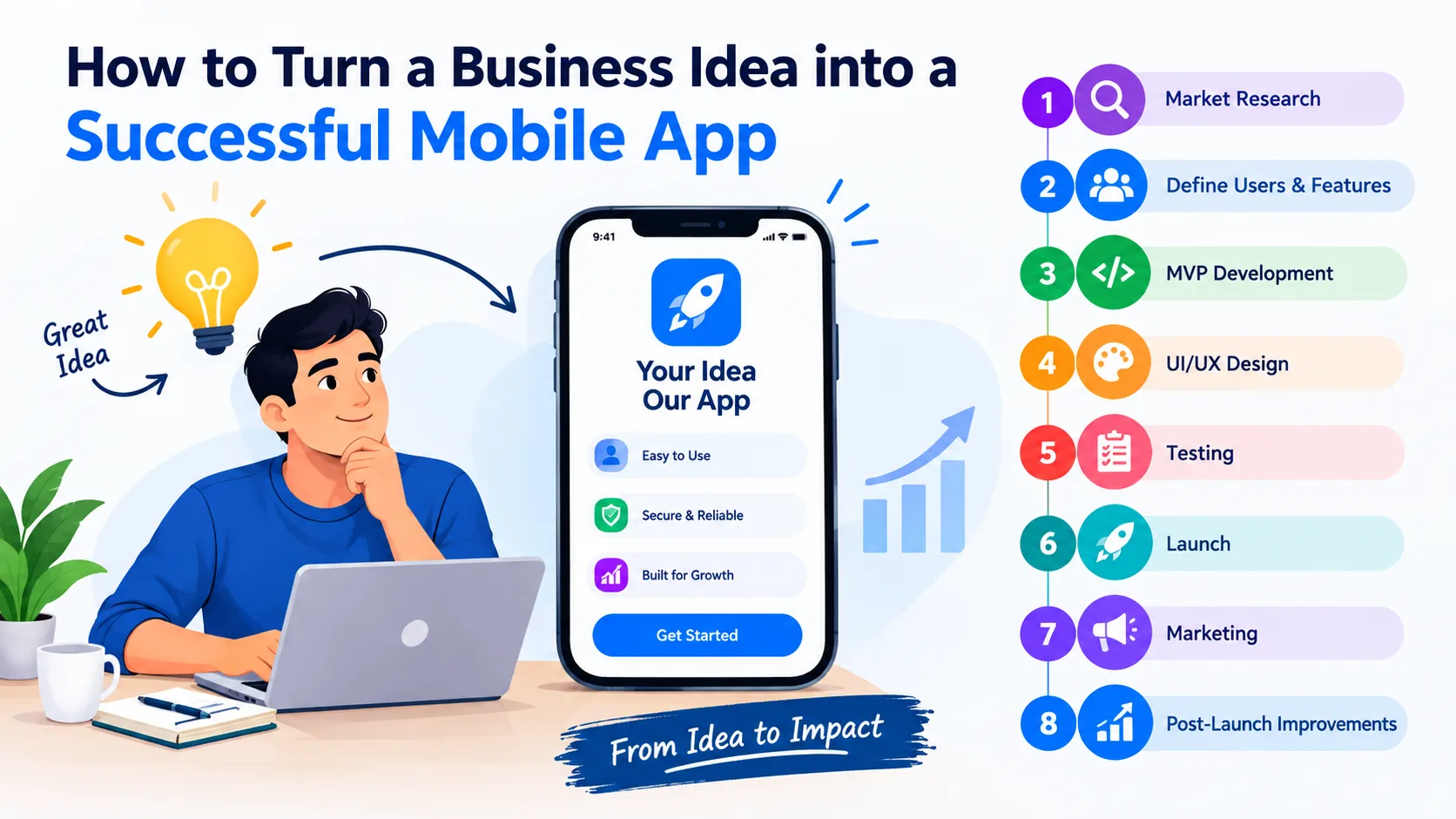
How to Turn a Business Idea into a Successful Mobile App With the Right Features
How to Turn a Business Idea into a Successful Mobile App depends on understanding the target audience, solving a real problem, and creating a useful digital experience. Proper research and planning can help businesses reduce risks and build an app that customers actually want to use.
The best way to turn an idea into an app is to follow a structured development process. Businesses should validate the idea before investing heavily in development, define the target audience, create a minimum viable product, focus on UI/UX design, test the application and prepare a clear launch strategy.
The process does not end when the app reaches the App Store or Google Play. User feedback, performance data and market changes should guide future updates.
Start With Market Research
Before developing an app, businesses should understand the market they want to enter. Market research can help determine whether the idea solves a real problem and whether people are willing to use the proposed solution.
Start by researching:
- Existing apps in the same category.
- Competitor features.
- Customer complaints and reviews.
- Pricing models.
- Market demand.
- Common user problems.
- Gaps in existing solutions.
Competitor research is particularly useful because it shows what users already have and where an opportunity may exist. Reading app reviews can reveal common complaints about confusing navigation, missing features, slow performance or poor customer support.
The objective is not to copy another application. Instead, businesses should identify opportunities to offer a simpler, faster or more useful experience.
Define Your Target Users
A mobile app should be designed for a specific audience. Trying to build an app for everyone can make the product unclear and difficult to position.
Create a simple user profile by considering:
- Age and location.
- Occupation or lifestyle.
- Common problems.
- Technology habits.
- Buying behavior.
- Reasons for using the app.
For example, an appointment-booking app may target busy customers who want to schedule services quickly. Understanding these users can help the development team decide which features should receive the most attention.
User research can also include interviews, surveys and feedback from potential customers. These activities can help businesses validate assumptions before development begins.
Define the Core Problem and Value
Once the target users are clear, define exactly what problem the app will solve.
A useful question is:
“What will users be able to do more easily with this app?”
The answer should be simple. If the value of the app is difficult to explain, the product may need a clearer purpose.
For example, a food delivery application could focus on helping users discover nearby restaurants and order meals quickly. A fitness application could help users follow personalized workout plans and track progress.
A clear value proposition also makes marketing easier because businesses can explain the benefit without using complicated language.
Choose the Right Features
Feature planning is an important part of mobile app development. Businesses often make the mistake of adding too many features during the first version.
Instead, separate features into three groups:
- Essential features.
- Useful future features.
- Optional features.
Essential features are necessary for the core purpose of the application. Future features can be added after the product has been tested with real users.
For example, a basic shopping app may initially need user registration, product browsing, search, cart management, payment and order tracking. Advanced recommendations or loyalty features can be considered later.
Prioritizing features keeps the first version focused and can help control development costs.
Build an MVP First
A practical way to turn a business idea into a successful mobile app is to start with an MVP. This allows businesses to test the core idea with real users before investing heavily in advanced features.
A Minimum Viable Product, or MVP, is an early version of an application containing the core features needed to solve the main user problem.
The purpose of an MVP is not to create an incomplete or low-quality app. It is to create a focused product that can be tested with real users before investing heavily in additional features.
An MVP allows businesses to learn:
- Whether users understand the product.
- Which features they use most.
- Where users face difficulties.
- Whether they return to the app.
- What improvements they expect.
This information can help businesses make better development decisions. Instead of spending a large budget on features that users may never need, teams can use real feedback to prioritize future improvements.
Focus on UI/UX Design
A powerful app can still fail if users find it difficult to navigate. UI refers to the visual interface, while UX focuses on the overall user experience.
Good mobile app design should be:
- Simple.
- Consistent.
- Easy to navigate.
- Responsive.
- Visually clear.
- Accessible.
Users should understand what to do when they open the app. Important actions should be easy to find, and unnecessary steps should be reduced.
The design process can include wireframes, prototypes and usability testing. A prototype allows teams to test the user journey before full development begins.
Good UI/UX design is not only about attractive screens. It is about making the application useful and comfortable to use.
Select the Right Development Approach
Businesses also need to decide how the app will be developed. Common options include native development, cross-platform development and other app development approaches.
Native development can provide strong platform-specific performance and access to platform features. Cross-platform development can allow businesses to build applications for multiple platforms with shared code, depending on the project requirements.
The right choice depends on factors such as:
- Budget.
- Target platforms.
- App complexity.
- Performance requirements.
- Development timeline.
- Long-term maintenance.
A development team should evaluate these factors before selecting a technology stack.
Test the App Before Launch
Testing should happen throughout development rather than only at the end.
A mobile application should be tested for:
- Functionality.
- Performance.
- Security.
- Navigation.
- Compatibility.
- Usability.
- Crashes.
- Different screen sizes and devices.
Real users can also identify problems that developers may not notice. Beta testing can provide valuable feedback before a public launch.
For iOS applications, Apple's TestFlight allows businesses to distribute beta builds to testers and collect feedback before submitting an app for distribution. Apple Developer
Testing should continue until major usability and performance problems have been addressed. A rushed launch can create negative reviews that are difficult to overcome later.
Prepare for the App Launch
Launching an app requires more than publishing it to an app store. Businesses should prepare their store listing, screenshots, description, branding and promotional materials.
Before launch, check:
- App name and description.
- App icon.
- Screenshots.
- Store keywords where applicable.
- Privacy information.
- Support details.
- Landing page.
- Marketing content.
- Analytics setup.
The launch message should clearly communicate the problem the app solves and why users should try it.
A soft launch can also be useful. Businesses can initially release the application to a smaller audience, monitor performance and fix issues before promoting it more widely.
Create a Mobile App Marketing Strategy
Even a well-designed application needs marketing to attract users.
A mobile app marketing strategy can include:
- Search engine optimization.
- Social media marketing.
- Content marketing.
- Paid advertising.
- Influencer partnerships.
- Email marketing.
- Referral campaigns.
- App store optimization.
The best marketing channels depend on the target audience. A consumer-focused app may benefit from short-form video and social media, while a business application may depend more on content, search and professional networks.
Marketing should begin before launch. Building awareness early can help create an initial audience instead of waiting until the app is published.
Measure App Performance
After launch, businesses should track how people interact with the application.
Important metrics can include:
- Downloads.
- Active users.
- Retention rate.
- Session length.
- Conversion rate.
- Feature usage.
- Uninstall rate.
- Crash rate.
- Customer feedback.
Downloads alone do not determine whether an app is successful. An application may receive many downloads but have poor retention if users do not find enough value after installation.
Businesses should identify where users leave the journey and investigate why. For example, if many users register but do not complete their first purchase, the onboarding or checkout process may need improvement.
Improve the App After Launch
Successful apps continue to evolve after launch. Customer expectations, operating systems, technology and competitors can change over time.
Customer feedback is essential when you want to turn a business idea into a successful mobile app. User reviews, analytics, and support requests can show which areas need improvement after launch.
Post-launch improvements can include:
- Fixing bugs.
- Improving performance.
- Adding useful features.
- Updating security.
- Improving navigation.
- Responding to user reviews.
- Testing new experiences.
User feedback should play an important role in deciding what to improve. Not every requested feature needs to be added, but recurring problems should be investigated.
Regular updates can also help maintain user trust. Businesses should communicate important improvements clearly so users understand how the application is becoming better.
Avoid Common Mobile App Development Mistakes
Businesses can reduce risk by avoiding common mistakes.
One mistake is developing the entire app before validating the idea. Market research and an MVP can provide useful evidence before major investment.
Another mistake is focusing only on visual design while ignoring usability. A beautiful interface does not help if users cannot complete basic tasks easily.
Ignoring testing is another serious problem. Bugs, crashes and security issues can damage user trust and lead to negative reviews.
Businesses should also avoid treating launch as the final step. A mobile app needs ongoing monitoring, maintenance, marketing and improvement.
Build for Long-Term Success
How to Turn a Business Idea into a Successful Mobile App? Think beyond the first release. A successful application needs a clear purpose, a well-defined audience, useful features, reliable technology and a strong user experience.
Businesses should also plan for future growth. This may include scalable infrastructure, analytics, customer support, security improvements and regular product updates.
The development process should remain flexible. Real user behavior can reveal information that was not visible during the planning stage. Using this information can help businesses make smarter decisions about future versions.
Conclusion
How to Turn a Business Idea into a Successful Mobile App requires more than good development. It starts with understanding the market, identifying the right users, solving a real problem, and choosing features that provide genuine value.
Businesses should begin with an MVP, focus on simple UI/UX design, test carefully, and create a strong launch and marketing strategy. After launch, analytics and customer feedback should guide regular improvements.
With proper planning and continuous optimization, a business idea can become a valuable mobile application that supports long-term customer engagement and business growth..
Frequently asked questions
How to Turn a Business Idea into a Successful Mobile App?
How to Turn a Business Idea into a Successful Mobile App? Start with market research, define your target users, identify the core problem, prioritize features, build an MVP, test it and create a clear launch and marketing plan.
What is an MVP in mobile app development?
An MVP is an early version of an application that includes the essential features needed to solve the main user problem. It helps businesses test their idea and collect feedback before investing in additional features.
Why is UI/UX design important for a mobile app?
UI/UX design helps make an application easy to understand, navigate and use. A clear user experience can reduce confusion and help users complete important actions more easily.
How should a business market a new mobile app?
Businesses can use SEO, social media, content marketing, paid advertising, email marketing, referrals and app store optimization. The best mix depends on the target audience and business goals.
What should businesses do after launching a mobile app?
After launch, businesses should monitor performance, collect user feedback, fix problems, improve features and release updates based on real user needs.