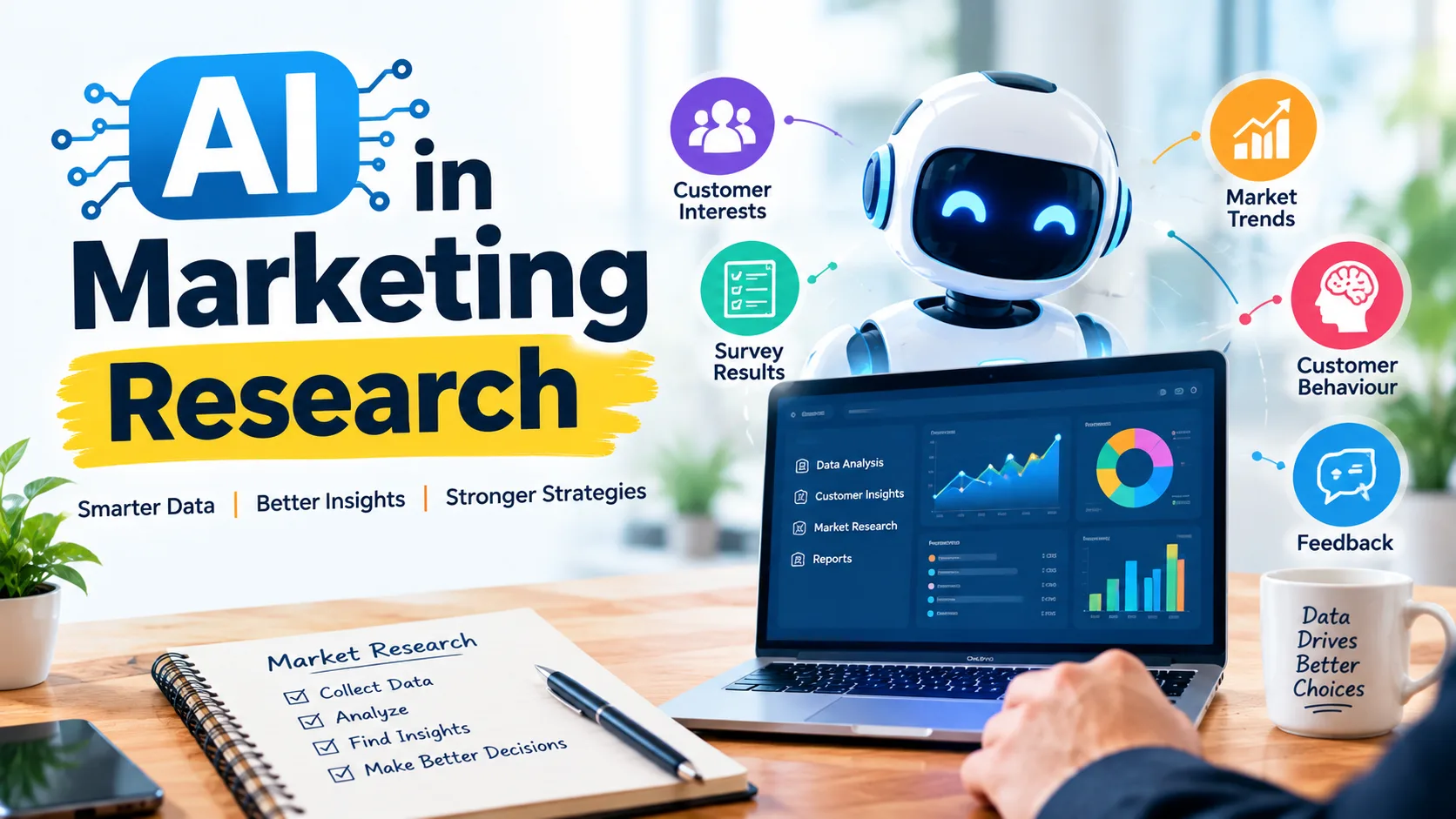
1. What Is AI in Marketing Research?
AI in Marketing Research means using artificial intelligence to collect, study, and understand marketing data. AI can help businesses process large amounts of information in less time. It can study customer behavior, survey answers, online activity, and market information. This helps marketers find useful patterns and make research easier. However, AI does not remove the need for human thinking. People still need to check the information and understand what the data really means.
Collecting Marketing Data
Businesses collect information from many places, such as websites, social media, customer reviews, surveys, and sales records. AI can help collect and organize this information.
Instead of checking every piece of data manually, marketers can use AI tools to arrange information into useful groups. This can save time and make the research process more organized.
Finding Useful Patterns
AI can look at a large amount of data and find common patterns. For example, it may show that customers are more interested in a particular product, service, or topic.
These patterns can help marketers understand customer interests and plan their next marketing activities.
2. How AI Helps With Marketing Data Analysis
Data analysis is an important part of marketing research. Businesses need to understand their data before making decisions. AI can make this process faster by studying large amounts of information in a short time.
Analyzing Large Amounts of Data
A business may have thousands of customer records, website visits, product searches, and sales details. Checking all this information manually can take a lot of time.
AI can process this information quickly and show important patterns. This allows marketers to spend more time understanding the results instead of doing every small task manually.
Comparing Different Data
AI can also compare information from different sources. For example, it can compare website traffic with sales or customer feedback with product interest.
This can help marketers understand what may be working well and where customers may be facing problems.
Finding Changes in Data
Customer behavior can change over time. AI can compare old and new data to find these changes.
For example, if interest in a product is increasing, marketers can notice the change and study the reason behind it.
3. How AI Gives Better Customer Insights
One major benefit of AI in Marketing Research is that it can help businesses understand customer behavior. Customers leave information through searches, clicks, purchases, reviews, and other online activities.
Understanding Customer Behavior
AI can study actions such as searches, website visits, clicks, purchases, and content engagement. These actions can provide useful information about customer interests.
For example, if many visitors search for the same product feature, a business may understand that the feature is important to its customers.
Studying Customer Feedback
Customers give feedback through reviews, comments, emails, and social media posts. Reading every message manually can be difficult when there are many responses.
AI can organize this feedback and identify common topics. It can help marketers see what customers like, what problems they mention, and what improvements they may want.
Finding Customer Needs
AI can combine different types of customer information to identify common needs. This can help businesses improve their products, services, and marketing messages.
However, marketers should not depend only on AI. Human review is still important because customer opinions can have different meanings depending on the situation.
4. How AI Is Changing Marketing Surveys
Surveys have been used in marketing research for many years. They help businesses ask customers direct questions. AI can now support different parts of the survey process, from creating questions to studying the answers.
Creating Survey Questions
AI can help marketers create simple and relevant survey questions. For example, a business that wants to know about customer satisfaction can create questions about product quality, price, service, and overall experience.
Marketers should still check the questions before using them. Poorly written questions can lead to confusing answers.
Analyzing Survey Responses
After collecting survey responses, AI can organize and summarize large numbers of answers.
For example, if 1,000 customers answer a survey, AI can help identify common answers and topics. This can make the first stage of analysis much faster.
Understanding Open-Ended Answers
Some surveys allow customers to write their own answers instead of selecting an option. These answers can contain useful information.
AI can group similar responses and highlight common issues. Still, marketers should read important responses themselves before making major decisions.
5. How AI Tracks Market Trends
Markets change regularly. New products, technologies, competitors, and customer interests can change what people want. AI in Marketing Research can help businesses monitor these changes.
Finding New Trends
AI can study information from online searches, social media, websites, and other available sources. It can help identify topics or products that are receiving more attention.
For example, if searches for a new type of product start increasing, marketers can notice the growing interest and study it further.
Studying Competitor Activity
AI can also help businesses organize information about competitors. Marketers can study changes in products, content, prices, and customer discussions.
This does not mean AI can perfectly understand a competitor's strategy. Human research is still needed to understand the full business situation.
Predicting Possible Market Changes
AI can use past and current data to identify possible patterns. These patterns may help businesses prepare for changes in customer demand.
However, AI predictions are not guaranteed. Unexpected events, new competitors, economic changes, or changes in customer behavior can affect the market.
6. Can AI Replace Traditional Marketing Research?
The question “Can AI replace traditional marketing research?” does not have a simple yes or no answer. AI can make many research tasks faster, but traditional research still provides information that technology may not fully capture.
Value of Interviews
Interviews allow researchers to speak directly with customers. A person can ask follow-up questions and understand why a customer feels a certain way.
For example, AI may show that customers are unhappy with a product, but an interview can help explain the exact reason behind that feeling.
Importance of Focus Groups
Focus groups bring several people together to discuss a product, service, or idea. Researchers can listen to their opinions and observe how people respond to different ideas.
This type of research can provide deeper human feedback that may not appear clearly in digital data.
Direct Customer Surveys
Traditional surveys are still useful when a business needs direct answers from a specific group of customers.
AI can help analyze the answers, but humans are still needed to choose the right audience, create useful questions, and understand the results correctly.
7. Why Businesses Should Combine AI and Traditional Research
Instead of using only AI or only traditional research, businesses can combine both approaches. AI in Marketing Research can handle large amounts of data, whiletraditional methodscan provide direct human opinions.
AI Provides Speed and Data
AI is useful for processing large amounts of information quickly. It can analyze data, organize feedback, identify patterns, and track market changes.
This can help marketing teams save time and focus on important research questions.
Traditional Research Provides Human Views
Traditional research gives businesses direct information from real people. Interviews, focus groups, and surveys can explain personal experiences, opinions, and reasons.
This human information can add more meaning to the data collected through AI.
A Balanced Research Approach
A business can first use AI to find important patterns and then use traditional research to understand those patterns more deeply.
For example, AI may show that customers are leaving a website quickly. A company can then interview some customers to understand why they are leaving.
This combination can give marketers both data-based information and human insights.
Conclusion
AI in Marketing Research is changing how businesses collect data, understand customers, study surveys, and track market trends. AI can process large amounts of information quickly and help marketers find useful patterns. However, traditional research is still important because interviews, focus groups, and direct surveys provide real human opinions and deeper explanations. Instead of completely replacing traditional methods, AI can work alongside them. Using both approaches can help businesses understand their customers and markets in a more complete way.AI in Marketing
Frequently asked questions
What is AI in Marketing Research?
AI in Marketing Research means using artificial intelligence to collect, analyze, and understand customer and market data. It can help marketers find patterns and insights quickly.
How does AI help in marketing research?
AI can analyze large amounts of data, study customer behavior, analyze survey responses, and track market trends. This can make research faster and more organized.
Can AI completely replace traditional marketing research?
No. AI can support many research tasks, but interviews, focus groups, and direct surveys are still useful for understanding customer opinions and experiences.
How does AI help understand customers?
AI can study customer searches, website activity, purchases, reviews, and feedback. It can find common patterns that help businesses understand customer interests and needs.
Why should businesses use AI and traditional research together?
Using both methods can provide a more complete picture. AI can handle large amounts of data quickly, while traditional research can provide direct human opinions and deeper insights.