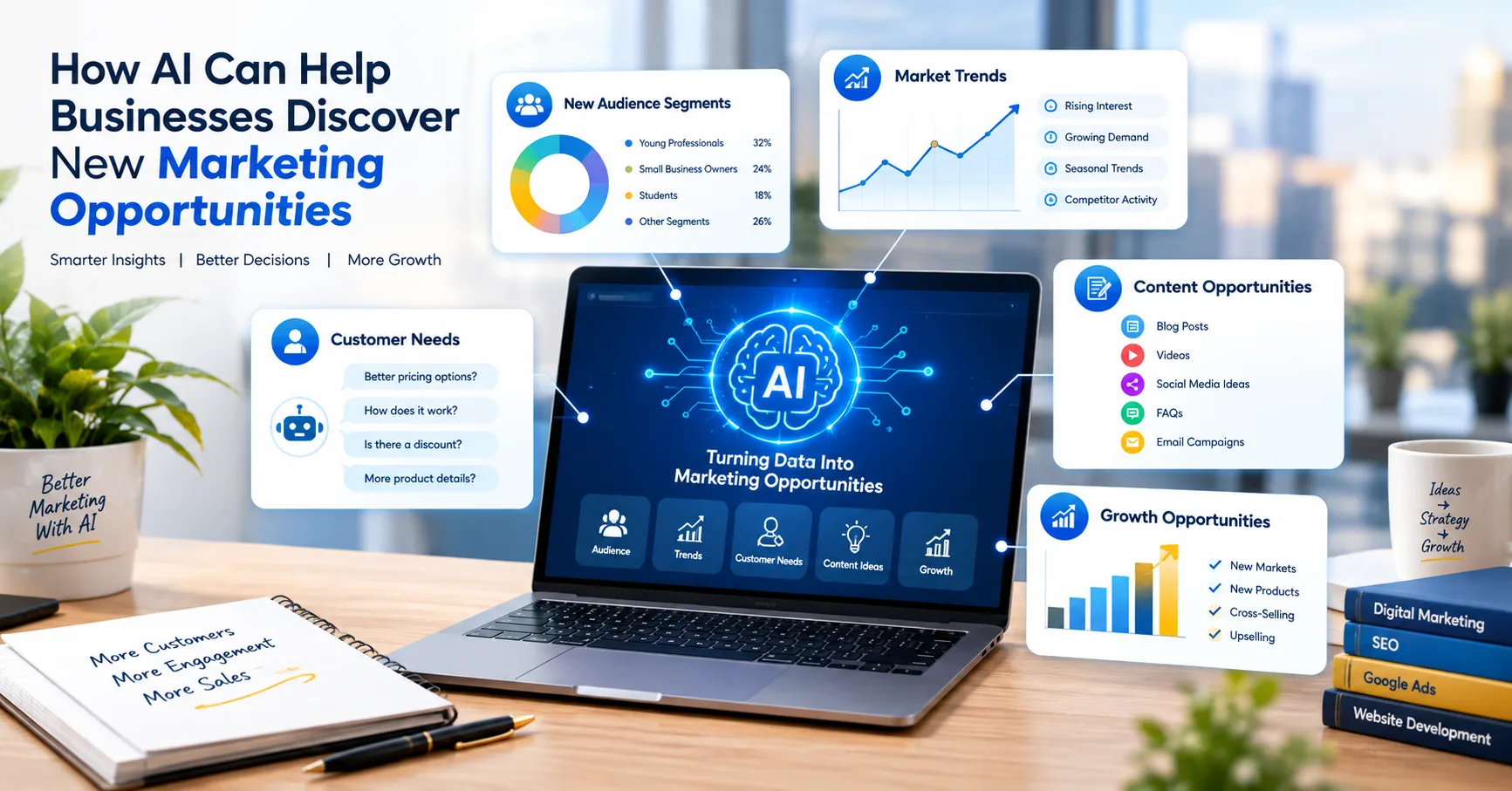
What Are Marketing Opportunities?
A marketing opportunity is a potential way for a business to attract more customers improve engagement increase sales or enter a new market
For example a local fitness business may notice that many customers are searching for beginner-friendly workout programs This could create opportunities for
Beginner fitness packages
Educational blog content
YouTube videos
Social media campaigns
Email newsletters
Local SEO pages
Online consultation services
AI can help businesses find these patterns by analyzing customer behavior search data, campaign performance, website activity, and other available information.
How AI Can Help Businesses Discover New Marketing Opportunities
AI can support marketing teams in several practical ways. From finding new audiences to identifying content gaps, it can make research faster and help businesses explore opportunities that may otherwise be missed.
1. Discovering New Audience Segments
Businesses often know their main customer group but may not realize that other valuable audiences are interested in their products or services.
AI can analyze customer information such as
Purchase behavior
Website activity
Search interests
Engagement patterns
Location
Previous interactions
Product preferences
This can help identify smaller audience groups with similar behaviors.
For example, an online clothing store may discover that customers buying formal shirts are also interested in office accessories. The business could then create a new campaign targeting professionals with related products.
AI-powered audience tools can identify patterns across customer and website data and help marketers create more precise segments.
2. Finding Emerging Market Trends
Market trends can change quickly. A product or topic that attracts little attention today may become much more popular later.
AI can help marketers monitor:
Search behavior
Social media discussions
Customer questions
Product demand
Industry news
Competitor activity
Popular topics
For example, a digital marketing agency may notice growing interest in AI search optimization. The agency can use this information to create educational content, develop a new service, or update existing service pages.
This gives businesses an opportunity to respond to changing customer interests instead of relying only on old marketing assumptions.
3. Understanding Customer Needs
Customer feedback contains valuable marketing information, but manually reading hundreds of reviews, emails, chats, and survey responses can take a lot of time.
AI can analyze customer conversations and feedback to identify repeated themes.
For example, suppose customers repeatedly ask an ecommerce company:
“How can I choose the right size?”
That question could become an opportunity to create:
A detailed size guide
A product comparison page
A short video
An FAQ section
Social media content
A chatbot response
AI can help organize these repeated questions so marketing teams can understand what customers actually need.
4. Finding New Content Opportunities
Content marketing depends heavily on understanding what people want to know.
AI can analyze existing content, customer questions, search topics, and performance data to suggest potential content areas.
For example, a company selling website development services may already have an article about website costs. AI could identify related topics such as:
Website development cost in India
How much does a business website cost?
Website maintenance checklist
Website speed optimization
How to improve website conversions
These topics can become new blog posts, videos, social media posts, FAQs, or downloadable guides.
Some modern marketing platforms also use AI to identify content opportunities and generate drafts based on recommendations, while keeping human review in the publishing process.
5. Identifying Content Gaps
A content gap exists when customers are searching for information that a business has not properly covered.
AI can compare existing content with customer questions and related topics to help marketers find areas that need more information.
For example, a company may have a general article about SEO services, but no detailed content covering:
Local SEO
Technical SEO
Ecommerce SEO
SEO for small businesses
SEO reporting
Google Business Profile optimization
These gaps can become opportunities for creating useful, targeted content.
6. Finding Potential Growth Areas
AI can help businesses analyze which products, services, customer groups, or marketing channels are performing well.
Suppose a company offers five services:
SEO
Website development
Google Ads
Social media marketing
Content marketing
After analyzing customer inquiries and conversions, AI may help the business identify that a particular customer segment frequently asks for both SEO and website optimization.
The company could then create a combined service package or targeted campaign around that need.
The important point is that AI provides insights from available data. The business still needs to evaluate whether the opportunity makes commercial and strategic sense
AI Marketing Opportunities: Practical Examples
Here are some simple examples of how businesses can use AI to discover opportunities.
| Business | AI Insight | Possible Marketing Opportunity |
|---|---|---|
| Ecommerce store | Customers frequently search for product comparisons | Create comparison content |
| Restaurant | Customers ask about healthy meal options | Promote a healthy menu category |
| Digital agency | Businesses ask about AI search visibility | Create an AI SEO service |
| Fitness business | Beginners engage with basic workout content | Create beginner packages |
| SaaS company | Users repeatedly ask the same setup questions | Create tutorials and onboarding content |
| Local service business | Most leads come from specific locations | Build location-specific landing pages |
These examples show that AI does not have to produce a completely new idea from nothing. Often, its value comes from finding useful patterns in information the business already has.
Using AI for Competitor and Market Research
Competitor research is another area where AI can support marketing teams.
AI tools can help organize information about competitors':
Content topics
Product positioning
Customer reviews
Marketing messages
Search visibility
Social media activity
Frequently discussed features
For example, if several competitors publish content around a specific customer problem but your business has no useful resource covering it, that may indicate a potential content opportunity.
AI can also help summarize large amounts of research so marketers can spend more time evaluating the findings and deciding what actions make sense.
Using AI to Personalize Marketing
Not every customer has the same needs.
AI can help businesses divide audiences based on interests, behavior, engagement, and previous interactions. Marketers can then create more relevant messages for different groups.
For example:
New visitor:
“Learn how our service works.”
Returning visitor:
“Compare our plans and features.”
Existing customer:
“Discover additional services that may help your business.”
This type of personalization can make marketing communication more relevant without requiring marketers to manually create every customer segment.
AI Can Turn Customer Data Into Marketing Ideas
One of the most useful applications of AI is connecting different types of customer information.
A business may have data from:
Website analytics
CRM systems
Email campaigns
Social media
Customer support
Reviews
Sales conversations
Search performance
When these sources are analyzed together, businesses may find relationships that are difficult to notice manually.
For example, customers who visit a particular blog article may also frequently request a specific service. That could suggest an opportunity to connect the article with a relevant service page or create a dedicated campaign.
Modern AI marketing platforms are increasingly designed to analyze CRM and engagement data for audience segmentation, campaign planning, and content recommendations.
How Businesses Can Start Using AI for Marketing Research
Businesses do not need to automate their entire marketing strategy at once. A simple process can work well:
Step 1: Collect Your Data
Bring together useful information from your website, CRM, social media, customer feedback, and marketing campaigns.
Step 2: Ask Specific Questions
Instead of asking AI, “Find marketing opportunities,” give it a clear task.
For example:
Which customer groups are growing?
What questions do customers ask repeatedly?
Which content topics are missing?
Which products receive the most interest?
Which audience segments have strong engagement?
What trends are appearing in our industry?
Step 3: Look for Patterns
Review the AI-generated insights and identify repeated customer behaviors or problems.
Step 4: Validate the Opportunity
AI-generated ideas should not automatically be treated as facts. Check important information using reliable data, customer research, search trends, and business results.
Step 5: Test Small
Start with a small campaign, article, landing page, offer, or audience segment.
Measure the results before investing more resources.
AI Should Support Marketers, Not Replace Them
AI can analyze information quickly, but human judgment remains important.
AI-generated insights can be incomplete, outdated, or based on poor-quality data. Businesses should review important recommendations before making decisions.
For example, AI may identify a growing search topic, but that does not automatically mean the topic is profitable for a particular company.
Marketers should consider:
Customer demand
Competition
Business goals
Available resources
Profit potential
Brand positioning
Data quality
The best approach is to combine AI-powered research with human experience and real customer feedback.
How TZAP Marketing Can Help
Finding marketing opportunities is only the first step. Businesses also need a clear strategy to turn those opportunities into campaigns, content, and measurable growth.
TZAP Marketing can help bineussses with services such as:
SEO and content strategy
Website development and optimization
Social media marketing
Google Ads
Content creation
Digital marketing strategy
For example, if your business discovers a new audience through customer data, the next step could be creating a targeted landing page, SEO content, social media campaign, or Google Ads campaign for that audience.
A structured marketing strategy can help turn useful insights into practical actions.
Conclusion
How AI Can Help Businesses Discover New Marketing Opportunities is ultimately about using data more effectively. AI can help businesses identify new audiences, understand customer needs, monitor market trends, discover content gaps, and explore potential growth areas.
However, AI works best as a support system for marketers rather than a replacement for human decision-making. When businesses combine AI insights with customer research, clear goals, and practical testing, they can discover more relevant marketing opportunities and turn useful ideas into real campaigns.
Frequently asked questions
Can AI find new customers for a business?
AI can help identify potential customer segments by analyzing customer behavior, website activity, engagement, and other available data. Businesses still need to validate and target those segments through appropriate marketing campaigns
How does AI find marketing trends?
AI can analyze large amounts of information such as search behavior, customer conversations, social media activity, and market data to identify recurring topics and patterns.
Can AI help with content ideas?
Yes. AI can analyze customer questions, existing content, search topics, and content gaps to suggest potential blog posts, videos, social media topics, FAQs, and other content formats.
Is AI reliable for marketing decisions?
AI can provide useful insights, but its recommendations should be reviewed and validated. Businesses should combine AI analysis with reliable data, customer feedback, and human judgment.
How can small businesses use AI in marketing?
Small businesses can start with simple tasks such as customer research, content ideas, audience segmentation, competitor research, campaign analysis, and customer support.