What Is Performance Marketing?
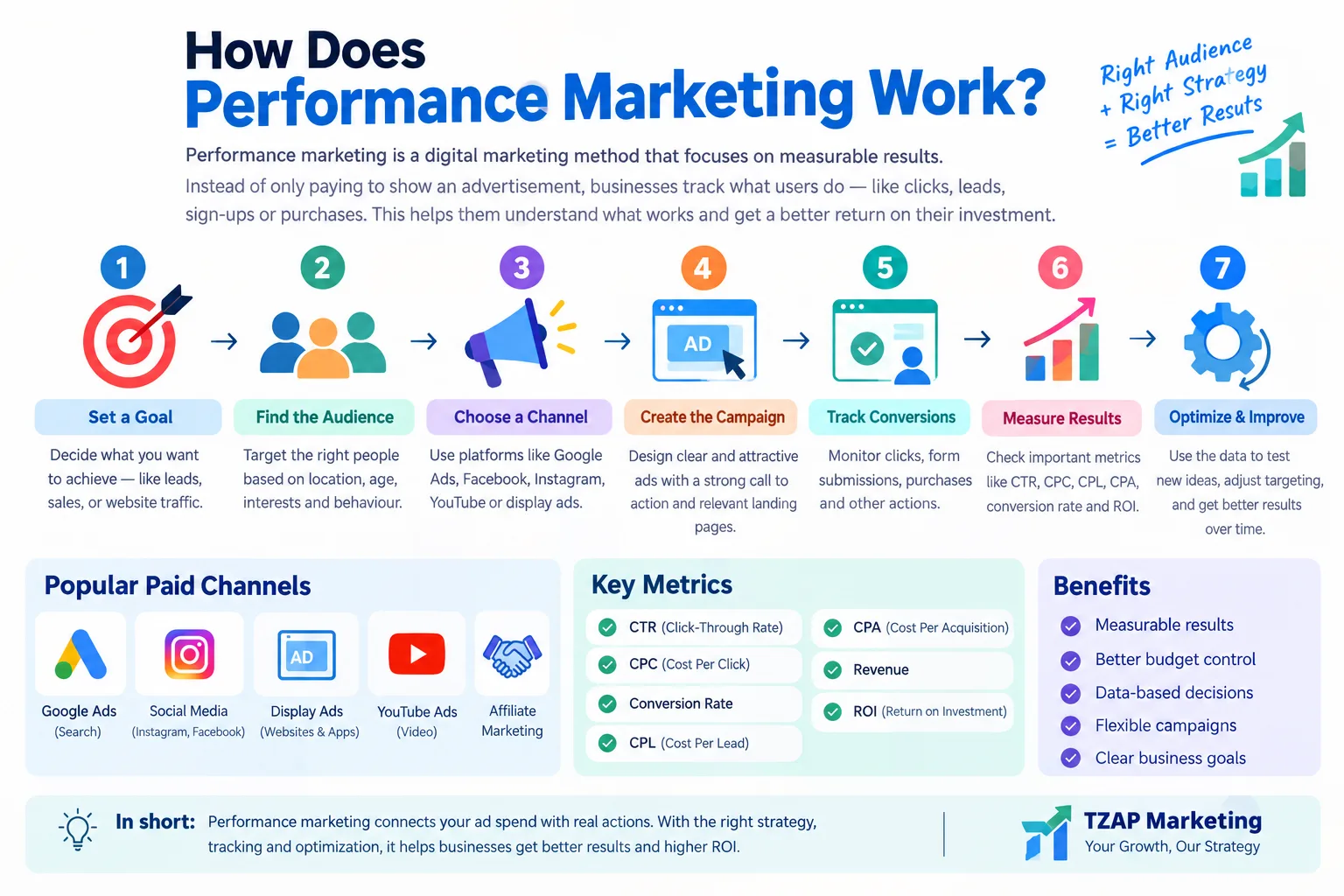
How Does Performance Marketing Work? Performance marketing is a type of digital advertising where campaigns are planned around specific and measurable actions. These actions can be clicks, leads, sales, downloads, registrations, or other conversions.
For example, suppose a website development company spends ₹10,000 on online advertising. The company can track how many people clicked the advertisement, how many visited the website, how many submitted an enquiry form, and how many became customers.
This information gives the business a clearer picture of campaign performance.
Common Performance Marketing Goals
A performance marketing campaign can have different goals depending on the business.
Common goals include:
Generating leads
Increasing product sales
Getting website traffic
Increasing app downloads
Getting more enquiries
Increasing registrations
Promoting subscriptions
Generating phone calls
Getting more bookings
The goal should be decided before launching the campaign because it helps determine what should be tracked.
How Does Performance Marketing Work Step by Step?
Understanding
the performance marketing process
becomes easier when it is divided into simple steps.
Each step helps businesses understand where their marketing budget is going and what results it is producing.
Step 1: Set a Clear Campaign Goal
The first step is to decide what the campaign should achieve.
For example, a business may want to generate 100 leads in one month. An online store may want to increase product purchases. An app company may want more downloads.
A clear goal makes it easier to measure campaign performance.
Instead of saying, “We want more people to know about our business,” a company can set a measurable goal such as, “We want 50 new enquiries from our advertising campaign.”
Step 2: Identify the Target Audience
After setting the goal, the business needs to decide who should see the advertisements.
Audience targeting can consider:
Location
Age
Interests
Search behavior
Online activity
Previous website visits
Purchase behavior
Customer needs
For example, a local SEO company may target businesses in a specific city instead of showing advertisements to people across the entire country.
The more relevant the audience is, the easier it can be to create advertisements that match their needs. readmore
Step 3: Choose the Right Advertising Channel
The next step is choosing where the campaign will run.
Different channels can be useful for different business goals.
Search advertising can reach people who are actively searching for a product or service. Social media advertising can help businesses reach specific audiences based on interests and behavior.
Other performance marketing channels include display advertising, affiliate marketing, shopping advertisements, and paid video campaigns.
The right channel depends on the target audience, campaign goal, budget, and type of product or service.
Paid Channels Used in Performance Marketing
Paid advertising channels are an important part of a performance marketing strategy. Businesses can use one channel or combine several channels depending on their goals.
Search Advertising
Search advertising allows businesses to display paid advertisements when users search for specific keywords.
For example, someone searching for “digital marketing agency in Singapore” may see advertisements from companies providing digital marketing services.
Search advertising can be useful because the user is already showing interest in a particular product or service.
Social Media Advertising
Social media platforms allow businesses to promote products and services to selected audiences.
Businesses can use social media advertisements for:
Lead generation
Product promotion
Website traffic
App downloads
Sales
Brand awareness
Images, videos, offers, and clear calls to action can be used to encourage users to take the next step.
Display and Affiliate Advertising
Display advertisements appear on websites and apps across the internet. They can help businesses reach new audiences or reconnect with previous visitors.
Affiliate marketing works differently. In this model, another person or business promotes a product or service and may receive a commission when a tracked action takes place.
Create Ads That Encourage Action
Once the channel is selected, the business needs to create the advertisement.
A good performance advertisement should be simple and relevant. It should quickly tell users what is being offered and what they should do next.
An advertisement may include:
A clear headline
A useful benefit
Relevant image or video
Short supporting text
A strong call to action
For example, a website company could use a message such as “Get a Free Website Consultation” instead of simply saying “Learn More.”
The advertisement should also match the landing page. If an advertisement promises a free consultation but the landing page does not mention the offer, users may leave without converting.
Understanding Conversions
A conversion happens when a visitor completes the action that a campaign is designed to achieve.
For example, a conversion could be:
Buying a product
Filling out a form
Calling a business
Downloading an app
Signing up for a service
Booking an appointment
Registering for an event
The conversion depends on the campaign goal.
For an online store, a purchase may be the main conversion. For a service company, a completed enquiry form may be more important.
Primary and Secondary Actions
Businesses can also track smaller actions that happen before the final conversion.
For example, an online store may track:
Product view
Add to cart
Checkout
Purchase
Tracking these steps helps marketers understand where customers are leaving the buying process.
Tracking Performance Marketing Campaigns
Tracking is one of the most important parts of a performance marketing campaign.
Without proper tracking, a business may spend money on advertisements without knowing which campaigns are producing useful results.
Important metrics can include:
Impressions
Clicks
Click-through rate
Cost per click
Leads
Sales
Conversion rate
Cost per lead
Cost per acquisition
Revenue
Return on investment
For example, an advertisement may receive thousands of clicks but generate very few leads. This tells the marketer that something in the campaign may need improvement.
The problem could be the audience, advertisement, offer, landing page, pricing, or conversion process.
Measuring ROI
Return on investment, commonly called ROI, helps businesses understand the financial result of their marketing investment.
A simple ROI formula is:
ROI = (Revenue − Marketing Cost) ÷ Marketing Cost × 100
For example, if a business spends ₹20,000 on advertising and generates ₹60,000 in revenue:
ROI = (₹60,000 − ₹20,000) ÷ ₹20,000 × 100
ROI = 200%
This is a simple example. In real business situations, companies should also consider product costs, platform fees, employee costs, and other expenses when calculating overall profitability.
ROI should therefore be considered along with other business metrics rather than viewed on its own.
Important Performance Marketing Metrics
To understand campaign performance , marketers should understand the basic metrics used to measure results.
Click-Through Rate
Click-through rate, or CTR, shows how many people clicked an advertisement compared with the number of people who saw it.
CTR can help marketers understand whether an advertisement is attracting attention.
Cost Per Click
Cost per click, or CPC, shows the average amount paid for each click on an advertisement.
Marketers can compare CPC across campaigns to understand how advertising costs differ.
Conversion Rate
Conversion rate shows the percentage of visitors who complete the desired action.
For example, if 100 people visit a landing page and 5 people submit the enquiry form, the conversion rate is 5%.
Cost Per Lead
Cost per lead, or CPL, shows how much it costs to generate one lead.
This is especially useful for service businesses that depend on enquiries from potential customers.
Cost Per Acquisition
Cost per acquisition, or CPA, measures the average cost of getting a customer or another defined conversion.
These metrics help marketers look beyond simple traffic numbers and understand the actual performance of a campaign.
Optimize the Campaign
A campaign should not simply be launched and forgotten. Regular optimization is an important part of performance campaign management .
Marketers can test different:
Headlines
Images
Videos
Audiences
Keywords
Offers
Landing pages
Calls to action
For example, a company may run two advertisements with different headlines. If one generates more qualified leads at a lower cost, the marketer can use the learning to improve future campaigns.
This process is commonly known as A/B testing.
The goal is not to change everything at once. Marketers should use campaign data to identify what needs improvement and test changes carefully.
Retargeting Interested Visitors
Many people do not become customers during their first visit to a website.
Retargeting allows businesses to reach people who have already interacted with their website, advertisement, or content.
For example, someone may visit an online store and view a product without buying it. A retargeting campaign can later show that person a relevant advertisement.
Retargeting can be useful because the audience has already shown some interest in the business.
However, businesses should use frequency controls and relevant messaging so that users do not feel overwhelmed by repeated advertisements.
Benefits of Performance Marketing
Performance marketing can provide several practical benefits.
Measurable Results
Businesses can track actions such as clicks, leads, sales, and registrations.
Better Budget Management
Campaign data helps marketers understand where advertising money is being spent.
Data-Based Decisions
Instead of relying only on assumptions, marketers can use campaign data to make adjustments.
Flexible Campaigns
Businesses can test different audiences, advertisements, offers, and landing pages.
Clear Business Objectives
Performance campaigns are normally connected to specific actions, making it easier to compare marketing activity with business goals.
Common Performance Marketing Mistakes
Even a well-funded campaign can produce weak results if it is not planned properly.
Some common mistakes include:
Starting without a clear goal
Targeting the wrong audience
Using irrelevant keywords
Sending users to a poor landing page
Not tracking conversions
Looking only at clicks
Ignoring lead quality
Changing campaigns too quickly
Not testing advertisements
For example, getting a large number of clicks may look positive, but if those clicks do not produce leads or sales, the campaign may need further investigation.
Marketers should therefore look at the complete customer journey.
Performance Marketing Example
Suppose a digital marketing company wants to generate new business enquiries.
First, the company sets a goal of getting 50 qualified leads.
Next, it identifies its target audience and chooses search and social media advertising. The company creates advertisements that offer a free consultation.
Users who click the advertisements are sent to a landing page containing information about the service and a simple enquiry form.
The company then tracks clicks, form submissions, cost per lead, and qualified enquiries.
After collecting enough data, the company can compare different advertisements and audiences. If one campaign produces better-quality leads at a reasonable cost, the business can use those insights when planning future campaigns.
This simple example shows how a performance marketing campaign works in a practical business situation. readmore
Why Performance Marketing Is Important for Modern Businesses
Businesses today have many ways to reach customers online. However, simply running advertisements is not enough.
Businesses need to know whether their campaigns are bringing useful results.
Performance marketing provides a structured way to connect advertising activity with measurable actions. Businesses can identify their goals, target specific audiences, track conversions, study campaign data, and make improvements.
For businesses operating in different markets, the strategy may also change according to location, audience behaviour, competition, and customer needs.
For example, a campaign targeting customers in Kolkata may use different messaging from a campaign targeting customers in Siliguri readmore
TZAP Marketing and Performance Marketing
TZAP Marketing helps businesses build a stronger online presence through digital marketing services such as SEO, website development, social media marketing, content creation, and online advertising.
A performance-focused approach can help businesses understand their marketing goals, target relevant audiences, track important actions, and improve campaigns using measurable data.
Whether a business wants more website visitors, leads, enquiries, or online sales, having a clear strategy and proper tracking is important for making better marketing decisions.
Conclusion
So, how does performance marketing work? It starts with a clear business goal and the right target audience. Businesses then select suitable paid channels, create relevant advertisements, send users to useful landing pages, track conversions, and measure important metrics such as CPC, CPL, CPA, conversion rate, revenue, and ROI.
The process continues after a campaign goes live. Marketers study the results, test different ideas, and optimize the campaign based on actual data.
The most important point is to focus on meaningful business results instead of looking only at clicks or impressions. With clear goals, accurate tracking, relevant targeting, and regular optimization, performance marketing can become an important part of a company's overall digital marketing strategy.
Frequently asked questions
What is performance marketing?
Performance marketing is a digital marketing method focused on measurable actions such as clicks, leads, sales, registrations, and app downloads.
How does performance marketing work?
It works by setting a goal, targeting the right audience, choosing paid channels, creating ads, tracking conversions, measuring results, and optimizing campaigns.
What are the main performance marketing channels?
Common channels include Google Ads, social media advertising, display ads, video advertising, affiliate marketing, and shopping ads.
How is performance marketing measured?
It can be measured using metrics such as CTR, CPC, conversion rate, CPL, CPA, revenue, and ROI.