What Is a Marketing Funnel?
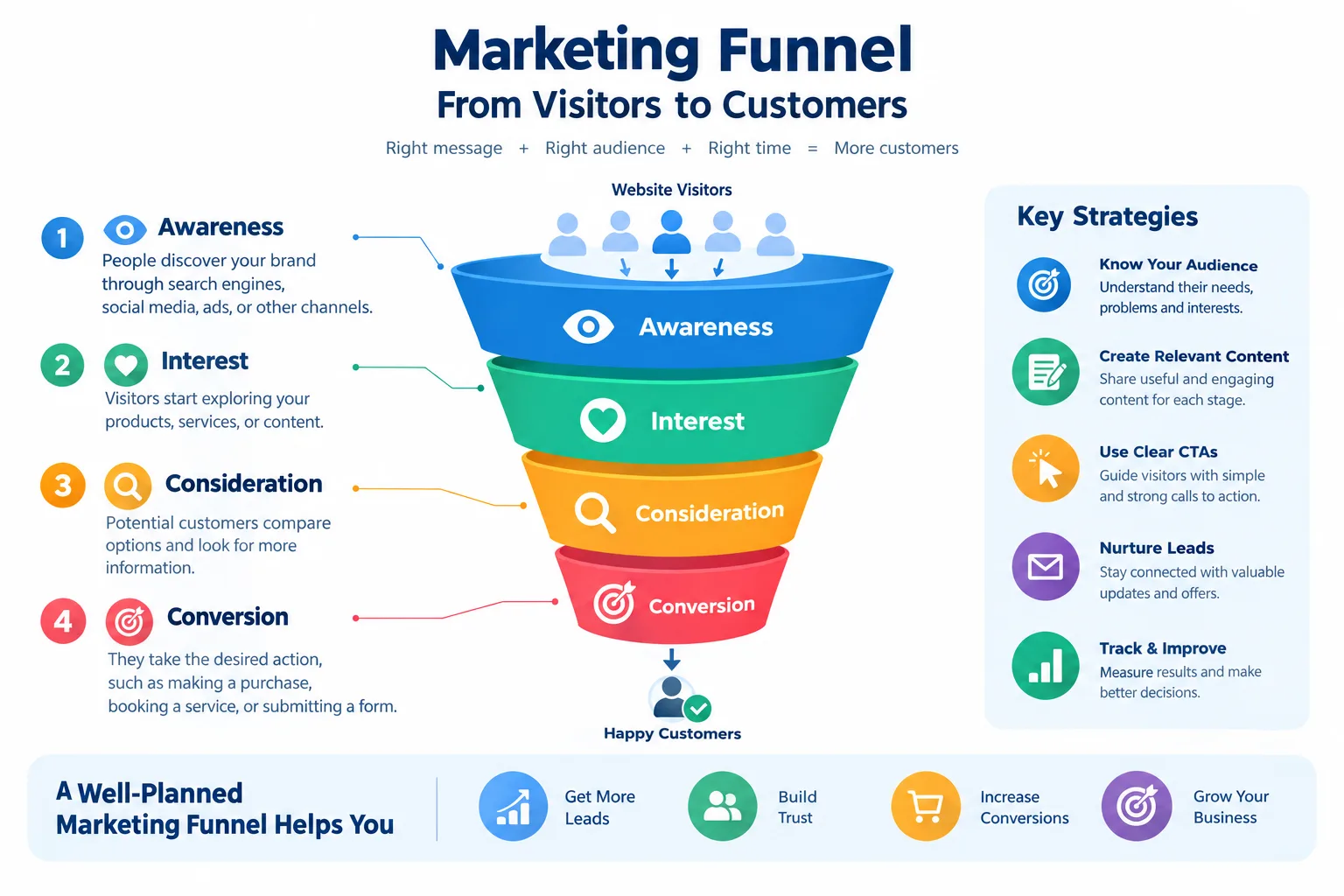
A marketing funnel represents the different steps a potential customer goes through before making a purchase or taking another desired action. Not every visitor is ready to buy immediately, so businesses need different types of content and communication for each stage.
A basic funnel usually includes four main stages:
Awareness: People discover your business through search engines, social media, advertisements, referrals, or other channels.
Interest: Visitors become interested in your products, services, or content and start exploring your website.
Consideration: Potential customers compare options, read reviews, check pricing, and look for more information.
Conversion: Visitors take the desired action, such as making a purchase, booking a service, requesting a quote, or submitting a form.
Understanding these stages helps you create a smoother customer journey and deliver the right message at the right time.
How to Build a Marketing Funnel That Converts
Knowing how to build a marketing funnel is not just about adding a landing page and a contact form. The goal is to create a complete customer journey where every stage supports the next one. You need to understand your audience, create useful content, nurture leads, and make the final conversion process simple.
1. Define Your Target Audience
The first step in how to build a marketing funnel is understanding who you want to attract. Identify your audience's needs, problems, interests, buying behaviour, budget, and common questions.
For example, a digital marketing agency may target small businesses that want more website traffic, online visibility, leads, or sales. Their content should focus on these specific challenges instead of trying to speak to everyone.
Creating an ideal customer profile can help you understand who is most likely to need your product or service.
When you know your audience, it becomes easier to create relevant content, offers, advertisements, and landing pages.
2. Create Content for Each Funnel Stage
Content plays an important role in how to build a marketing funnel because visitors need different information depending on where they are in their buying journey.
At the awareness stage, use educational blog posts, social media content, videos, guides, and informative articles to attract attention.
At the interest stage, provide detailed service pages, tutorials, newsletters, checklists, and useful resources.
At the consideration stage, use case studies, testimonials, comparisons, FAQs, product demonstrations, reviews, and pricing information.
At the conversion stage, provide a clear offer and strong call to action that encourages the visitor to take the next step.
The goal is not simply to create more content. The goal is to create useful content that answers questions and moves potential customers closer to a decision.
3. Use Clear Calls to Action
A call to action, or CTA, tells visitors what they should do next. Without a clear CTA, even interested visitors may leave your website without taking action.
Depending on your business and funnel stage, you can use CTAs such as:
Get a Free Consultation
Request a Quote
Book a Demo
Download the Guide
Start Your Free Trial
Contact Us
Your CTA should match the visitor's intent. Someone reading an introductory blog post may not be ready to make a purchase, but they may be interested in downloading a useful guide or joining an email list.
Clear and relevant CTAs can make the customer journey easier to follow.
4. Build a Lead Nurturing Process
A successful funnel does not stop after the first visit. Lead nurturing keeps your business connected with people who need more information, time, or trust before making a decision.
You can use email newsletters, educational content, follow-up messages, useful resources, webinars, and personalized offers to keep potential customers engaged.
For example, someone who downloads a marketing guide could receive helpful follow-up emails related to their problem. Over time, this can help the business stay relevant while providing useful information.
The key is to focus on value instead of sending repeated sales messages.
5. Make the Conversion Process Easy
A major part of how to build a marketing funnel is reducing unnecessary steps between interest and conversion.
A complicated checkout process, long contact form, unclear pricing, slow website, or confusing navigation can make visitors leave.
Keep important pages simple and make the next step obvious. Use:
Short and relevant forms
Mobile-friendly landing pages
Clear pricing or service information
Visible contact details
Strong but relevant CTAs
Simple checkout or enquiry processes
For example, if your goal is to generate enquiries, a short contact form asking only for essential information can make it easier for visitors to reach you.
6. Build Trust Before Asking for the Sale
Trust is an important part of the customer journey. Visitors may hesitate to buy from a business they do not know.
You can build trust through customer reviews, testimonials, case studies, helpful content, transparent information, clear service details, and professional website design.
If you have completed successful projects, explain what problem you solved and what the customer achieved. Real examples can help potential customers understand your experience and services.
Trust-building content is especially useful during the consideration stage when visitors are comparing different options.
7. Measure and Improve Your Funnel
Understanding how to build a marketing funnel also means knowing how to measure its performance.
Track important metrics such as:
Website traffic
Landing-page engagement
Leads generated
Conversion rate
Email engagement
Cost per lead
Customer acquisition cost
Sales generated
Suppose a landing page receives many visitors but very few people submit the form. This could be a sign that the offer, page content, CTA, form, or user experience needs improvement.
Review your data regularly and test different headlines, CTAs, offers, content, and page layouts where appropriate.
Small improvements across different stages can make the overall funnel more effective.
Common Marketing Funnel Mistakes to Avoid
When learning how to build a marketing funnel, it is also important to understand common mistakes.
Some businesses try to target everyone instead of focusing on a specific audience. Others create content without a clear purpose or use the same message at every stage of the buying journey.
Other common mistakes include:
Using too many CTAs on one page
Making contact forms unnecessarily long
Ignoring mobile users
Not following up with potential leads
Creating weak or unclear offers
Focusing only on traffic instead of conversions
Failing to track funnel performance
Making the buying process unnecessarily complicated
Avoiding these issues can help create a clearer and more user-friendly customer journey.
How TZAP Marketing Can Help
Building and managing a funnel requires the right combination of strategy, content, website optimization, SEO, advertising, and lead generation. TZAP Marketing can help businesses improve different parts of their digital marketing strategy.
From SEO and website development to content creation, social media marketing, Google Ads, and website optimization, TZAP Marketing can help businesses build a stronger online presence and create better opportunities to generate leads.
If you need help improving website traffic, landing pages, lead generation, or the overall conversion process, a structured digital marketing strategy can help connect these different areas.
Conclusion
Learning how to build a marketing funnel can help businesses create a clear path from website visitors to potential customers and, eventually, conversions. Start by understanding your target audience, create useful content for every stage, use clear CTAs, nurture leads, build trust, and make the conversion process simple. Most importantly, track your results and continue improving your funnel based on real user behavior. A well-planned funnel can become an important part of a long-term digital marketing strategy.
Frequently asked questions
What is a marketing funnel?
A marketing funnel is a process that guides potential customers from discovering a business to taking an action such as making a purchase or submitting an enquiry
What are the main stages of a marketing funnel?
The main stages are awareness, interest, consideration, and conversion. Each stage requires different content and messaging
How can a marketing funnel increase conversions?
A well-planned funnel gives visitors relevant information, builds trust, and makes it easier for them to take the next step
What content should be used in a marketing funnel?
You can use blog posts, videos, social media content, case studies, FAQs, email campaigns, landing pages, and offers based on the customer's stage