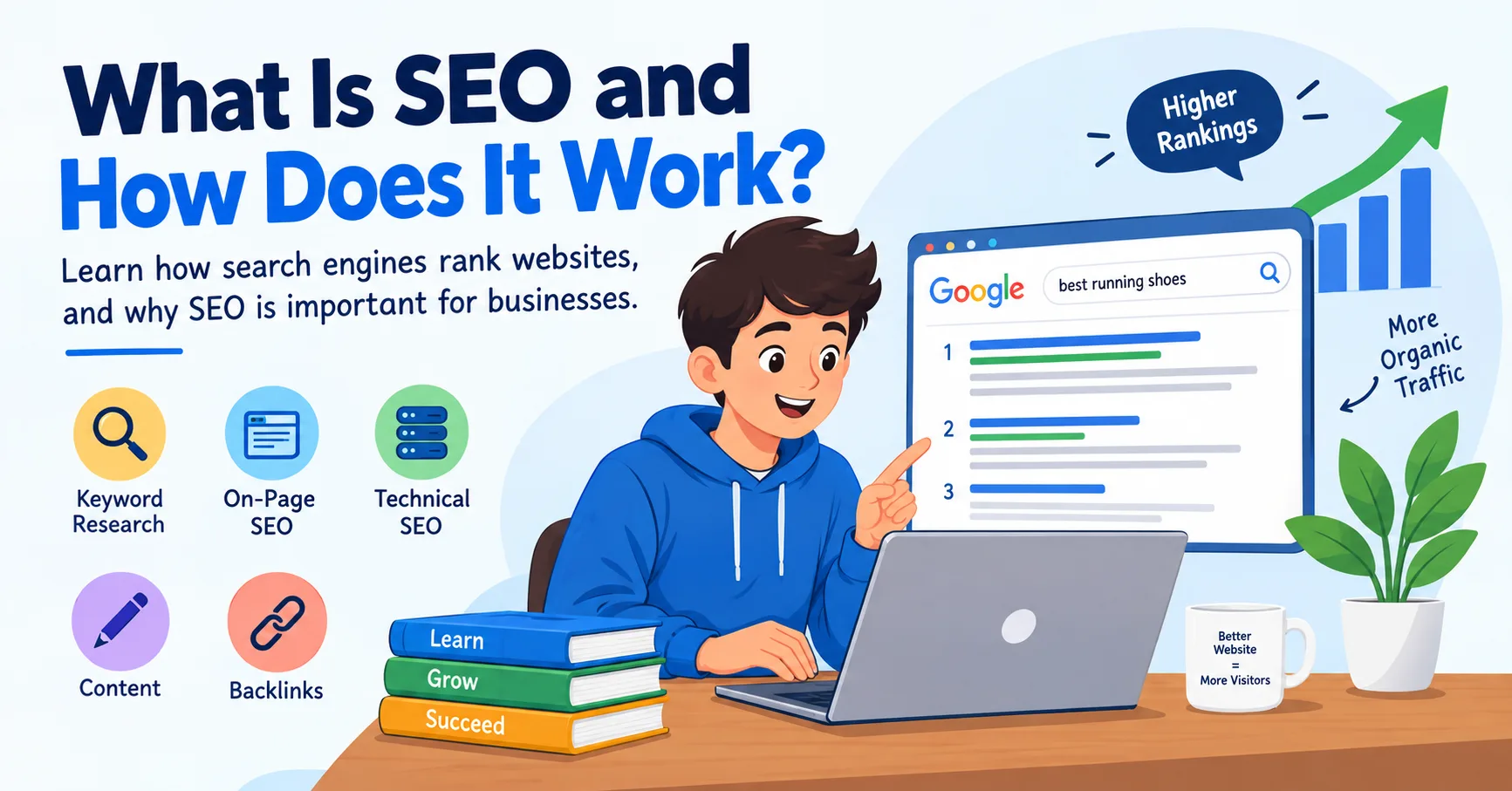
What Is SEO?
SEO stands for Search Engine Optimization. It is the process of improving a website so that it can appear more clearly in search engine results.
For example, imagine you own a website that sells shoes. Someone searches Google for “best running shoes for beginners.” If your website has useful information about running shoes and follows good SEO practices, Google may understand that your page is relevant to the search.
SEO is not about forcing a website to the top of Google. Instead, it helps search engines understand what a website is about and helps users find useful information.
For businesses, SEO can help bring people to a website without depending only on paid advertising.
How Does SEO Work?
To understand What Is SEO and How Does It Work?, you first need to understand how search engines work.
Search engines such as Google generally follow three important steps:
1. Crawling
Search engines use automated programs called crawlers to discover web pages. These crawlers can follow links from one page to another and collect information about websites.
2. Indexing
After finding a page, a search engine analyzes and stores information about it. This process is called indexing.
The search engine tries to understand the page's topic, content, images, links, and other information.
3. Ranking
When someone searches for something, the search engine chooses pages that it believes are relevant and useful for that search.
Many signals can affect how pages appear in search results. These can include relevance, content quality, website usability, links, and other technical factors.
Why Is SEO Important for Businesses?
SEO can be useful for businesses because people often use search engines before choosing a product, service, or company.
For example, a person looking for a local service may search for:
SEO company near me
website development company
digital marketing agency
best restaurant in my city
If a business has useful and well-optimized pages, those pages may appear when people search for related topics.
SEO can help businesses:
Increase website visibility
Reach people who are already searching for related information
Bring more organic traffic
Build an online presence
Support long-term content growth
Help users discover products and services
However, SEO usually takes time. Results can depend on competition, website quality, content, technical issues, and other factors.
Keyword Research
Keyword research is one of the basic parts of SEO.
A keyword is a word or phrase that people type into a search engine.
For example, if someone wants to learn about SEO, they might search:
what is SEO
how does SEO work
SEO for beginners
how to improve website ranking
Keyword research helps you understand what your audience is searching for.
A good keyword should match the topic of your page and the needs of your readers. You should not simply repeat the same keyword many times.
Instead, use the main keyword naturally and include related terms where they make sense. readmore
On-Page SEO
On-page SEO means improving things directly on your website pages.
It includes elements such as:
Title
Your page title should clearly explain what the page is about. It should also be useful to people who see it in search results.
Headings
Use headings such as H1, H2, and H3 to organize your content.
A clear structure makes a long article easier to read.
Content
Your content should answer the reader's question clearly. Avoid writing only to use keywords.
Images
Images can make an article easier to understand. Use descriptive file names and helpful alt text where appropriate.
URLs
Keep URLs simple and related to the page topic. Avoid unnecessary words, numbers, and complicated structures.
Internal Links
Internal links connect one page of your website to another page on the same website.
For example, an article about SEO can link to another article about keyword research or technical SEO.
Internal links help readers discover more information and help search engines understand the relationship between pages.
Technical SEO
Technical SEO focuses on the technical side of a website.
A technically healthy website should be easy for search engines to crawl and easy for visitors to use.
Important areas include:
Website loading speed
Mobile-friendly design
Secure HTTPS connection
Proper website structure
Crawlability
Indexing
XML sitemap
Broken links
Structured data where appropriate
For example, if a website works well on a computer but is difficult to use on a mobile phone, visitors may have a poor experience.
Technical SEO helps remove these types of problems.
Creating Useful SEO Content
Content is an important part of What Is SEO & How Does It Work?
Good SEO content should first help the reader.
Before writing an article, ask:
What does the reader want to know?
For example, if someone searches “how to do keyword research,” they probably want a simple explanation and practical steps.
A useful article should:
Answer the main question
Use simple and clear language
Provide helpful examples
Use headings and short paragraphs
Avoid unnecessary repetition
Give accurate information
Cover related questions naturally
Do not create separate pages just to target slightly different versions of the same keyword. Focus on creating useful resources that genuinely help your audience. readmore
What Are Backlinks?
A backlink is a link from another website to your website.
For example, suppose a marketing website writes an article about SEO tools and links to your website. That link is a backlink for your website.
Backlinks can help search engines discover pages and can also act as signals about a site's reputation. However, not every backlink has the same value.
The goal should not be to collect hundreds of random links.
Instead, focus on creating useful content that other websites may naturally want to reference.
Common SEO Mistakes to Avoid
Beginners often make a few common SEO mistakes.
Keyword Stuffing
Repeating the same keyword again and again can make content difficult to read. Use keywords naturally.
Writing Only for Search Engines
Your content should be written for real people first.
Ignoring Technical Problems
Slow pages, broken links, poor mobile usability, or indexing problems can affect how a website performs.
Copying Content
Publishing copied or low-value content does not create a strong reason for users to visit your website.
Expecting Instant Results
SEO is usually a long-term process. A new website may need time to build useful content and visibility.
How TZAP Marketing Can Help With SEO
SEO can become difficult when a business has to manage keywords, content, website improvements, technical issues, and performance tracking at the same time.
TZAP Marketing can help businesses improve their digital presence through services such as SEO, website development and optimization, content creation, social media marketing, and Google Ads.
For example, a business may need SEO to improve organic search visibility, a well-optimized website to provide a better user experience, and useful content to answer customer questions.
TZAP Marketing can help businesses bring these different digital marketing activities together based on their goals and target audience.
Whether a business is building a new website or trying to improve an existing online presence, having a clear digital marketing strategy can make the process easier to manage.
How to Check Your SEO Performance
After making SEO changes, you should track your website's performance.
Tools such as Google Search Console and Google Analytics can help you understand website traffic, search queries, clicks, impressions, and other useful data.
You can check questions such as:
Which pages are getting traffic?
Which keywords are bringing visitors?
Are people clicking your search results?
Which pages need improvement?
Are important pages being indexed?
Regularly checking this information can help you understand what is working and what needs improvement. Readmore
Conclusion
So, What Is SEO and How Does It Work? SEO is the process of improving a website so search engines can better understand its pages and users can find useful information more easily.
The main parts of SEO include keyword research, on-page SEO, technical SEO, helpful content, internal links, and backlinks.
For beginners, the best approach is to start with the basics. Understand what your audience searches for, create useful content, keep your website technically healthy, and improve your pages over time.
If you need help with SEO, website optimization, content, or other digital marketing activities, TZAP Marketing can help you build and improve your online presence with practical digital marketing solutions.
SEO is not about finding one secret trick. It is about building a website that is useful, easy to understand, and technically accessible for both users and search engines.
Frequently asked questions
What is SEO in simple words?
SEO stands for Search Engine Optimization. It is the process of improving a website so search engines can understand it better and people can find it more easily in search results.
How does SEO work on Google?
Google finds, understands, and organizes web pages before showing them in search results. SEO helps Google understand a website's content, topic, structure, and usefulness so the right pages can appear for relevant searches.
Why is SEO important for businesses?
SEO can help businesses increase their online visibility and reach people who are already searching for their products or services. It can also help bring organic traffic to a website over time.
What are the main types of SEO?
The main areas of SEO include on-page SEO, technical SEO, off-page SEO, and content SEO. Keyword research, website optimization, useful content, internal links, and backlinks are important parts of these areas.
How long does SEO take to show results?
SEO does not usually produce instant results. The time can depend on factors such as website age, competition, content quality, technical issues, and the SEO work being done. Consistent improvement and regular monitoring are important.