What Is Growth Marketing and Why Are Businesses Using It?
When people search what is growth marketing and why are businesses using it, they are usually looking for a simple explanation of how modern businesses grow beyond traditional advertising. Growth marketing is a data-driven approach that focuses on the complete customer journey, from attracting a new visitor to turning that person into a loyal customer.
Instead of depending on one campaign, growth marketing combines SEO, content marketing, paid advertising, social media, email marketing, analytics, conversion optimization and customer retention.
The main idea is simple: attract the right people, understand their behavior, test different approaches and keep improving what works.
What Is Growth Marketing and How Does It Work?
Growth marketing is a marketing approach that focuses on improving different stages of the customer journey. It is not limited to getting website traffic or generating new leads.
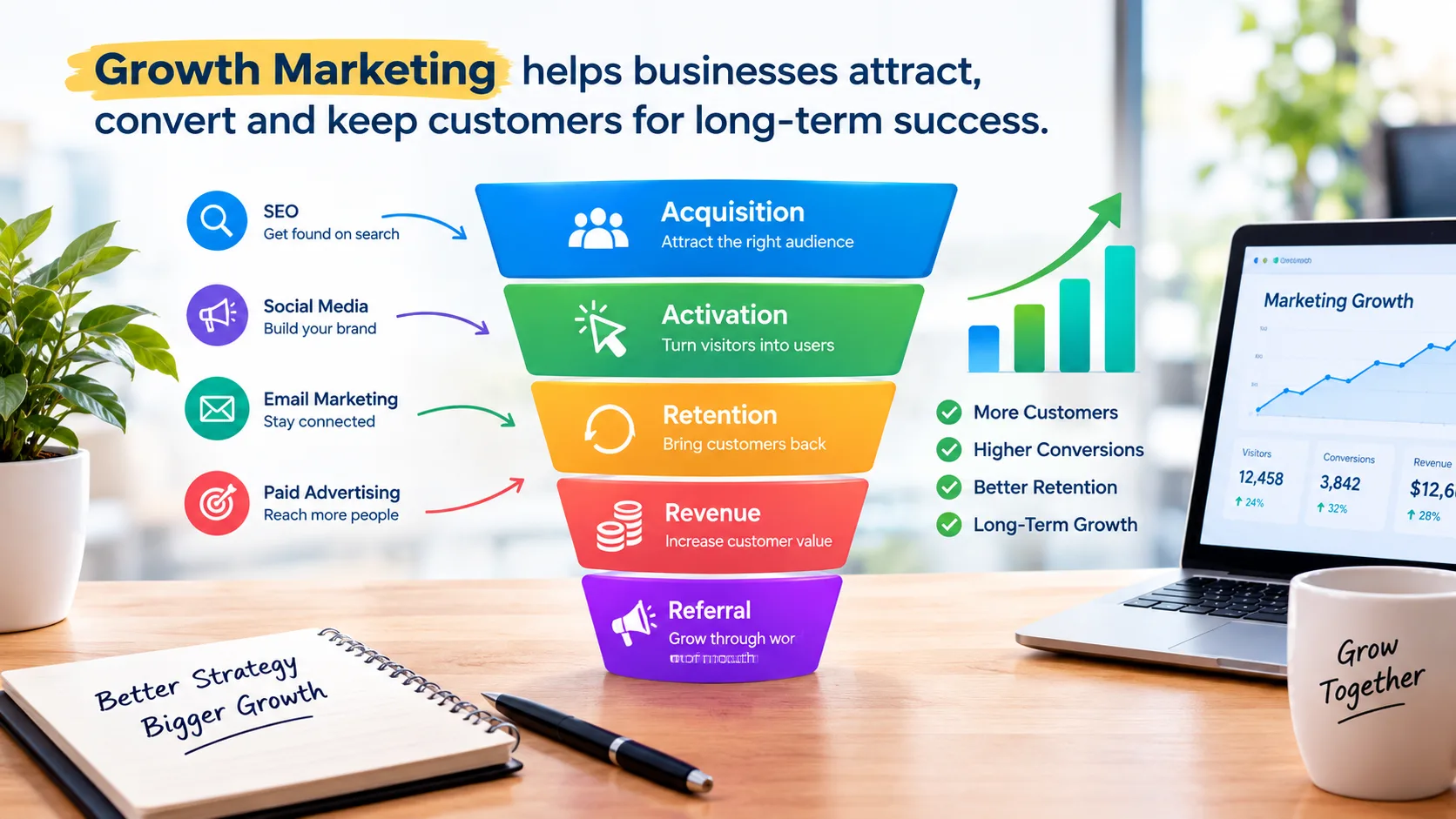
A growth-focused business may look at five important stages:
- Acquisition: Bringing potential customers to the business.
- Activation: Encouraging visitors to take an important first action.
- Retention: Giving customers reasons to return.
- Revenue: Increasing the value generated from customers.
- Referral: Encouraging satisfied customers to recommend the business.
For example, imagine an online clothing store. SEO and social media may bring visitors to the website. A better product page can encourage them to purchase. Email reminders can bring previous customers back, while a referral offer can encourage them to introduce friends.
This approach makes marketing more connected to actual customer behavior.
Growth marketing also depends heavily on measurement. Businesses can monitor metrics such as website traffic, conversion rate, customer acquisition cost, repeat purchases and customer lifetime value.
The goal is not simply to collect numbers. The goal is to use those numbers to understand what should be improved.
Growth Marketing vs Traditional Marketing: What Is the Difference?
Traditional marketing often focuses on reaching a large audience through channels such as television, newspapers, radio, outdoor advertising and broad promotional campaigns.
Growth marketing can use some of the same channels, but its approach is different. It focuses more heavily on testing, measurement and continuous improvement.
For example, a traditional campaign may promote a product through an advertisement and measure overall reach. A growth marketing team may go further by checking how many people clicked the advertisement, visited the website, completed a purchase and returned later.
Another difference is experimentation.
A business might test two landing pages with different headlines or calls to action. Google Analytics documentation describes A/B testing as comparing different versions to determine which performs better for a specific goal. Google Support
This means businesses can learn from customer behavior instead of making every marketing decision based only on assumptions.
Traditional marketing still has an important role in brand awareness and broad reach. Growth marketing simply adds a stronger focus on measurable customer actions and the complete funnel.
Key Growth Marketing Strategies Businesses Can Use
A strong growth marketing plan usually combines several strategies instead of depending on one channel.
1. Search Engine Optimization
SEO helps businesses reach people who are already searching for information, products or services.
Useful content, relevant service pages, technical SEO and internal linking can help create a stronger search presence. Google recommends using descriptive, crawlable links and relevant anchor text so users and search engines can better understand connected pages. Google for Developers
For businesses working on their online visibility, you can also explore our Digital Marketing Services.
2. Content Marketing
Helpful content can answer customer questions before they contact a business.
For example, a website development company can publish articles about website costs, website features and common development mistakes. This can attract people at different stages of the buying journey.
3. A/B Testing
A/B testing allows marketers to compare different versions of a page, advertisement, email or other customer experience.
For example, a business could test two different call-to-action buttons and measure which version generates more enquiries.
4. Conversion Rate Optimization
Getting visitors is only one part of marketing. Businesses also need to make it easy for visitors to take action.
Clear headings, simple forms, useful information, visible contact options and strong calls to action can improve the user journey.
5. Customer Retention
Growth is not only about finding new customers.
Businesses can use email marketing, loyalty programmers, useful updates, personalized offers and good customer support to encourage existing customers to return.
6. Referral Marketing
Satisfied customers can become another source of new customers. Referral programmers and positive customer experiences can encourage people to recommend a business to friends, family or colleagues.
Why Are Businesses Using Growth Marketing?
Businesses are using growth marketing because attracting a customer is only one part of building a sustainable business.
A company may receive thousands of visitors but still struggle if those visitors do not become leads or customers. Similarly, a business may acquire many customers but lose them quickly because the customer experience is poor.
Growth marketing looks at these different stages together.
One important benefit is better decision-making. Instead of spending money on every available marketing channel, businesses can analyze results and identify where their resources are producing useful outcomes.
Growth marketing can also help improve customer retention. For example, if a company notices that customers often stop using its service after the first purchase, it can investigate the reason and test different follow-up strategies.
Another benefit is continuous learning.
A campaign does not necessarily have to remain unchanged for months. Marketers can study performance, identify weak areas and test improvements.
For example:
Problem: Many people visit a website but do not submit the enquiry form.
Possible test: Make the form shorter and add a clearer call to action.
Measurement: Compare the conversion rate before and after the change.
Next step: Keep the change if the data supports it, or test another idea.
This process makes marketing more practical and measurable.
For businesses that need a stronger online foundation, a well-planned [website development service] Website Development Services can work alongside SEO and other growth activities.
Google also recommends people-first content and making important pages discoverable through links, which supports the role of useful content and good website structure in modern search visibility. Google for Developers
Practical Examples of Growth Marketing for Businesses
Growth marketing can be used by businesses of many sizes.
Example 1: Local Service Business
Suppose a local business receives website visitors but very few enquiries.
The business could check its analytics and identify where visitors leave. It might then test a clearer headline, better service information, a shorter contact form and a more visible WhatsApp button.
The aim is not simply to bring more visitors. It is to make existing traffic more useful.
Example 2: Online Store
An ecommerce business may receive many first-time customers but few repeat orders.
It could experiment with personalized product recommendations, email reminders, loyalty offers and post-purchase communication.
The business can then measure repeat purchases and customer behavior to understand which activities are useful.
Example 3: Mobile App
An app may receive many downloads but have low user engagement.
The team could examine the onboarding process and identify where users stop. It might then test a shorter registration process or clearer first-time instructions.
This is another example of how data, experimentation and customer experience work together.
Example 4: B2B Company
A B2B company may receive website traffic but very few qualified leads.
Instead of immediately increasing advertising spending, the company could improve service pages, publish useful industry content, simplify its enquiry process and test different calls to action.
This can help the business understand which improvements have the strongest effect on lead generation.
For businesses looking to content marketing, websites and digital growth, TZAP Marketing provides digital marketing and website-related solutions for businesses.
Conclusion: Why Growth Marketing Matters
So, what is growth marketing and why are businesses using it? It is a continuous approach that combines customer data, experimentation, marketing channels and customer experience to improve business growth.
Rather than focusing only on getting new customers, growth marketing looks at the complete journey—from the first visit to conversion, repeat business and referrals.
For a business, the most useful approach is to understand its audience, measure meaningful results, test realistic improvements and continue learning from customer behavior. This makes growth marketing a practical framework for businesses that want to build long-term digital growth.
Looking to improve your online growth? Connect with TZAP Marketing for SEO, websites, digital marketing and growth-focused digital solutions.
Frequently asked questions
What is growth marketing in simple words?
Growth marketing is a data-driven approach that helps businesses attract customers, improve conversions, retain customers and encourage referrals through continuous testing and improvement.
Is growth marketing the same as digital marketing?
No. Digital marketing covers online channels such as SEO, social media, email and paid advertising. Growth marketing focuses more broadly on improving the complete customer journey using data, experimentation and optimisation.
What are the main growth marketing strategies?
Common strategies include SEO, content marketing, A/B testing, conversion rate optimisation, customer retention, personalisation and referral marketing.
Why is customer retention important in growth marketing?
Retention matters because sustainable growth is not only about acquiring new customers. Businesses can also grow by encouraging existing customers to return, purchase again or recommend the brand.
Can small businesses use growth marketing?
Yes. Small businesses can start with simple activities such as SEO, useful content, analytics, customer feedback, conversion improvements and basic testing.
How does A/B testing help growth marketing?
A/B testing allows businesses to compare different versions of an experience and measure which one performs better against a specific goal.