Modern enterprises across the regional industrial belt are rapidly turning toward intelligent systems to outpace competition and eliminate daily operational friction. Partnering with a dedicated AI consulting company in Asansol empowers local manufacturers, traders, and service providers to modernize legacy processes safely. By aligning technical roadmaps with measurable business outcomes, an experienced AI consulting company in Asansol guides organizations through end-to-end digital transformation, unlocking sustainable profitability and operational resilience.
What Does an AI Consulting Company in Asansol Actually Do?
At its core, an advisory agency does not simply sell off-the-shelf software tools. It functions as a complete digital transformation partner, guiding companies through every stage of technological adoption—from diagnostic feasibility audits to production deployment and long-term governance.
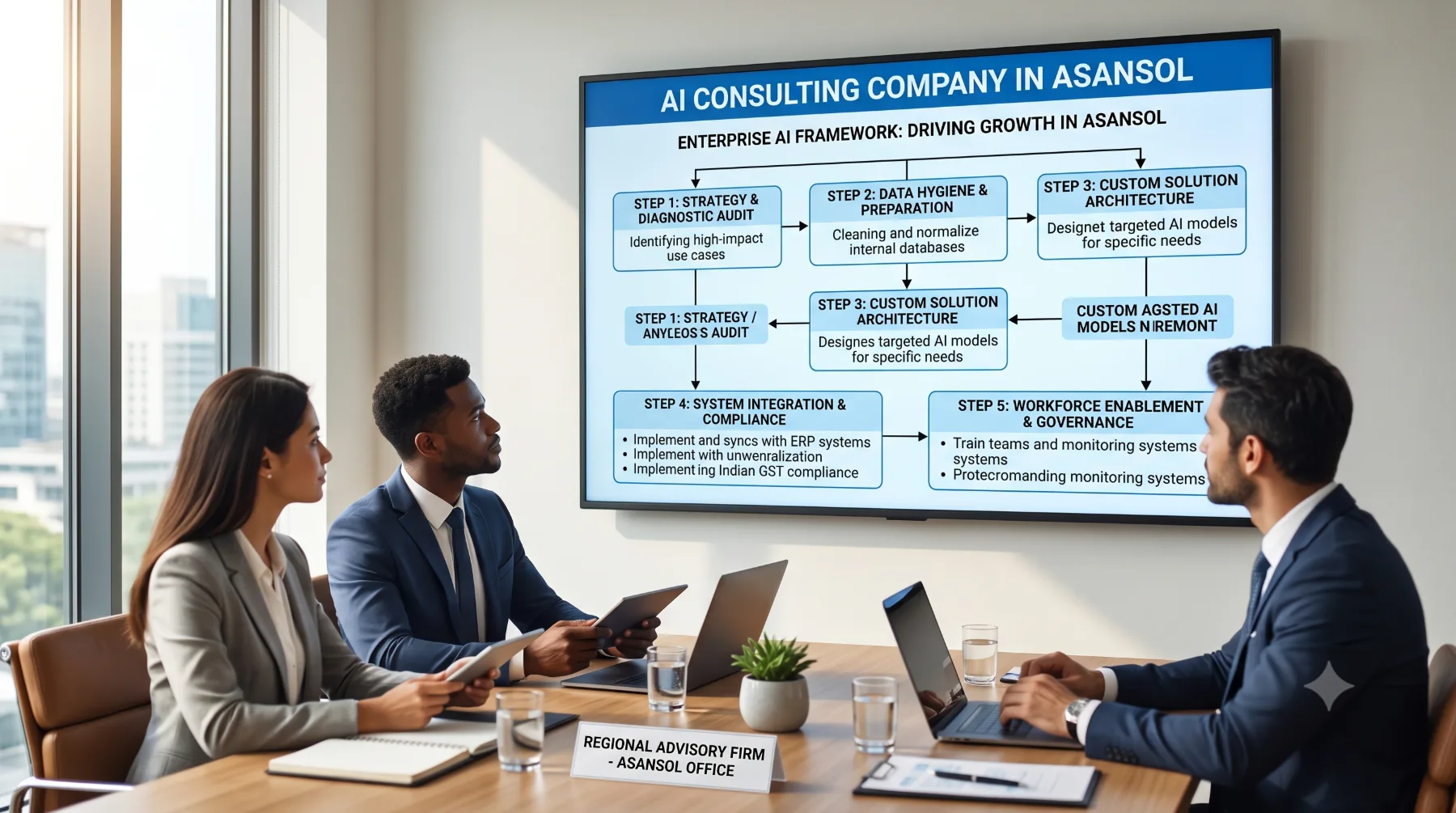
Many regional businesses know they need intelligent systems, yet they struggle to identify where machine learning delivers measurable financial returns versus where it creates unnecessary complexity. An experienced AI consulting company in Asansol eliminates this confusion through disciplined planning, architectural design, and localized technical implementation. The adoption journey generally moves through four continuous operational phases:
Strategic Discovery & Diagnostic Audit: The consulting team evaluates your business model, current software stack, and daily pain points to identify high-impact opportunities where artificial intelligence solves real operational problems.
Data Pipeline Engineering & Hygiene: Historical business records, database schemas, and daily transaction logs are cleaned, standardized, and structured so machine learning models receive accurate inputs.
Architecture & Solution Design: Advisors choose the right computational approach—such as local lightweight models or cloud-hosted platforms—customizing algorithms to your internal data and security standards.
Production Integration & Workforce Enablement: The finalized solution connects directly into legacy enterprise systems, paired with practical training programs to ensure your team operates the new tools with complete confidence.
Regional enterprises across West Bengal face unique ground realities: paper-based warehouse logs, standalone on-premises accounting applications, unorganized customer databases, and mixed digital literacy among operational teams. A dedicated advisory team evaluates these legacy environments, cleans historical data pipelines, selects appropriate computational models, and connects modern intelligence directly into daily commercial workflows.
Formulating an Actionable AI Strategy for Business Growth
Every successful technological investment begins with business objectives rather than raw code. Without an actionable operational roadmap, digital initiatives often stall in endless experimental phases. Comprehensive AI consulting services begin by anchoring leadership goals to clear, measurable commercial milestones.
Feasibility and Technical Readiness Audits
Advisors evaluate existing workflows to see whether operational bottlenecks stem from simple organizational gaps or truly demand advanced machine learning. This objective audit ensures businesses avoid overspending on complex neural networks when streamlined process engineering is all that is required.
ROI-Driven Use Case Prioritization
Not all operational workflows offer equal returns when upgraded with intelligent systems. An experienced consultancy structures projects using a prioritized impact matrix:
Immediate High-Value Targets: Document data extraction, automated billing reconciliation, customer ticket categorization, and energy monitoring.
Medium-Term Strategic Projects: Plant-level predictive maintenance, real-time demand forecasting, and inventory optimization.
Low-Yield Concepts: Replacing working deterministic software with unpredictable generative algorithms unnecessarily.
Technology Stack and Infrastructure Architecture
Consultants recommend appropriate deployment options—ranging from private cloud environments to local on-premise hardware—balancing latency requirements, data security, and budget limits. They guide leadership through the trade-offs of lightweight open-source models versus managed enterprise APIs according to global industry benchmarks published by Gartner.
Change Management and Team Upskilling
True digital transformation reshapes daily staff responsibilities. A practical AI strategy outlines structured employee training, establishes human-in-the-loop validation, and institutes governance frameworks that keep algorithmic decisions transparent, compliant, and accountable.
Driving Business Automation Across Everyday Workflows
Manual, repetitive tasks drain productive hours and introduce human error into everyday reporting. Modern business automation goes far beyond legacy scripts by embedding cognitive decision-making into organizational pipelines.
Traditional automation relies on rigid rule-based pathways. If an input deviates slightly—such as a blurred scanned invoice, a non-standard order sheet, or an unstructured customer email—the script crashes. Cognitive business automation interprets varied formats, extracts essential metadata, and acts safely without requiring constant manual intervention.
Automated Document Processing
Using optical character recognition (OCR) and document understanding models, organizations can ingest vendor invoices, shipping manifests, and order forms in seconds. Data is extracted and verified before syncing with ERP ledgers, drastically reducing processing costs.
Intelligent Operational Communications
Modern enterprises implement automated conversational systems that handle multi-channel client inquiries, issue dynamic order status reports, and route complex service tickets to the correct team members. For creative, marketing, and training workflows, companies are pairing communication tools with top-tier creative engines like the Best AI Video Generator 2026 to produce internal guides and customer marketing materials at scale.
Bridging Modern AI with Web and Legacy Systems
Algorithms cannot deliver commercial value in isolation; they must interact directly with customer-facing portals and core databases. Partnering with a reliable Website Development Company in Asansol ensures that your web platforms, client portals, and back-office applications are architected to exchange data seamlessly with your automated intelligence pipelines.
Unlocking Hidden Value with Data Analysis and Predictive Modeling
Every operational business accumulates data daily, from inventory logs and point-of-sale receipts to machinery maintenance records. Unfortunately, most of this information sits untouched in isolated silos. Professional consultants convert static historical records into forward-looking operational intelligence.
| Analytical Dimension | Traditional Business Intelligence | AI-Driven Predictive Analytics |
|---|---|---|
| Analytical Dimension | ||
| Operational Perspective | Historical reporting (What were last quarter's sales?) | Forward forecasting (What inventory will be required next month?) |
| Data Diversity | Uniform tables and clean relational databases | Mixed data: scanned PDFs, machine sensor feeds, unstructured text |
| Decision Speed | End-of-month manual reviews and static summaries | Live, automated alerts triggered in real time |
| Anomaly Detection | Fixed threshold alerts that frequently cause alert fatigue | Adaptive baseline pattern recognition that flags true deviations |
Predictive data modeling allows wholesale distributors and retailers to forecast stock requirements accurately, freeing up locked working capital. In heavy industrial setups, predictive models monitor vibration, thermal, and electrical metrics from factory machinery to identify equipment fatigue days before catastrophic mechanical failure occurs.
End-to-End Implementation, Compliance, and System Integration
Transforming a conceptual prototype into a dependable production tool requires disciplined engineering. A competent partner oversees data preparation, middleware architecture, secure API connections, and thorough load testing.
The integration architecture follows three critical structural tiers:
Tier 1: Enterprise Data Sources and Records: Ingesting live feeds from local billing setups, enterprise resource planning databases, warehouse spreadsheets, point-of-sale machines, and plant sensors.
Tier 2: Intelligent Middleware and Security: Sanitizing data in real time, validating data schemas, running secure model inference endpoints, and applying strict role-based access control.
Tier 3: Operational Interfaces: Delivering real-time inventory adjustments, auto-reconciled ledgers, dispatch alerts, and executive decision dashboards directly to business owners.
Navigating Digital Compliance and Tax Regulations
Deploying intelligent billing systems, automated invoice readers, and automated cross-border e-commerce solutions introduces regulatory obligations. Digital billing systems must adhere strictly to statutory tax frameworks. Understanding How GST Affects Digital Businesses in India ensures your automated transactional pipelines generate legally compliant, audit-ready invoices without creating unexpected tax liabilities.
Cost Factors in Deploying AI Solutions in Asansol
Budgeting for advanced technologies requires balancing upfront setup expenses against sustained productivity gains. Deploying customized AI solutions in Asansol involves distinct cost drivers that depend heavily on organizational maturity and project complexity.
Scope and Algorithmic Complexity
Configuring existing, pre-trained enterprise models for administrative tasks (such as automated customer routing or invoice ingestion) requires considerably less capital than building custom computer-vision networks for physical manufacturing inspection.
Data Cleanliness and Preparation
If internal records exist primarily in physical filing cabinets or fragmented, duplicate-heavy spreadsheets, substantial preliminary effort must go into data sanitization, schema normalization, and database structuring before any predictive model can run reliably.
Compute Infrastructure and API Fees
Cloud-hosted deep learning models and high-frequency API calls incur recurring monthly operational fees. On the other hand, deploying open-weight models on dedicated local servers involves higher initial hardware investments but yields predictable, minimal ongoing costs.
Personnel Training and Ongoing Maintenance
A complete implementation budget must account for upskilling staff, setting up supervisory controls, and establishing technical support arrangements to monitor model drift and ensure ongoing operational accuracy.
Practical Business Benefits for Regional Enterprises
Companies that work with specialized consultants realize substantial, long-term commercial returns:
Sustained Operational Efficiency: Automating high-volume administrative tasks significantly lowers manual processing costs per transaction.
Higher Decision Velocity: Leadership acts on live predictive trends rather than outdated historical reports, adapting instantly to market fluctuations.
Accelerated Time-to-Market: Standardized deployment frameworks help enterprises launch digital features and automated services in weeks instead of quarters.
Decreased Operational Risk: Continuous monitoring models flag mechanical anomalies, billing irregularities, and logistical delays before they become costly emergencies.
Local Market Competitiveness: Deploying enterprise-grade automation allows regional mid-market businesses to compete effectively against national conglomerates on operational speed and service quality.
Conclusion
Transitioning into an intelligent, data-driven organization does not require rebuilding company infrastructure from the ground up overnight. It begins with identifying clear operational friction, validating a targeted use case, and deploying scalable software systems with measurable milestones. Selecting a knowledgeable
AI consulting company in Asansol provides your business with the strategic vision, local accessibility, and engineering rigor needed to implement technology responsibly. By grounding digital adoption in practical business objectives, modern enterprises can optimize their workflows, empower their workforce, and ensure sustainable market growth for decades to come.
Frequently asked questions
Why should my business hire an AI consulting company in Asansol instead of using off-the-shelf AI tools?
Off-the-shelf tools provide generic functionality but lack integration with your specific workflows, local compliance rules, and legacy ERP systems. An advisory company tailors algorithms to your unique data, trains your internal team, and ensures your deployment delivers measurable financial ROI.
How long does a typical AI implementation take for an SME?
A focused pilot project or automated workflow typically takes 4 to 8 weeks from audit to deployment. Comprehensive enterprise-wide implementations involving predictive analytics, legacy database migration, and customized models generally take between 3 to 6 months.
Do we need to move all our business data to the cloud to use AI?
No. Depending on your data privacy policies and budget, modern solutions can run on-premise using dedicated local server hardware, in a private hybrid cloud, or via secure edge devices directly on the factory floor.