Are you tired of sifting through pages of cluttered links just to find a single straightforward answer? In this comprehensive 2026 review, we break down the best AI search engines—benchmarking Google AI Overviews, Perplexity AI, and ChatGPT Search across live accuracy, citations, research depth, and everyday search scenarios.
Traditional Link-Based Search vs Modern Answer Engines
For more than two decades, web search operated on a predictable, mechanical loop. You typed disjointed keywords into an input box, an algorithm indexed relevant HTML pages, and a server returned the familiar "ten blue links."
While effective in the early web era, this model offloaded all cognitive labor onto the user. You were forced to open half a dozen browser tabs, manually skim through aggressive advertisements and SEO filler, verify conflicting dates, and piece together your own synthesis.
In contrast, an intelligent best AI search engine functions as an active answer engine. Instead of acting as an index directory, it leverages Retrieval-Augmented Generation (RAG). When a user enters a complex query, the system simultaneously browses the live web, extracts pertinent text chunks from authoritative domains, evaluates consensus across multiple publishers, and composes a coherent, human-readable brief.
The primary advantages of modern answer engines include:
Retrieval-Augmented Generation (RAG): Rather than hallucinating from outdated static weights, modern engines ground their responses in live web crawls conducted in milliseconds.
Instant Synthesis: Multiple viewpoints, numerical datasets, and step-by-step troubleshooting workflows are merged into unified summaries and clean comparison tables.
Granular Inline Attribution: Every factual claim is tethered to a direct, clickable citation link, making fact-checking immediate and verifiable.
Interactive Dialogue Continuity: If an initial summary requires clarification, users can ask follow-up questions without restarting the search or re-explaining the context.
As online workflows expand, modern internet users regularly combine answer engines with specialized creation platforms—from automating visual production with the Best AI Video Generator 2026 to drafting technical documentation and conducting institutional research.
Comprehensive Benchmark: Top AI Search Engines Compared
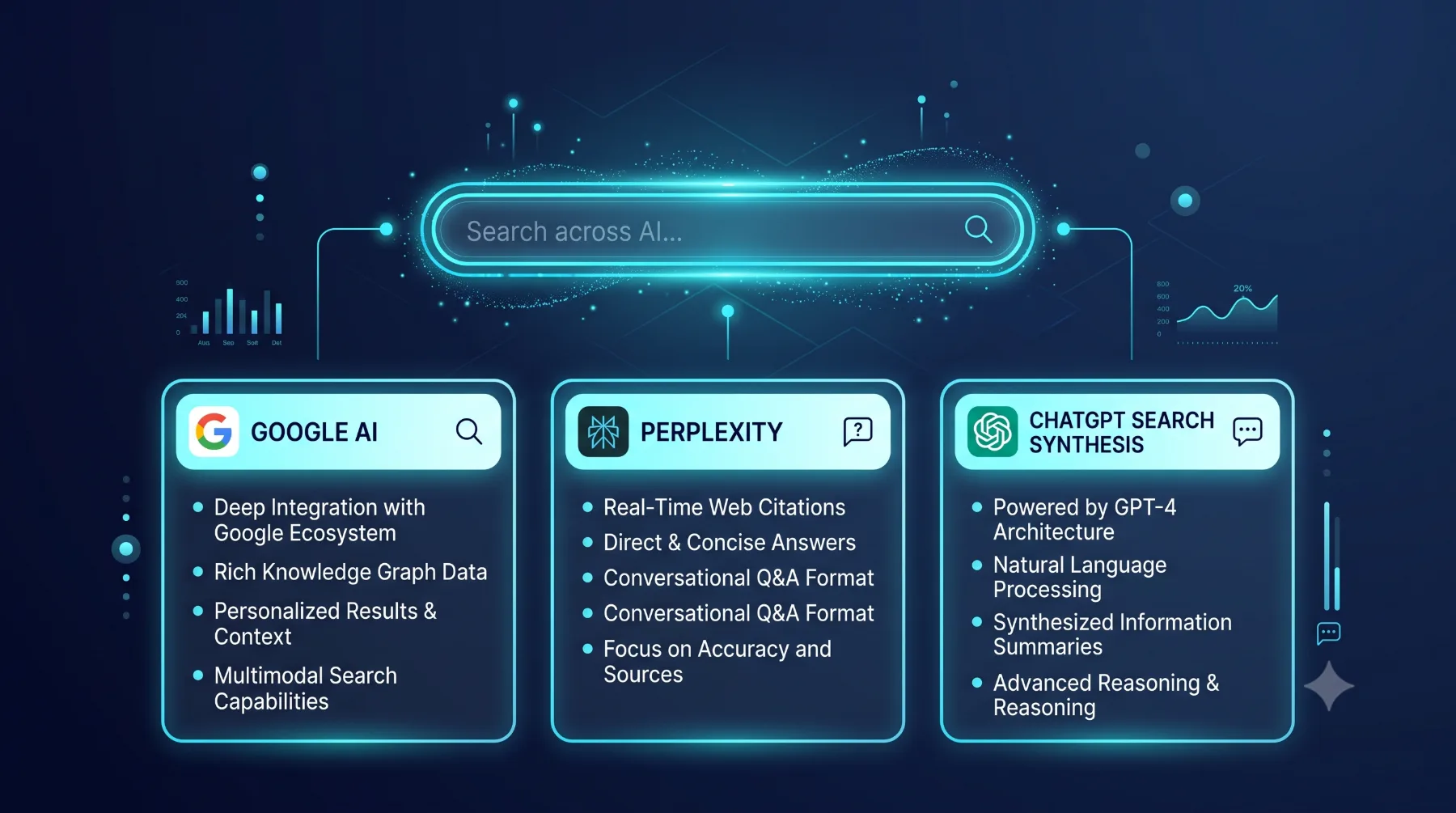
To understand where each platform excels, we evaluated the three dominant market contenders across architecture, citation transparency, search intent, and platform constraints.
| Feature & Metric | Google (AI Overviews & AI Mode) | Perplexity AI | ChatGPT Search |
|---|---|---|---|
| Feature & Metric | |||
| Primary Architecture | Full Google web index + Gemini synthesis layer | Live multi-source RAG engine + dedicated index | Selective GPT web routing via OAI-SearchBot |
| Citation Methodology | Expandable SERP chips & Knowledge Graph cards | Exact, numbered inline footnote citations | Clickable footnote links with side-panel previews |
| Real-Time Freshness | Unmatched sub-minute crawling & news indexing | Continuous web grounding with dynamic recency weighting | High-accuracy retrieval, activated selectively on query intent |
| Local Search & Mapping | Native Google Maps, live foot traffic, reviews | Basic web scraping, third-party directory mentions | General web aggregation, external map provider snippets |
| Academic & Data Rigor | Broad media index, consumer-focused summaries | Dedicated Academic Mode (arXiv, PubMed, Semantic Scholar) | Strong conceptual explanation, less granular citation trails |
| Free Access Model | Built into default Google Search interface | Robust free tier; Pro tier for multi-model access | Integrated free access; Plus subscription for heavy usage |
In-Depth Scenario Testing & Real-World Performance
Evaluating an AI search engine requires testing it against distinct, high-friction user intents. We stress-tested Google AI, Perplexity, and ChatGPT Search across four fundamental categories.
Breaking News, Live Events, and Real-Time Information
When news breaks, web crawling speed and factual deduplication matter above all else.
Google AI remains the undisputed industry leader for instant information retrieval. Because its crawlers touch billions of pages continuously, Google can reflect live cricket scores, election results, financial market movements, and sudden natural events within seconds.
Perplexity AI performs admirably for developing news stories. Rather than simply pulling the newest headline, it scans multiple international and regional outlets, recognizes emerging consensus, and explicitly flags unverified claims.
ChatGPT Search handles real-time news reliably when its browsing agent triggers, though it occasionally exhibits a 15-to-30-minute latency window on rapidly changing events compared to Google's immediate infrastructure.
Deep Academic Research & Citation Transparency
For academic researchers, university students, and policy analysts, source verifiability is non-negotiable.
Perplexity AI takes top honors in this category. Its Academic Focus Mode bypasses content farms and directly queries scientific repositories, pre-print archives, and institutional publications. Every statement is pinned to a numbered reference that users can hover over to see exact quotes.
ChatGPT Search is exceptionally skilled at explaining dense academic papers, translating complex mathematics into plain language, and restructuring scientific methodology into code. However, its citation density is lower, frequently citing high-level hub pages rather than exact page paragraphs.
Google AI Overviews tend to favor broad consumer media outlets, digital encyclopedias, and high-DA lifestyle sites, which makes them less suitable for peer-reviewed technical research.
Shopping, Commercial Intent, and Business Research
Commercial queries require real-time pricing data, return policy breakdowns, and product availability.
Google’s direct integration with the Google Merchant Center gives it an unassailable advantage. A search for consumer hardware surfaces verified retailer inventory, immediate delivery windows, regional pricing variants, and merchant reviews right within the AI summary.
Business queries also require financial precision. For instance, digital service providers evaluating cross-border platforms or software licenses often need to assess regulatory implications like How GST Affects Digital Businesses in India. Similarly, regional organizations looking to modernize their web presence regularly rely on established local agencies, such as a Website Development Company in Asansol, to ensure scalable, search-compliant technical foundations.
Local Search, Navigation, and Geo-Intent
Local intent is the sharpest differentiator between native search infrastructure and conversational wrappers.
If you search for "authorized laptop repair centers open now" or "24-hour diagnostic labs nearby," Google AI delivers actionable local intelligence. It correlates live GPS data, verified business hours from Google Business Profiles, user-uploaded storefront imagery, and direct directions via Google Maps.
Perplexity and ChatGPT Search fall behind here: they can list well-known local recommendations by scraping review aggregator sites, but they cannot provide live route guidance, real-time table booking status, or accurate operating hours.
Google vs AI Search: The Shift in Consumer Behavior
The rise of conversational search has fundamentally reshaped user habits and web economics:
From Keywords to Natural Prompts: Users no longer type fragmented strings such as
best lightweight running shoes flat feet 2026 review. Instead, they query engines conversationally: "I have flat feet and run 5 km daily on pavement. What cushioned shoes under $130 will prevent shin splints?"The Demand for Source Provenance: As generative hallucinations remain a risk in large language models, research from bodies like the Pew Research Internet Project indicates that modern users actively gravitate toward platforms that display clear source citations alongside factual claims.
The Reality of Zero-Click Search: As answer engines solve transactional and informational questions on the primary results page, organic click-through rates to generic web publishers continue to decline, forcing content creators to produce deeper, primary-source analysis.
Conclusion
If your daily work involves deep-dive research, academic verification, competitive intelligence, and verifiable source gathering, Perplexity AI is the clear winner. If you want a flexible workspace where search seamlessly converts into outlines, computer code, business correspondence, and creative drafts, ChatGPT Search delivers the most integrated workflow.
Finally, for real-time breaking news, local navigation, retail price comparisons, and everyday casual queries, Google AI remains the most ubiquitous and context-rich foundation on the web. Using a combination of these platforms tailored to your tasks ensures you maximize speed, depth, and factual accuracy in the modern AI-driven internet.
Frequently asked questions
What is the best AI search engine for academic research?
Perplexity AI is widely regarded as the premier AI engine for academic and technical research. Its dedicated Academic Focus Mode crawls peer-reviewed repositories like PubMed and arXiv, backing assertions with clickable, numbered inline citations.
Is ChatGPT Search completely free to use?
Yes, OpenAI provides web search functionality to free-tier ChatGPT users. However, subscribers to the Plus tier benefit from significantly higher rate limits, faster inference speeds, and access to more complex analytical reasoning models.
How does Google AI Overview differ from traditional Google Search?
Traditional Google Search provides a ranked list of links and sponsored ads, requiring users to open individual pages. Google AI Overviews read top-ranking documents across the web and deliver a unified, synthesized answer directly at the top of the search engine results page.
Can AI search engines hallucinate false information?
Yes. Large language models can occasionally state inaccurate claims with high linguistic confidence. Because of this, reliable AI search engines incorporate direct inline citations, allowing readers to independently verify quotes, numbers, and dates against original publisher documents.