Social media advertising helps businesses reach potential customers, build brand awareness, and generate leads. However, poor audience targeting, weak ad content, and limited performance tracking can reduce campaign results and waste advertising budgets.
AI can help businesses analyze audience data, identify useful patterns, improve ad creatives, personalize messages, and track campaign performance. By using these capabilities, marketers can make better decisions and improve their social media advertising over time.
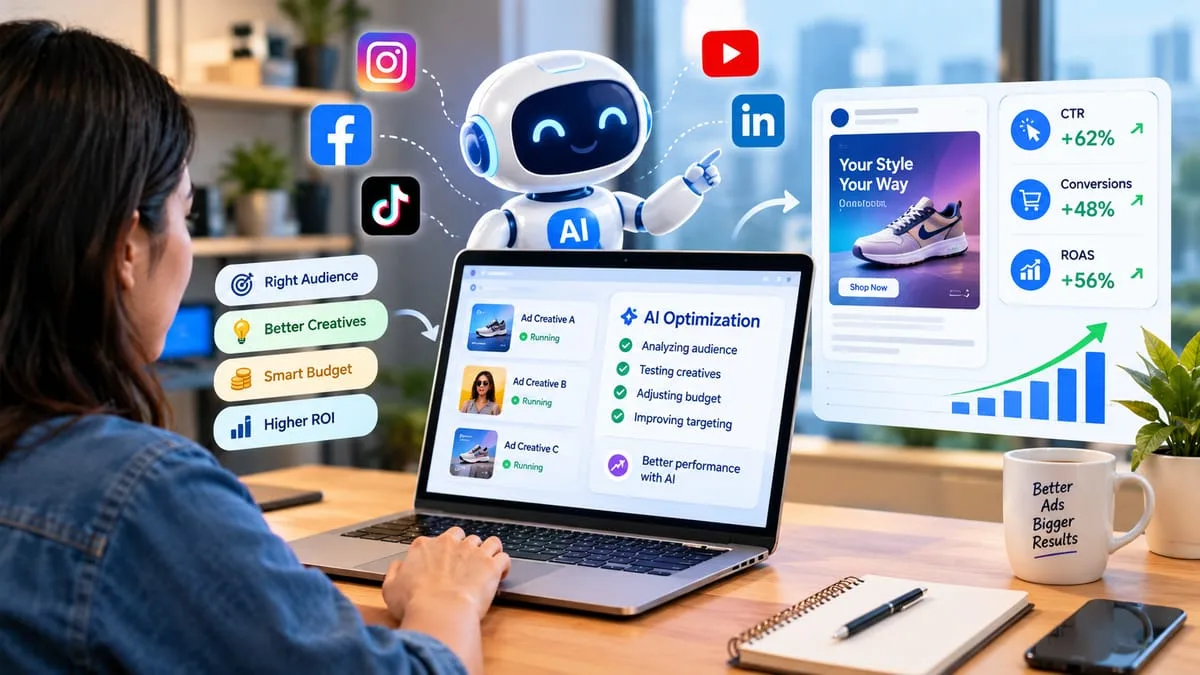
How Does AI Improve Social Media Advertising?
AI helps businesses make social media advertising more data-driven and efficient. It can analyze audience behavior, test different ad creatives, personalize messages, support budget decisions, and track campaign performance. This allows marketers to understand what works and make better decisions without relying only on assumptions.
Better Audience Analysis
AI can analyze audience data to identify patterns in interests, behaviour, interactions, and engagement. These insights help businesses create more focused audience segments and show relevant advertisements to potential customers.
Smarter Creative Testing
AI can help marketers create and compare different versions of an advertisement. Businesses can test different headlines, images, videos, calls to action, and messages to understand which creative gets better responses.
Personalized Ad Messaging
AI can help businesses create more relevant messages for different audience groups. For example, new customers may need educational content, while existing customers may respond better to product updates or offers.
Better Budget and Performance Decisions
AI can analyze campaign performance and help marketers identify which audiences, creatives, or campaign elements are performing better. These insights can support smarter advertising budget decisions.
Faster Performance Analysis
AI can quickly analyze campaign data and highlight important changes in clicks, engagement, conversions, and other metrics. This helps marketers understand campaign performance and focus more on strategy.
Common Social Media Marketing Mistakes That Reduce Ad Performance
Before using AI, it is important to understand the problems that can affect social media marketing results. Many campaigns fail not because the product or service is weak, but because the marketing process is not planned properly.
A successful social media ad campaign depends on several connected factors, including the right audience, useful content, consistent communication, engagement, and performance measurement. If one of these areas is ignored, advertising results can become difficult to improve.
Inconsistent Posting and Campaign Activity -
One common mistake is posting content without a consistent schedule. A business may publish several posts in one week and then remain inactive for the next few weeks. This can make the brand appear less active and can make it harder to maintain regular communication with its audience.
Consistency does not mean posting randomly every day. It means creating a realistic content schedule and following it. AI-powered social media tools can help marketers plan content calendars, identify suitable posting times, and organize different types of content in advance.
For example,
a business can use AI to create a weekly plan that includes educational posts, product updates, customer-focused content, short videos, and promotional messages. This creates a balanced content strategy instead of repeatedly publishing the same type of post.
Poor Audience Targeting -
Another major mistake is showing advertisements to people who are unlikely to be interested in the product or service. A campaign can have attractive content and a reasonable budget but still produce weak results if it reaches the wrong audience.
AI can help marketers analyze audience behavior, interests, demographics, previous interactions, and other available campaign signals. These insights can help businesses understand which types of users are more likely to engage with their content or take a desired action.
Instead of targeting a broad audience without a clear reason, marketers can use data to create more relevant audience segments. For instance, an online clothing business may identify different groups based on product interests, previous website activity, or engagement with specific content.
Low-Quality or Irrelevant Content -
Good targeting cannot completely solve the problem of poor content. Users see a large amount of content on social platforms every day, so advertisements need to communicate their message clearly and quickly.
Low-quality images, confusing copy, weak headlines, and repetitive promotional posts can reduce user interest. AI can support the creative process by suggesting content ideas, headlines, captions, variations of ad copy, and different messaging angles.
However, AI should support human creativity rather than completely replace it. Marketers should review AI-generated content to make sure that the message matches the brand voice, customer expectations, and campaign objective.
Ignoring Audience Engagement -
Some businesses treat social media as a one-way advertising channel. They publish a post or advertisement but do not pay enough attention to comments, questions, shares, or other forms of audience interaction.
Engagement provides useful information about what customers think and what they want to know. A repeated question in the comments, for example, may reveal that customers need more information about pricing, delivery, product features, or availability.
AI can help organize and analyze large amounts of engagement data. It can identify frequently discussed topics and highlight patterns that may otherwise take a marketer a long time to discover Businesses can then use these insights to improve future content and advertising messages.
Using Irrelevant Hashtags -
Hashtags can help organize and discover content, but using a large number of unrelated hashtags does not automatically improve reach. Businesses sometimes add popular hashtags simply because they appear frequently on social platforms, even when those hashtags have little connection with the content.
A better approach is to use hashtags that are relevant to the topic, industry, product, or target audience. AI can help generate hashtag ideas and group them according to different content themes. Marketers should still review these suggestions and select hashtags that genuinely match the post.
The goal should be relevance rather than simply using as many hashtags as possible.
Not Tracking Results -
One of the biggest mistakes is running campaigns without regularly checking performance. Without tracking results, marketers may continue spending money on advertisements that are not meeting their objectives.
Important metrics can include impressions, reach, clicks, engagement, click-through rate, conversions, cost per result, and return on advertising spend, depending on the campaign goal.
AI can help analyze these metrics and identify patterns. Instead of manually checking every number, marketers can use automated reports and dashboards to understand which campaigns, audiences, creatives, or messages are performing differently.
Practical Tips to Avoid Social Media Marketing Mistakes
AI can improve the marketing process, but businesses still need a clear strategy. The following practices can help reduce common mistakes.
Create a Consistent Content Calendar -
Plan content before publishing it. Decide how often the business can realistically post and maintain that schedule. Use different content formats, such as educational posts, videos, customer stories, product information, and promotional content.
AI can help generate ideas and organize the calendar, but the final content should remain relevant to the audience.
Define the Target Audience Clearly -
Do not begin advertising without understanding who the campaign is designed for. Consider customer needs, interests, problems, buying behavior, and the type of solution the business provides.
Use AI-generated insights as supporting information rather than treating them as the only source of audience research.
Focus on Useful Content -
Every advertisement or social media post should have a clear purpose. It may educate, solve a problem, demonstrate a product, answer a common question, or encourage an action.
Avoid creating content simply because there is a need to post something. Quality and relevance are more important than producing content without a clear objective.
Respond to Engagement -
Monitor comments, messages, reactions, and questions. Engagement can reveal what customers like, what they find confusing, and what information they need.
Businesses should use these conversations as feedback for future content and campaigns.
Use Relevant Hashtags -
Choose hashtags that directly relate to the topic, industry, product, or audience. Avoid adding unrelated popular hashtags simply to increase visibility.
A smaller set of relevant hashtags can be more useful than a long list that has little connection with the content.
Track the Right Metrics -
Choose metrics based on the campaign objective. If the goal is awareness, reach and impressions may matter more. If the goal is website traffic, clicks and click-through rate can be important. For lead generation or sales, conversions and cost per result become more relevant.
Review performance regularly and compare results over time instead of judging a campaign from one day's data.
Use AI as a Marketing Assistant Not a Replacement
The most effective approach is to combine AI capabilities with human judgment. AI can process data quickly, identify patterns, generate ideas, and automate repetitive work. However, marketers understand the brand, customer emotions, business goals, and market context in ways that automated tools may not fully understand.
Before publishing AI-assisted content, check the accuracy, tone, originality, and relevance of the message. The final advertisement should sound natural and align with the brand's identity.
Businesses should also avoid making every decision based only on short-term performance. Some content may support brand awareness or customer trust even when it does not immediately produce a conversion.
Conclusion
AI can make social media marketing more organized, efficient and data-driven. It can help businesses understand their audiences, create better content variations, analyze engagement, test advertisements, and monitor campaign performance. At the same time, marketers need to avoid common mistakes such as inconsistent posting, poor targeting, low-quality content, irrelevant hashtags, ignored engagement, and weak performance tracking.
A successful social media ad campaign is not simply about using AI tools or increasing advertising spend. It requires the right audience, useful content, clear objectives, continuous testing, and regular analysis. When AI is combined with human creativity and marketing judgment, businesses can make smarter decisions and build campaigns that provide better experiences for their audiences while using their resources more effectively.
Frequently asked questions
How does AI optimize a social media ad campaign?
AI optimizes a social media ad campaign by analyzing audience data, improving targeting, testing ad creatives, and identifying performance patterns.
Can AI improve social media ad targeting?
Yes, AI can analyze audience behavior, interests, and engagement patterns to help businesses target more relevant users with their social media ads.
How does AI help improve ad performance?
AI can compare different creatives, analyze campaign metrics, identify weak areas, and provide insights that help marketers improve ad performance.
Can AI create social media ad content?
Yes, AI can generate ad copy, captions, headlines, content ideas, and creative variations. Marketers should review the content before publishing it.
How can AI help with social media audience analysis?
AI can analyze user interactions and campaign data to identify audience patterns, preferences, and segments that may respond better to specific marketing messages.
What social media ad metrics can AI analyze?
AI can help analyze metrics such as reach, impressions, clicks, engagement, click-through rate, conversions, and cost per result.
Can AI reduce social media advertising costs?
AI can help identify inefficient campaigns, improve audience targeting, and support better budget decisions, which may help businesses use their advertising budget more effectively.