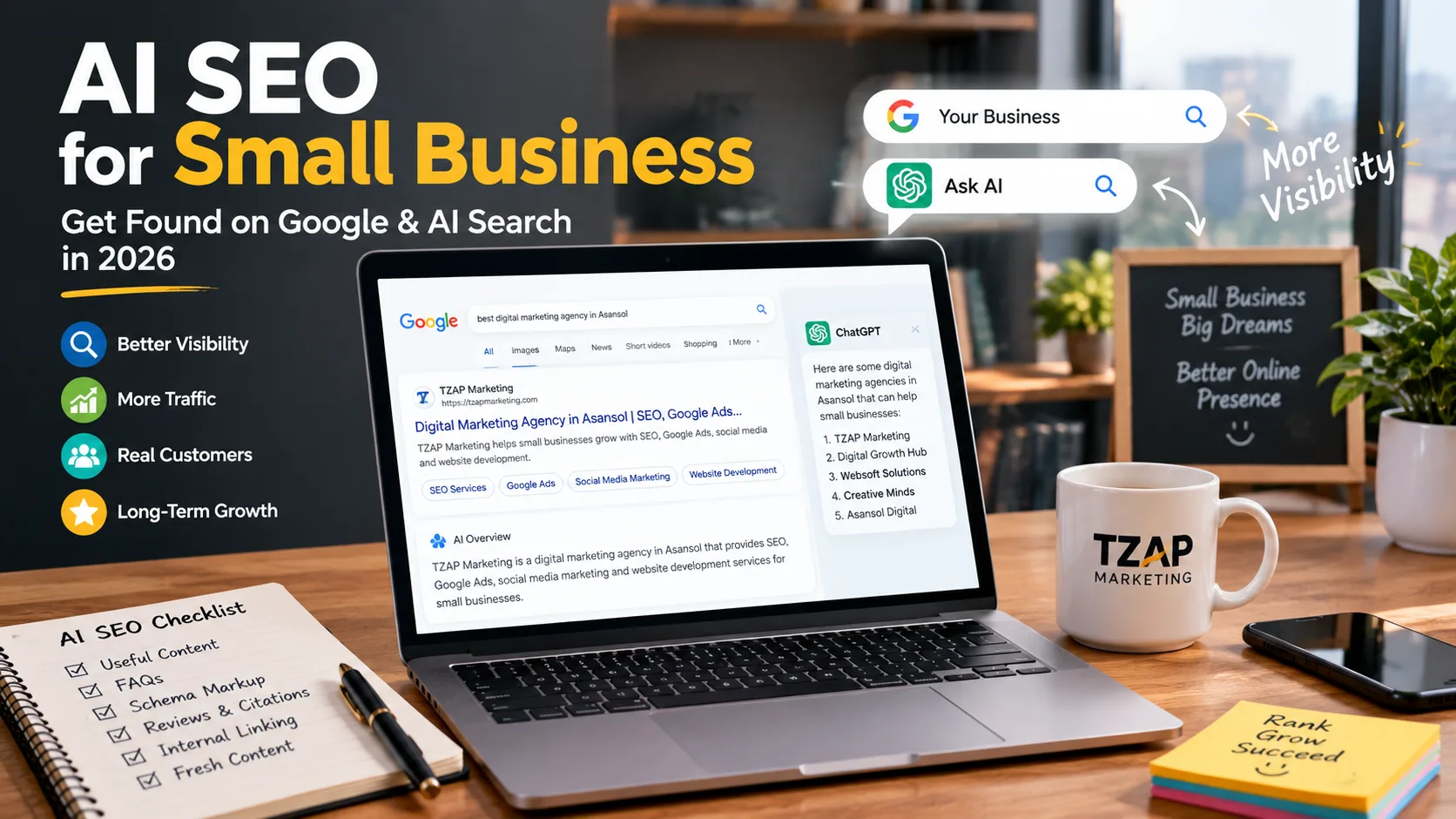
1. What Is AI SEO for Small Business?
AI SEO for Small Business means making your website easy to understand for both Google and AI search tools.
Traditional SEO helps search engines understand your website.
AI SEO also focuses on helping AI understand:
What your business does
What services you offer
Who your customers are
What questions customers ask
Where your business works
What information is available about your business online
For example, one person may search:
“Digital marketing agency in Asansol”
Another person may ask an AI tool:
“Which digital marketing agencies in Asansol help small businesses?”
The questions are different, but both need clear and useful information.
The simple goal of AI SEO is to make your business easy for people, Google, and AI search tools to understand.
2. Why AI SEO Matters for Small Businesses
Small businesses often compete with bigger companies with larger websites and bigger marketing budgets.
But you do not need hundreds of pages to build a strong online presence.
Focus on what your customers actually want to know.
Good SEO for AI search helps your website clearly explain:
🏢 What your business does
👥 Who you serve
📍 Where you work
🛠️ What services you offer
⭐ What makes you different
📞 How customers can contact you
🤝 Why customers can trust you
The goal is simple:
make your website clear, useful, and trustworthy for both people and search systems
3. AI SEO vs Traditional SEO
AI SEO does not replace traditional SEO.
Think of it in a simple way:
Traditional SEO
→ Helps search engines find, understand, and rank your pages.
AI Search Optimization
→ Helps AI-powered search systems understand your business and content so they can use relevant information when answering users.
The good thing is that many SEO practices help both.
| SEO Area | Traditional Search | AI Search |
|---|---|---|
| Useful content | Important | Important |
| Search intent | Important | Important |
| Clear business information | Important | Important |
| Internal links | Important | Useful |
| Structured data | Useful | Helps machines understand information |
| Original experience | Important | Important |
| Reviews | Useful | Useful for trust and local context |
| Fresh content | Useful | Useful when information changes |
| Clear FAQs | Useful | Useful for answering questions |
So, you do not need to create a completely different SEO strategy for AI search.
Start with the basics: create useful content, explain your business clearly, answer customer questions, and keep your information updated.
4. Start With Search Intent and Customer Questions
Search intent means what a person really wants when they search.
For example, imagine you provide website development services.
Someone searches:
“How much does a website cost?”
They probably want pricing information.
Another person searches:
“Website development company in Asansol”
They may be looking for a service provider.
Someone searches:
“How to make a business website?”
They probably want a guide.
These searches have different purposes.
Your content should match what the person wants.
Use Helpful FAQs
FAQs are another simple way to answer real customer questions.
For example, a website development page could answer:
How much does a business website cost?
The cost can depend on the number of pages, design, features, integrations, and development work.
Will the website work on mobile?
A modern website should work properly on common screen sizes, including phones, tablets, and computers.
Can I update the website later?
That depends on the platform and development setup. For example, WordPress websites can usually be managed through a content management system.
The important thing is to give a useful answer.
Do not add FAQs just to repeat keywords.
5. Make Your Business Easy to Understand
Your website should not make visitors guess what your business does.
Keep important business information clear.
Include:
- Business name
- Main services
- Location or service area
- Who you help
- Contact details
- Important business information
For example:
Digital marketing, website, SEO, advertising, and online growth services for businesses.
This is much clearer than using only a creative sentence such as:
“We create digital experiences for tomorrow.”
Creative writing can make a website interesting, but basic business information should always be easy to find.
Build Clear Service Pages
If you provide several services, give your main services their own pages.
For example:
- SEO Services
- Google Ads
- Meta Ads
- Website Development
- Social Media Marketing
- AI Solutions
Each service page can explain:
- What the service is
- Who needs it
- What it includes
- How the process works
- Common customer questions
- How to contact you
Make Your Business Entity Clear
An entity is simply a clearly identifiable thing, such as a business, person, place, product, or organisation.
For a business, clearly show information such as:
Business name: TZAP Marketing
Business type: Digital marketing company
Services: SEO, advertising, websites, social media and digital growth
Location: Your actual service area
Website: Your official website
Clear information helps people and search systems understand what your business is about.
6. Show Original Experience, Reviews and Citations
Small businesses can make their content more useful by sharing real experience.
Do not write only general information that can be found on many websites.
You can add:
- Real examples
- Your working process
- Common mistakes
- Lessons from projects
- Screenshots where suitable
- Before-and-after examples
- Practical checklists
- Real customer questions
For example, instead of only writing:
“SEO is important for small businesses.”
You can explain a real problem:
“A business may get website visitors but few enquiries if its service pages do not clearly explain what it offers.”
This gives readers something useful that they can understand and apply.
Build Genuine Reviews
Reviews can help customers decide whether they want to contact a business.
Ask real customers for honest feedback.
Do not:
- Create fake reviews
- Copy reviews from another website
- Pretend to be a customer
- Buy fake feedback
Genuine reviews are more useful than trying to create a perfect-looking profile.
Build Relevant Citations
In local SEO, a citation usually means your business information being mentioned on another website or platform.
This may include:
- Business directories
- Local websites
- Industry websites
- Relevant business platforms
- Partner websites
Keep important information such as your business name, address, phone number, and website accurate.
You do not need to list your business everywhere.
Focus on relevant and trustworthy sources.
7. Use Internal Links and Structured Data
Link relevant pages within your website to help users and search engines discover related content easily and, Add relevant schema markup, such as Article, FAQ, or Product schema, to help search engines understand your page content.
Use Internal Links:
Internal links connect one page on your website to another page on the same website.
For example, an article about AI SEO could link to:
- SEO service page
- Digital marketing page
- Website development page
- Related AI article
Internal links help readers discover more useful information.
They also help search engines understand how your pages are connected.
Add links where they are useful, not just to increase the number of links.
Use Structured Data Carefully:
Structured data is code that helps search engines understand information on a webpage.
It can describe information such as:
- Business name
- Business type
- Address
- Website
- Phone number
- Article information
- Product information
Use a suitable Schema.org type for the content.
For example, Local Business structured data can be useful for relevant local business information.
But remember:
Structured data is not a magic ranking button.
It does not guarantee higher rankings or special search results.
The information in your structured data should also match the information visible on your webpage.
8. Keep Your Website and Content Fresh
Some information stays useful for years.
Other information changes quickly.
For example:
Evergreen topic:
“What is SEO?”
This can stay useful for a long time.
Changing topic:
“AI SEO Trends in 2026”
This may need updates when important information changes.
Freshness does not mean changing the date every month.
Update content when there is a real reason.
Check for:
- Old statistics
- Outdated tools
- Broken links
- Old screenshots
- Changed search features
- Old prices
- Changed business details
Also keep your main business information consistent.
Check:
- Business name
- Website
- Phone number
- Address
- Services
- Business description
If important information changes, update it across your main online presence.
A good update should make the page more useful.
👉More Information About Website Audit Check list 2026 Learn More
9. Prepare Your Website for Google and AI Search
You do not need a complicated system to start.
Begin with the basics.
Website Checklist
(i) Make important pages accessible
Search engines and relevant crawlers need access to your public pages.
(ii) Use clear page titles
Tell users what each page is about.
(iii) Use clear headings
Break information into simple sections.
(iv) Keep URLs simple
For example:
/seo-services/
is easier to understand than a URL filled with random numbers.
(v) Create useful service pages
Give each important service enough information to answer customer questions.
(vi) Add internal links
Connect related pages naturally.
(vii) Use suitable structured data
Use the right type when it is useful.
(viii) Make the website mobile-friendly
Your pages should work well on phones, tablets, and computers.
(ix) Check crawl access
Make sure important public pages are not accidentally blocked.
(x) Keep important information updated
Review services, contact details, prices, and other important information when they change.
Do not change technical settings blindly.
If you are not comfortable with things such as robots.txt, noindex, or crawl settings, ask your website developer to check them.
10. Measure Your AI SEO and Keep Improving
Do not measure AI SEO only by asking:
“Is my business showing in ChatGPT?”
Look at several useful numbers.
| Metric | What It Tells You |
|---|---|
| Organic clicks | People coming from search |
| Impressions | How often your pages appear |
| Search queries | What people search for |
| Page views | Which pages get attention |
| Leads | Whether visitors contact you |
| Calls | Direct customer interest |
| Form submissions | Potential customers |
| Conversion rate | How visitors take action |
| AI referrals | Traffic from AI services when measurable |
Google Search Console can help you understand how your website performs in Google Search.
AI search is still changing, so not every AI visit or mention will be easy to measure.
A Simple 4-Week Plan
Week 1 — Fix business information
Check your business name, services, location, contact details, and main pages.
Week 2 — Improve service pages
Make your main service pages clear and answer common customer questions.
Week 3 — Create helpful content
Write useful articles based on real customer questions.
Week 4 — Connect and improve
Check internal links, citations, reviews, structured data, mobile experience, and outdated information.
Then measure traffic, search queries, leads, and customer actions.
AI SEO Checklist
Before publishing a page, ask:
- Is the main topic clear?
- Does it match search intent?
- Does it answer a real customer question?
- Is the business information correct?
- Is the content original?
- Does it include useful experience or examples?
- Are the headings easy to understand?
- Are important questions answered?
- Are internal links useful?
- Is structured data suitable for the page?
- Are reviews genuine?
- Is the page mobile-friendly?
- Can search engines access the page?
- Is the information current?
- Is there a clear next step for the reader?
If most answers are yes, you have a good foundation for AI SEO for Small Business.
11. How TZAP Marketing Can Help
AI SEO is only one part of online marketing.
A small business may also need a better website, SEO, Google Ads, social media, or a clear digital marketing plan.
TZAP Marketing provides services across areas such as SEO, paid advertising, social media, websites, and digital growth.
For example, one business may first need better service pages.
Another may need technical SEO improvements.
Another may need SEO, Google Ads, and social media working together.
The right approach depends on the business, its customers, and its goals.
If you are looking for a Digital Marketing Agency in Kolkata, you can explore TZAP Marketing to digital marketing services for local businesses.
👉 Explore the Digital Marketing Agency in Kolkata guide and learn what services your business may need.
12. Final Thoughts
AI SEO for Small Business is not about finding a secret trick to appear in AI search.
It starts with simple things:
- Make your business clear.
- Answer real customer questions.
- Share useful experience.
- Build genuine reviews and citations.
- Connect related pages.
- Use structured data correctly.
- Keep important information updated.
- Measure traffic, searches, and leads.
Google and AI search will continue to change.
Your website should be useful today and easy to improve tomorrow.
If you need help with SEO, website development, Google Ads, social media, or AI SEO, explore TZAP Marketing and see how its digital marketing services can support your business.
👉 Explore TZAP Marketing and take the next step for your business.
Frequently asked questions
What is AI SEO for small business?
AI SEO is the process of making a small business website easier to understand and discover in traditional search and AI-powered search experiences.
Is AI SEO different from normal SEO?
There are some differences in how AI search systems present information, but many important practices are the same. Useful content, clear information, good technical SEO and strong website structure remain important.
What is GEO for small business?
GEO, or Generative Engine Optimization, is a term used for improving visibility in generative AI search experiences. For small businesses, many GEO practices overlap with normal SEO.
How can a small business appear in ChatGPT Search?
A public website can appear in ChatGPT Search, but placement is not guaranteed. OpenAI recommends allowing OAI-SearchBot to crawl the website so the site can be eligible for inclusion.
Is AI SEO different from normal SEO?
There are some differences in how AI search systems present information, but many important practices are the same. Useful content, clear information, good technical SEO and strong website structure remain important.