Publishing great content and watching your impressions flatline hurts, especially when algorithm updates keep rewriting the playbook every three months. Google has stopped rewarding generic summaries; it now hunts for direct experience, structural speed, and unshakeable topical authority that actually solves a visitor's problem.
If your website traffic hit an invisible plateau recently, this comprehensive SEO Guide 2026: How to Rank Higher on Google delivers a direct action plan. Stop guessing with outdated 2020 tactics—here is the exact roadmap to claim top positions and turn search impressions into loyal readers.
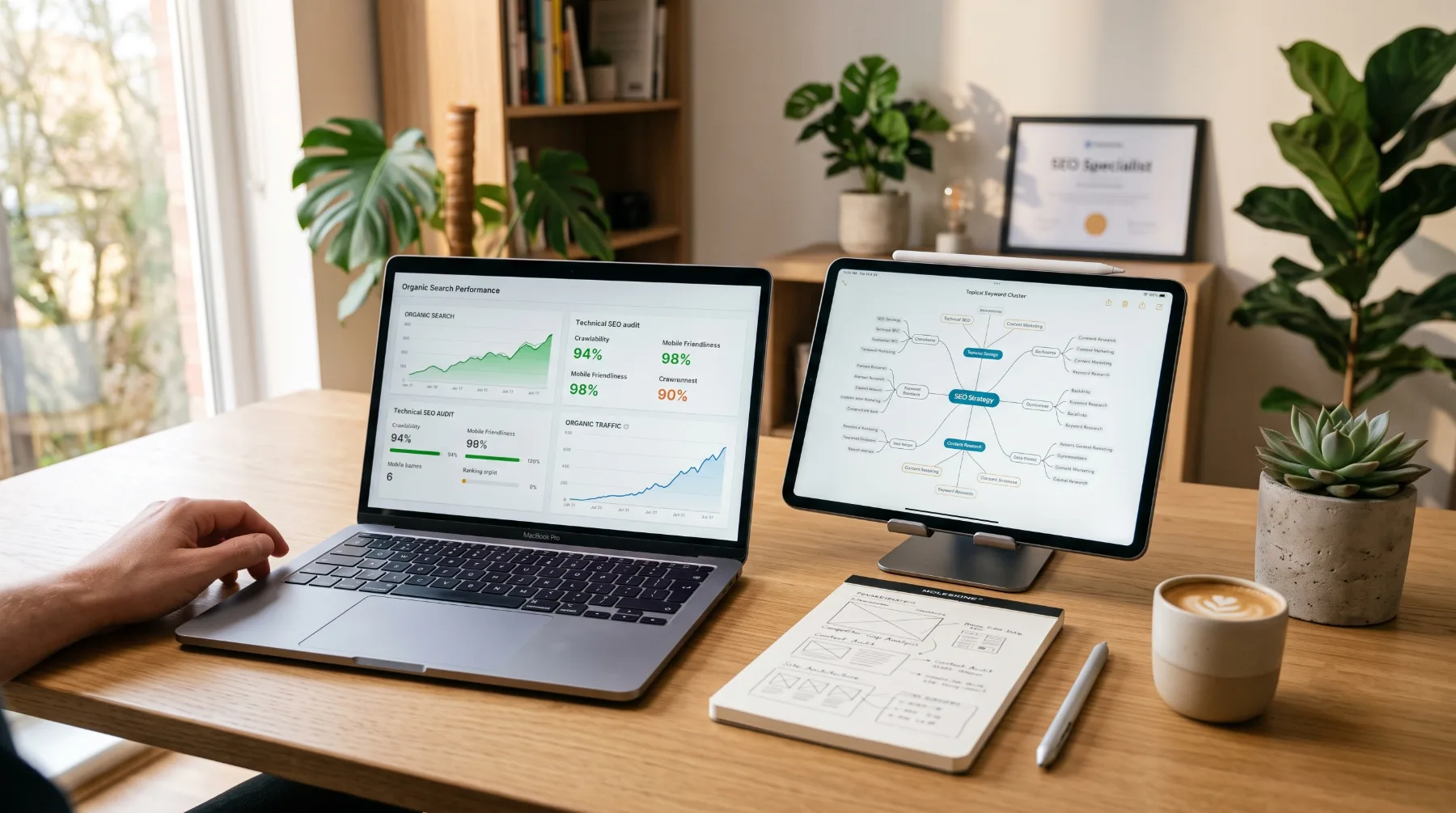
Intent-Driven Keyword Research: Moving Beyond Volume
Targeting high-volume keywords used to be the default starting point for digital marketing campaigns. In 2026, ranking for a broad phrase with heavy search volume delivers zero value if visitors bounce back to search results within seconds.
Modern search algorithms evaluate actual user satisfaction and semantic intent over query numbers. When your content misjudges what a searcher wants to accomplish, rankings decay rapidly regardless of how many links point to your URL.
Understanding the Four Layers of Search Intent
Search intent defines why a person types a specific phrase into the search box. When your page structure clashes with their objective, your rankings suffer because automated systems register that users must click elsewhere to find relief:
Informational Queries: The searcher seeks direct explanations, tutorials, or industry education (for example, understanding Core Web Vitals, crawl budgets, or server response times). These visitors expect comprehensive, logically structured walkthroughs, clear definitions, code snippets, and diagrammatic aids.
Navigational Queries: The user wants to reach a specific destination, platform portal, or brand login. Ranking here requires clear brand signals, accurate homepage metadata, and consistent knowledge graph verification.
Commercial Investigation: Searchers compare platforms, review competing workflows, or assess software features before spending money (e.g., evaluating top crawling software or comparing CMS platforms). These readers look for unbiased comparison tables, pros and cons, feature matrices, and transparent pricing breakdowns.
Transactional Queries: The user has their payment method ready and wants to complete an action immediately. Clean conversion flows, transparent service terms, transparent checkout processes, and zero friction win these commercial rankings.
Mapping Semantic Clusters and Long-Tail Variations
- Instead of isolating single keywords and building standalone pages for each synonym, modern practitioners build structured topic clusters centered around a definitive pillar page. For instance, if your pillar asset covers holistic search engine visibility, your supporting cluster articles must thoroughly address crawl budget allocation, structured schema implementations, anchor text distribution, and Search Console log analysis.
- Use tools like Google Search Central documentation, Google Search Console query performance reports, and community discussions across forums to uncover natural, multi-word phrases. When you answer secondary questions directly inside your subheadings, you unlock impressions across hundreds of related long-tail queries without creating thin, duplicative URLs that dilute domain equity.
Evaluating Keyword Difficulty and SERP Layouts
Keyword difficult metrics provided by third-party tools only tell half of story. You must manually inspect the live search results page to examine what features occupy real state. If the first screen is dominated by sponsored listings, local map packs, video carousels, and generative summary modules, the actual organic click-through rate for standard links will be compressed. Prioritize queries where traditional organic results receive high above-the-fold engagement, or optimize your content format specifically to earn placement inside rich snippet features.
On-page SEO: Structuring for Skimmers and Crawlers
On-page optimization connects search intent with accessible, well-engineered web architecture. Search engines read documents sequentially, evaluating hierarchical logic, keyword proximity, and contextual relationships across headings. A messy page layout confuses automated indexing spiders and alienates human visitors simultaneously.
Title Tags, Meta Description, and Clean URLs
Your title tags remains your most influential on-page signal and your primary click-through driver:
1. Title Tag Strategy: Place your primary focus keyword within the first 40 to 60 characters. Front-loading critical terms ensures mobile browsers do not truncate key phrases on narrow screens. Avoid aggressive clickbait that misrepresent the content, as rapid bounce rates signals low-quality to ranking algorithm.
2. Meta Description Precision: Treat your 120 to 155-character description as promotional advertising copy. Clearly state the practical outcome of the guide, weave in a related secondary keyword naturally, and close with an actionable invitation to read.
3. URL Slugs: Keep slugs clean, lowercase, and concise. Omit autogenerated database parameters, dates, and non-essential stop words. A clean slug like /seo-guide-2026-rank-higher/ establishes immediate contextual relevance for both crawlers and human visitors.
Strategic Heading Hierarchy and Document Structure [H3]
Search engine crawlers use heading tags to generate a semantic outline of your page:
One Primary
H1: Reserve theH1tag exclusively for the main title, ensuring it clearly establishes the core subject.Logical
H2Sections: UseH2tags to separate distinct themes, strategic steps, and major theoretical concepts.Granular
H3Subheadings: Break intricate ideas down withH3elements to avoid dense blocks of unbroken prose, improving readability on mobile devices.
Natural Keyword Placement Without Stuffing
Keyword stuffing triggers algorithmic spam demotions. Place your focus keyword naturally within the first hundred words of your opening section, across one or two prominent headings, and within your closing takeaways. Throughout the rest of the article, rely on related terminology, conceptual synonyms, and contextual phrasing. Read your copy aloud; if any sentence feels forced or unnatural, edit it immediately to prioritize flow and clarity.
Creating Genuinely Helpful Content: The E-E-A-T Framework
Search engines prioritize authentic, human-first utility over repetitive web copy. The Helpful Content system evaluates entire domains, demoting websites that publish superficial summaries rewritten from competitor articles.
Content built strictly to capture search volume without contributing fresh perspectives struggles to hold rankings. Sustainable visibility requires firsthand insight, proprietary observations, and original angles that competing pages fail to provide.
Demonstrating Real Experience and Subject Authority
Google's E-E-A-T framework- Experience, Expertise, Authoritativeness, and Trustworthiness- guides how search algorithms access credibility:
- First-Hand Experience: Incorporate original case studies, custom workflow screenshots, proprietary split-test results, and direct field observations. Documenting real challenges and solutions distinguishes your work from generic text.
- Transparent Authorship: Every educational or advisory article must clearly display an author byline connected to a verifiable bio highlighting relevant industry experience, credentials, and published work.
- Information Gain: Strive to deliver unique value beyond existing search results. Introduce novel frameworks, summarize proprietary benchmarks, or highlight operational details that competitor guides routinely overlook.
Multi-Format Content and Engagement Assets
Monotonous walls of text drive high bounce rates. Break up your analysis using responsive comparison tables, step-by-step checklists, key takeaways, and illustrative diagrams. Additionally, modern users consume information across multiple mediums. If your distribution plan includes short-form or long-form video explainers, utilizing the Best AI Video Generator 2026 helps you generate crisp, high-engagement visual summaries that rank in dedicated video carousels and YouTube search results.
Technical SEO: Building a Bulletproof Foundation
Writing exceptional content yields minimal returns if search engine bots cannot crawl your site efficiently, or if rendering lag creates friction for mobile users. Technical SEO ensures your site remains accessible, fast, and easy for crawlers to parse.
Core Web Vitals and Modern Page Performance
Page experience metrics play a measurable role in organic positioning:
Interaction to Next Paint (INP): INP tracks interface responsiveness across user interactions like clicks, taps, and keyboard inputs. Keep main-thread JavaScript tasks minimal and optimize event listeners to keep input latency under 200 milliseconds.
Largest Contentful Paint (LCP): Your primary content block—whether a hero image or an introductory heading—must render within 2.5 seconds. Use modern image compression like WebP or AVIF, specify responsive dimensions, and leverage Content Delivery Networks (CDNs).
Cumulative Layout Shift (CLS): Prevent unexpected visual shifts during loading by specifying explicit width and height dimensions on all images, embed containers, and dynamic banner slots.
Deploying a fast, mobile-ready web platform requires deliberate engineering. Partnering with a reliable development provider, such as an established Website Development Company in Asansol, ensures that server response times, responsive frameworks, clean code structures, and mobile accessibility standards are configured correctly from day one.
Structured Schema Markup Implementation
Schema markup uses structured JSON-LD syntax to help search engines understand key entities, relationships, and context:
Article Schema: Outlines published dates, modification history, headline data, and author entities.
Organization / Person Schema: Clarifies corporate identity, official brand names, social handles, and editorial credentials.
FAQ Schema: Formats key questions and answers directly on the search engine results page, expanding visual presence and driving higher click-through rates.
Crawl Budget and Site Architecture Hygiene
For websites containing hundreds of pages, efficient crawl budget management is essential:
Audit your
robots.txtfile regularly to prevent crawlers from indexing internal search query pages, administrative logins, or staging environments.Keep your XML sitemap updated, containing only canonical, status-200 URLs.
Eliminate internal redirect chains and resolve broken links (404 errors) to ensure crawling bots spend their allocations exclusively on high-value, indexable assets.
Strategic Internal Linking and Site Architecture
Internal links act as pathways for search crawlers, passing link equity throughout your domain while contextualizing the thematic relationships between separate pages. Without intentional site architecture, search engines struggle to understand which pages hold the highest priority.
| Internal Linking Principle | Implementation Rule | Primary Ranking Benefit |
|---|---|---|
| Internal Linking Principle | ||
| Topical Hubs | Link supporting cluster posts upward to pillar guides | Builds consolidated domain authority across broad topics |
| Descriptive Anchor Text | Use keyword-rich, natural anchor phrases | Clarifies the target URL's topic before crawlers land |
| Orphan Page Elimination | Ensure every indexable URL has at least 3-5 internal links | Guarantees indexation and frequent crawler visits |
| Contextual Breadcrumbs | Use structured hierarchical navigation | Helps users and crawlers navigate parent categories effortlessly |
For digital businesses managing commercial checkouts or SaaS services across different regions, transparent financial structures directly reinforce customer trust and platform credibility. For example, reviewing How GST Affects Digital Businesses in India provides necessary clarity when configuring tax-compliant invoices, terms of service, and commercial checkout flows that align with Google's quality standards for merchant trust.
Earning High-Impact Backlinks: Practical Methods
Backlinks function as third-party endorsements in search algorithms. However, the approach to link building has evolved significantly. Low-quality directory submissions, automated blog comments, and mass outreach for guest posts on disconnected blogs carry algorithmic penalty risks. Quality, relevance, and editorial integrity far outweigh sheer volume.
High-Yield Organic Link Strategies
Publishing Original Research: Conduct original industry surveys, aggregate public datasets into actionable charts, or publish proprietary performance benchmarks. Content creators and journalists routinely cite primary research when backing their own claims, earning your domain organic, authoritative backlinks.
Digital PR and Expert Commentary: Sign up for journalist inquiry networks such as Connectively, SourceBottle, or industry-specific press channels. Providing timely, expert quotes to writers covering your space frequently results in contextual editorial links from trusted news outlets.
Interactive Tools and Free Calculators: Develop lightweight, high-utility resources such as ROI calculators, responsive checklist generators, or downloadable templates. Practical web tools naturally attract organic links from resource roundups, community discussions, and educational portals over time.
Tracking Performance: Measuring Real Business Impact
Securing high rankings is only useful if those positions generate meaningful business results. Rather than reacting to daily keyword ranking fluctuations, build an analytics routine focused on reliable, trend-level performance data.
Google Search Console (GSC) Health Checks
Examine your Google Search Console performance data weekly to identify actionable opportunities:
The "Striking Distance" Optimization: Filter queries where your average ranking sits between positions 8 and 20. These URLs already possess baseline trust from Google. By refreshing the content, clarifying search intent, improving the title tag, and adding 2 to 3 contextual internal links from strong pages, you can often lift them into top-tier page-one positions.
Indexing and Coverage Audits: Routinely check the Page Indexing report to catch soft 404s, accidental
noindextags, canonical mismatches, or redirect errors before they affect traffic.
Google Analytics 4 (GA4) Engagement Metrics
Review key behavioral metrics like engaged sessions, average engagement duration, and key event conversions. If an article generates thousands of monthly visits but records an average engagement duration of under fifteen seconds, your content is likely failing to satisfy the searcher's intent. Use these behavioural insights to refine your introductions, restructure subheadings, or add practical summaries that keep readers engaged.
Conclusion
Building lasting organic search visibility requires consistent engineering rather than overnight shortcuts. As automated search algorithms grow better at assessing quality and user satisfaction, the websites that succeed will be those that prioritize their audience's real needs.
By carrying out intent-focused keyword research, optimizing Core Web Vitals, structuring internal links carefully, and earning authoritative external mentions, you build a resilient foundation for long-term growth. Apply this SEO Guide 2026: How to Rank Higher on Google right now: review your existing content, eliminate technical crawl barriers, and publish clear solutions that your readers can count on.
Frequently asked questions
How long does it take for a new website to rank on Google in 2026?
A new domain typically requires three to six months to establish baseline search engine trust and begin ranking for competitive commercial queries. However, by targeting low-competition long-tail keywords, maintaining technically clean code, and publishing helpful, experience-driven content, individual pages can secure page-one rankings within four to eight weeks.
What is the most important ranking factor for Google today?
Google evaluates hundreds of interconnected ranking signals, but topical authority paired with satisfying search intent forms the foundation of modern search performance. If your page delivers direct, accurate, and comprehensive answers faster than competitors—supported by clean mobile speed and genuine backlinks—your rankings will grow sustainably.
Can AI-assisted content rank well on Google?
Yes, search guidelines focus on content utility and depth rather than the specific production tools used. However, mass-produced, unedited AI content often lacks unique experience, original data, and authentic perspective (E-E-A-T), which frequently leads to algorithmic demotions. The most effective strategy uses AI for preliminary research and structural outlining, while subject matter experts provide original analysis, data validation, and real-world insights.