Business trends in 2026 are changing how companies work, serve customers, and grow. AI, automation, online tools, and cybersecurity are becoming more important every day.
Businesses do not need to follow every new trend. They just need to find the trends that can help them save time, reach more customers, and grow.
Let’s look at the most important business trends for 2026. 🚀
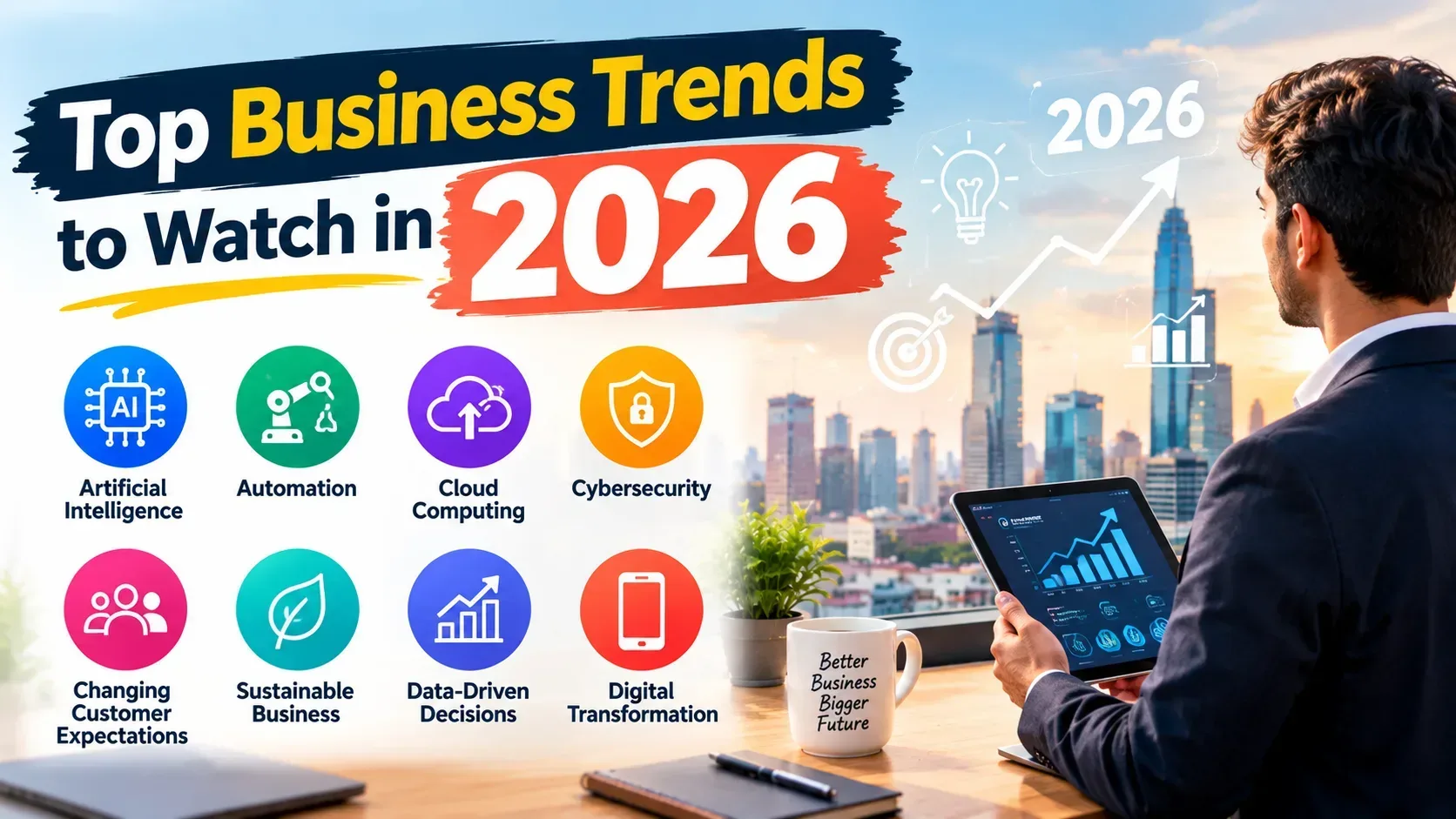
AI Will Become Part of Everyday Business
Artificial intelligence is no longer only for large technology companies. Many small and medium businesses are also using AI for everyday work.
AI can help with content, customer support, data analysis, research, marketing, and many other tasks.
🤖 AI for Daily Work
Businesses can use AI to reduce repetitive work.
For example:
✅ Write simple content drafts
✅ Create marketing ideas
✅ Summarize documents
✅ Analyze basic data
✅ Answer common customer questions
✅ Help employees find information
This does not mean that AI will do everything.
People still need to check important information and make final decisions.
💡 More Businesses Will Try AI Tools
In 2026, businesses may use different AI tools instead of relying on one tool for everything.
A marketing team may use AI for content ideas. A sales team may use it to organize customer information. A support team may use AI to answer common questions.
The opportunity is simple: use AI where it saves time or improves work.
The challenge is also important. Businesses need to protect private information and make sure AI-generated work is accurate.
Digital Transformation Will Go Beyond Websites
Having a website is no longer the only part of going digital.
Businesses are connecting websites, apps, payments, customer data, marketing tools, and internal systems.
This is one of the major business trends for 2026 because digital tools are becoming part of normal business operations.
🌐 Businesses Will Connect More Tools
A business may use:
✅ Website
✅ Mobile app
✅ CRM
✅ Payment system
✅ Email marketing
✅ Customer support tools
✅ Analytics
When these tools work together, employees can spend less time moving information from one system to another.
For example:
Customer order → Payment → Database → Notification → Delivery update
A connected system can make this process easier to manage.
📱 Mobile Experience Will Matter More
Many customers use their phones as their main way to search, shop, book services, and contact businesses.
So businesses need to check whether their website and online services work well on mobile devices.
A slow website or confusing mobile experience can make customers leave.
For businesses planning a new digital product, this may be the right time to consider a custom website, web application, or mobile app based on their actual needs.
Automation Will Help Businesses Save Time
Automation is becoming easier for businesses to use.
It does not always mean complex technology. Even a simple automated process can remove repeated manual work.
⚙️ What Can Businesses Automate?
Some common examples include:
✅ Sending customer emails
✅ Creating invoices
✅ Updating customer records
✅ Sending order notifications
✅ Booking appointments
✅ Collecting leads
✅ Moving data between tools
✅ Generating regular reports
For example, when someone fills out a form on a website, automation can send the information to a CRM and notify the sales team.
No one needs to copy the same information manually.
🚀 Small Businesses Can Benefit Too
Automation is not only for large companies.
A small business can start with one simple task.
For example:
New lead → Automatic email → Sales team notification
Later, more steps can be added.
The main goal should not be to automate everything. Choose tasks that happen often and take unnecessary time.
⚠️ Automation Still Needs Human Control
Not every task should be fully automated.
Important decisions, customer complaints, financial work, and sensitive information may still need human attention.
Good automation supports people instead of creating more problems.
Personalization Will Shape the Customer Experience
Customers do not always want the same message or offer.
They expect businesses to understand what they need and provide useful information.
This is why personalization will remain important in 2026.
😊 Give Customers More Relevant Experiences
A business can use customer data to provide more relevant experiences.
For example:
✅ Product suggestions based on previous activity
✅ Relevant offers
✅ Personalized emails
✅ Useful recommendations
✅ Faster customer support
An ecommerce website may show products related to what a customer viewed earlier.
A service business may send reminders based on previous bookings.
🔍 Use Customer Data Carefully
Personalization needs data, but businesses should use customer information responsibly.
Customers want useful experiences, but they also care about privacy.
Businesses should:
✅ Collect only useful information
✅ Protect customer data
✅ Explain how information is used
✅ Follow relevant privacy requirements
Trust is important. A personalized experience should feel helpful, not uncomfortable.
💬 Customer Expectations Are Changing
People are also becoming more comfortable with fast digital services.
They may expect:
Quick replies
Easy payments
Simple websites
Mobile-friendly services
Clear information
Easy returns or support
Businesses that make common tasks simple can create a better customer experience.
Cybersecurity Will Become a Business Priority
As more business activities move online, cybersecurity becomes more important.
A company may store customer information, payment details, employee data, passwords, and business documents.
A security problem can affect both the business and its customers.
🔐 Basic Security Matters
Businesses should take simple security steps seriously.
✅ Use strong passwords
✅ Turn on two-factor authentication
✅ Keep software updated
✅ Limit access to sensitive data
✅ Back up important information
✅ Train employees about common scams
These steps may look simple, but they can reduce avoidable risks.
🛡️ Small Businesses Should Not Ignore Security
Cybersecurity is not only a concern for banks or large companies.
Small businesses can also face phishing emails, stolen passwords, malware, fake payment requests, and other online risks.
As businesses use more cloud tools, apps, websites, and connected systems, security should be considered during development—not only after a problem happens.
⚠️ Security Can Also Affect Customer Trust
Customers want to know that their information is safe.
A business that takes security seriously can protect its operations and build trust with customers.
This is why cybersecurity should be part of the digital plan, not an afterthought.
What These Business Trends Mean for Companies in 2026
The major trends in 2026 are connected.
AI can help businesses work faster. Automation can reduce repetitive tasks. Digital transformation can connect different systems. Personalization can improve customer experiences, while cybersecurity can help protect the business.
📈 New Opportunities for Businesses
These changes can create opportunities such as:
✅ Faster business processes
✅ Lower manual workload
✅ Better customer service
✅ More useful data
✅ New digital products
✅ Better online reach
✅ Easier business management
A small business does not need to adopt every trend.
Start with the problem that affects your business most.
If employees spend hours doing repetitive work, automation may help.
If customers struggle to use your website, improve the digital experience.
If customer data is not organized, consider a better system.
If the business wants to reach more people online, focus on its website, SEO, social media, and digital marketing.
🏢 How TZAP Marketing Can Help
Businesses often need more than one digital service.
TZAP Marketing can help businesses with areas such as digital marketing, SEO, websites, applications, AI, automation, and other digital solutions.
For example, a business launching a new service may need a website, SEO, online advertising, social media support, and automation.
Instead of looking at each activity separately, businesses can plan them around one clear goal.
The important thing is to choose services that solve a real business need.
🎯 Focus on What Your Business Actually Needs
Following every new trend is not a business strategy.
Before spending money, ask:
✅ What problem am I trying to solve?
✅ Will this tool save time?
✅ Will it help my customers?
✅ Can my team use it properly?
✅ What will it cost to maintain?
These questions can help you avoid spending money on tools that your business does not really need.
Conclusion
The major business trends for 2026 show one clear change: businesses are using technology more deeply in everyday work. 🚀
AI can save time, automation can reduce repetitive tasks, digital tools can improve customer experience, and cybersecurity can help protect important information.
But businesses do not need to follow every trend.
✅ Find a real problem
✅ Choose the right solution
✅ Start small
✅ Measure the results
✅ Improve over time
The goal is not to use more technology. The goal is to use useful technology that makes the business better.
📚 Want to Learn More?
If you want to explore more about AI, marketing, and business, these guides may help:
👉 How to Grow a Business With Marketing: A Practical Guide
👉 Small Business Ideas With Big Potential for New Entrepreneurs to Start
👉 Best Business Ideas for the Future
👉Business Ideas You Can Start With Low Investment
Frequently asked questions
What are the biggest business trends in 2026?
AI, digital transformation, automation, personalization, cybersecurity, and changing customer expectations are some major trends businesses are watching in 2026.
Is AI useful for small businesses?
Yes. Small businesses can use AI for tasks such as content ideas, customer support, research, data work, and other repetitive activities.
Does every business need automation?
No. Automation is most useful when a business has repeated tasks that take a lot of time.
Why is cybersecurity important for businesses?
Businesses store important information online. Good security practices can help protect customer data, business information, accounts, and daily operations.
How can businesses prepare for 2026?
Start by finding the biggest business problem. Then choose the digital tools or services that can solve that problem.