Social media has become an important way for businesses creators, and brands to connect with their audiences. But creating fresh posts regularly is not always easy. Finding new ideas, writing captions, creating visuals, understanding trends, and checking performance can take a lot of time. This is where AI can make the process easier and more efficient.
How AI Can Improve Social Media Content is not just about allowing AI to create posts automatically. AI can support different stages of content creation, from generating ideas and writing captions to analyzing trends, personalizing content, and improving performance. When AI tools are combined with human creativity and proper review, businesses can create more useful, relevant, and engaging social media content.
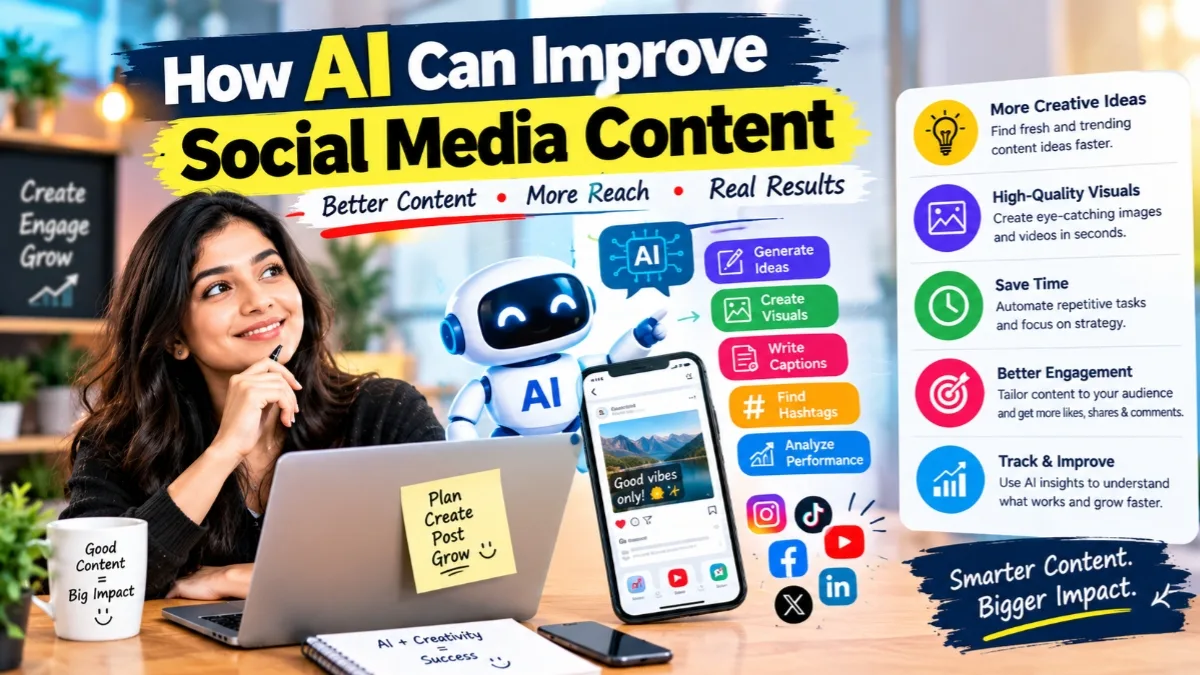
How AI Can Improve Social Media Content Creation
AI can support almost every stage of the social media content process. Instead of starting from a blank page, marketers can use AI to brainstorm ideas, organize content calendars, improve captions, develop visual concepts, and analyze audience behavior.
One of the biggest benefits is saving time. Tasks that previously required hours of research and editing can often be completed much faster with AI assistance. However, AI should work as a supporting tool because the final content still needs human judgment, creativity, and brand knowledge.
Generate Fresh Content Ideas -
One of the biggest challenges in social media marketing is finding new content ideas consistently. After posting for several weeks or months, creators can easily feel that they have already covered everything about their topic.
AI can help generate content ideas based on an industry, product, target audience or campaign. For example, a digital marketing agency can ask an AI tool for ideas related to SEO, content marketing, Google Ads, or social media marketing.
AI can also suggest different content formats, such as educational posts, polls, carousel posts, short videos, questions, tips, and customer-focused content. This makes AI particularly useful for businesses that need to maintain a regular posting schedule.
For example,
a clothing brand could ask AI for content ideas around seasonal fashion, styling tips, product benefits, and frequently asked customer questions. The marketing team can then select the most relevant ideas and develop them into original posts.
Create Better Social Media Captions -
Writing a good caption can sometimes take almost as much time as creating the post itself. A caption needs to explain the topic clearly while also encouraging people to stop scrolling and engage with the content.
AI can create several caption variations for the same post. A business can ask for a professional LinkedIn caption, a shorter Instagram caption, or a conversational Facebook version.
For example,
when launching a new product, a business can ask AI to create informative, promotional, storytelling, or question-based captions. The social media manager can then choose the most suitable version and edit it according to the brand's voice.
This approach makes AI a useful writing assistant rather than a complete replacement for the person managing the social media account.
Improve Social Media Visuals -
Visual content plays a major role in social media engagement. AI can help marketers develop visual concepts, generate images, remove backgrounds, resize designs, and suggest layouts for different platforms.
For example,
a restaurant promoting a new dish can use AI to develop a professional visual concept showing the food in an attractive setting. Similarly, an online store can use AI-assisted design tools to experiment with backgrounds and product presentations.
AI can also help adapt one design for different social media platforms. A visual created for Instagram may need a different size or layout for Facebook or LinkedIn.
However, AI-generated visuals should always be reviewed before publishing. AI may sometimes create unrealistic details, incorrect text, or elements that do not match the brand's identity.
Personalize Content for Different Audiences -
Every social media follower is different. A new customer, an existing customer, and someone who has only viewed a product may respond differently to the same message.
AI can help businesses understand audience groups and create more relevant content for each segment. For example, an online store could create one post introducing a product to new customers and another explaining advanced product benefits to existing customers.
Personalization can involve changing the language, tone, format, or call-to-action according to the audience.
The goal is not necessarily to create completely different content for every individual. Instead, AI can help marketers understand audience segments and adjust their content so that it feels more relevant.
Analyze Social Media Trends -
Social media trends can change very quickly. New topics, hashtags, video formats, and content styles can become popular within a short period.
AI can analyze large amounts of social media data and help identify patterns in audience interests. Marketers can use these insights to understand which topics are receiving attention and which content formats are becoming popular.
For example,
a technology company may notice increasing interest in artificial intelligence. Instead of simply copying a trending post, the company can use the trend as inspiration and create original educational content explaining how AI can help its customers.
However, not every trend is suitable for every brand. Human judgment is still necessary to decide whether a particular trend matches the company's audience, message, and values.
Optimize Social Media Performance -
Creating social media content is only one part of social media marketing. Businesses also need to understand whether their posts are actually producing results.
AI can analyze metrics such as reach, impressions, engagement, comments, shares, clicks, and conversions. By comparing previous posts, AI can help identify patterns in content performance.
For example,
an analysis may show that educational carousel posts receive more saves while short videos generate more shares. A marketer can use this information when planning future content.
AI can also help compare different captions, headlines, calls-to-action, and content formats. This allows marketers to make decisions based on performance data instead of relying only on assumptions.
Make Content Creation More Consistent -
Maintaining a consistent posting schedule can be difficult, especially for small businesses with limited marketing teams.
AI can help create content calendars, organize topics, suggest post ideas, and repurpose existing content. This makes it easier to maintain a regular social media presence.
For example,
one detailed blog post can be turned into a LinkedIn post, Instagram carousel, short video script, and several smaller educational posts. The information remains consistent, but the format is changed for different platforms.
This allows businesses to get more value from content they have already created instead of constantly starting from scratch.
Practical Example of Using AI for Social Media Content
Consider a small online clothing business launching a new summer collection.
The business can first use AI to generate ideas around summer fashion, styling tips, product benefits, and common customer questions. It can then create several caption options for each post.
Next, AI-assisted design tools can help develop visual concepts for product promotions. The business can also analyze previous social media performance to understand which types of posts received the most engagement.
For personalization,
the business could create different messages for new and existing customers. After publishing the content, AI can help analyze performance and identify which posts generated the most engagement, shares, saves, or clicks.
The important point is that AI supports the complete workflow, while the business owner or social media manager remains responsible for deciding what should actually be published.
Why Human Creativity Still Matters
AI can produce content quickly, but speed does not automatically mean quality. Human creativity remains important because people understand emotions, cultural context, humor, personal experiences, and brand personality in ways that AI may not always capture correctly.
A social media account that depends entirely onAI-generated content can also become repetitive. Human input can add personal stories, original opinions, experiences, and a unique brand perspective.
Human review is also important for facts, statistics, product claims, and other important information. AI-generated content can sometimes contain inaccurate or outdated information, so important claims should always be checked before publication.
The most useful approach is to combine AI's speed and analytical capabilities with human creativity and judgment. AI can handle repetitive tasks and provide ideas, while people make the final creative and strategic decisions.
Best Practices for Using AI in Social Media Marketing
Businesses can get better results from AI by treating it as a supporting tool rather than a replacement for their social media team.
First,
provide clear instructions. Instead of simply asking AI to “write a social media caption,” mention the platform, target audience, product, tone, and objective.
Second,
edit AI-generated content before publishing it. Add your own examples, brand language, experiences, and perspective so that the content feels more authentic.
Third,
verify important facts and claims. This is especially important when creating content about technical financial, medical, or industry-specific subjects.
Finally,
use real performance data to improve future content. AI becomes more useful when it works together with audience feedback, engagement data, and human experience.
Conclusion
How AI Can Improve Social Media Content is ultimately about using AI as a creative and analytical assistant rather than treating it as a complete replacement for human content creators. AI can help businesses generate ideas, write captions, develop visual concepts, personalize messages, analyze trends, and optimize social media performance.
The real value comes from combining AI's speed and data-processing abilities with human creativity, experience, and judgment. With proper human review and editing, businesses can use AI to create social media content that is more consistent, relevant, useful, and authentic while saving valuable time.
Frequently asked questions
How can AI improve social media content?
AI can improve social media content by generating ideas, writing captions, creating visual concepts, analyzing trends, personalizing posts, and optimizing performance.
Can AI create social media posts automatically?
Yes, AI can generate post ideas, captions, scripts, and visual concepts. However, human editing and review are important before publishing.
How does AI help with social media content ideas?
AI can suggest content ideas based on your industry, target audience, products, current trends, and social media goals.
Can AI improve social media engagement?
AI can help identify content patterns, audience interests, effective formats, and suitable messaging, which can support better engagement when used correctly.
How does AI help with social media personalization?
AI can analyze audience segments and help create different messages, content formats, and calls-to-action for different groups of users.
How can AI analyze social media performance?
AI can analyze metrics such as reach, impressions, engagement, clicks, shares, and conversions to identify patterns and suggest content improvements.
Should humans review AI-generated social media content?
Yes. Human review helps ensure that AI-generated content is accurate, relevant, authentic, brand-appropriate, and free from unnecessary or misleading information.