Understanding this distinction is vital for small business owners, freelancers, and accounting teams looking to prevent costly invoicing discrepancies. In this practical guide, we break down simple formulas and real-world billing examples showing how to calculate GST from an inclusive price so your bookkeeping remains perfectly compliant every single month.
What Is an Inclusive Price and How Does It Work?
An inclusive price represents the total gross figure quoted to a buyer, bundling together the product or service cost along with the statutory Goods and Services Tax. In everyday retail shopping, stores display inclusive prices upfront. This approach ensures customers face no unexpected surprises at the final checkout counter.
From an accounting standpoint, however, an inclusive total is not a single revenue figure. It represents two separate legal values combined into one sum: the net taxable revenue belonging to the seller, and the statutory indirect tax collected on behalf of the tax authorities.
The Core Anatomy of a GST-Inclusive Invoice
Every inclusive total comprises two components:
The Base Value (Taxable Value): The actual revenue the business keeps for selling the item or rendering the service.
The GST Component: The legal tax levied according to the specified HSN or SAC code slab, which must be remitted to the government during the monthly tax filing window.
When a store quotes ₹2,500 inclusive of tax, the seller does not keep that full amount. Failing to separate the tax portion inflates profit margins and leads to severe reporting errors on your tax filings.
Inclusive Pricing vs Exclusive Pricing: Key Invoicing Differences
The choice between quoting prices on an inclusive or exclusive basis depends heavily on whether your clients are retail end-consumers or registered corporate businesses. To understand how line-item structures change between retail receipts and B2B bills, review our detailed guide on GST inclusive vs exclusive price differences before standardizing your quotation templates.
In B2B commerce, exclusive pricing remains the industry standard. Corporate buyers require full tax transparency to claim input tax credits against their outward liabilities easily. In consumer-facing (B2C) retail, inclusive quotes prevent checkout cart abandonment and foster price transparency.
Common Mistakes People Make When Extracting GST
Before learning the correct mathematical procedure, it is critical to address the single most widespread calculation error made by accountants, store managers, and freelancers alike: direct percentage subtraction.
Why Direct Deduction Fails Every Time
Many people assume they can simply subtract 18% from a ₹1,180 total. This calculation yields ₹212.40 as tax and ₹967.60 as base value, which is mathematically incorrect.
The statutory 18% tax applies strictly to the base figure. Taking 18% of ₹1,180 taxes an amount that already contains tax. This double-calculation distorts both your gross revenue and your net tax dues.
The Financial Consequences of Inaccurate Tax Separation
Relying on direct deduction leads to real financial harm:
Under-Reported Revenue: Your calculated base revenue appears artificially lower than it actually is.
Incorrect Tax Calculation: The GST component is overstated, which can lead to inaccurate invoice and accounting records.
Audit and Reconciliation Penalties: Discrepancies between your reported taxable value and matching GSTR forms trigger automated notices and reconciliation delays.
Step-by-Step: How to Calculate GST From an Inclusive Price
To extract the exact base value and tax amount from any gross total without mathematical errors, tax authorities and certified accounting bodies use standard reverse-calculation formulas.
The Primary Formulas for Reverse GST Calculations
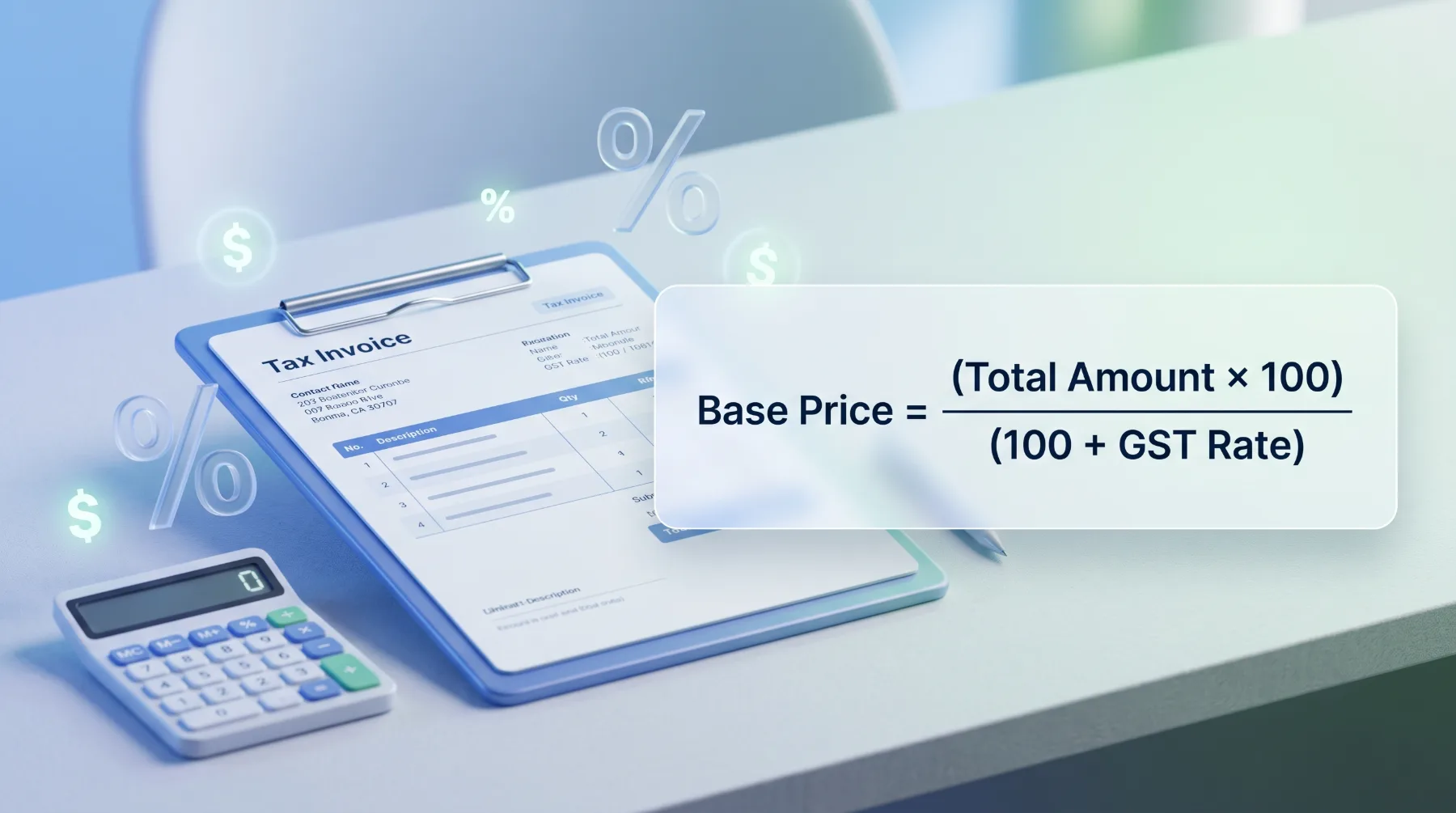
When learning how to calculate GST from an inclusive price, the relationship between the base price, the GST rate, and the gross total is straightforward:
Base Price = (Total Inclusive Amount × 100) ÷ (100 + GST Rate)
GST Amount = Total Inclusive Amount − Base Price
Alternatively, if you want to extract the exact tax portion directly without calculating the base price first, use this dedicated formula:
GST Amount = (Total Inclusive Amount × GST Rate) ÷ (100 + GST Rate)
Practical Walkthrough with Common Figures
Let us evaluate this using a standard billing example where the gross payment received is ₹1,180 under the standard 18% tax slab.
Identify the variables: Inclusive Amount = ₹1,180; GST Rate = 18%.
Apply the base formula: Base Price = (1,180 × 100) ÷ (100 + 18) = 118,000 ÷ 118 = ₹1,000.
Calculate the GST portion: GST Amount = ₹1,180 − ₹1,000 = ₹180.
To see this exact arithmetic applied across various invoice templates and billing situations, check out our dedicated case breakdown of ₹1,180 including 18% GST.
Standard Indian GST Slabs: Reverse Calculation Matrix
Goods and services in India fall under four primary tax brackets: 5%, 12%, 18%, and 28%. The table below illustrates how a flat ₹10,000 inclusive payment breaks down across each official slab using the reverse calculation formula.
| Inclusive Total | GST Rate Slab | Reverse Multiplier Formula | Extracted Base Price | Extracted Tax Amount |
|---|---|---|---|---|
| Inclusive Total | ||||
| ₹10,000 | 5% | (10,000 × 100) ÷ 105 | ₹9,523.81 | ₹476.19 |
| ₹10,000 | 12% | (10,000 × 100) ÷ 112 | ₹8,928.57 | ₹1,071.43 |
| ₹10,000 | 18% | (10,000 × 100) ÷ 118 | ₹8,474.58 | ₹1,525.42 |
| ₹10,000 | 28% | (10,000 × 100) ÷ 128 | ₹7,812.50 | ₹2,187.50 |
Extracting Tax From the 18% GST Slab
Because the 18% bracket covers the majority of commercial contracts, professional consulting fees, IT services, and digital subscriptions, mastering this specific slab is essential for daily financial workflows.
The Simplified 118 Divisor Technique
When you need to calculate GST from an inclusive price under the 18% bracket, you do not need to punch multi-step equations into your calculator. Because the denominator is always (100 + 18) = 118:
Direct Base Price Formula: Gross Total ÷ 1.18
Direct Tax Extraction Formula: (Gross Total ÷ 118) × 18
For instance, suppose a freelancer bills a client ₹59,000 inclusive of 18% GST:
Base Earnings: ₹59,000 ÷ 1.18 = ₹50,000
Statutory Tax Collected: ₹59,000 − ₹50,000 = ₹9,000
If your business handles flat quotes, check our guide on [how to remove 18% GST from a total amount](/gst/how-to-remove-18-percent-gst-from-total-amount/). It helps you process invoice math in seconds.
Understanding CGST, SGST, and IGST Splits
Once you extract the net tax, you must format it correctly across your accounting ledger. Tax treatment depends on whether the transaction crosses state boundaries.
Intra-State Sales (Within the Same State)
When the seller and the buyer operate within the same state, the extracted GST is divided equally between the Central Government (Central Goods and Services Tax) and the State Government (State Goods and Services Tax):
CGST Rate: Half of the total GST slab (e.g., 9% on an 18% item).
SGST Rate: Half of the total GST slab (e.g., 9% on an 18% item).
Using our earlier ₹900 tax example on a ₹5,900 transaction:
CGST (9%) = ₹450
SGST (9%) = ₹450
Inter-State Sales (Across State Borders)
When goods or services move across state lines, the entire tax component is allocated to Integrated Goods and Services Tax (IGST):
IGST Rate: Full rate of the applicable slab (e.g., 18%).
Split Allocation: The entire ₹900 is booked under the IGST ledger heading.
For a comprehensive explanation of place-of-supply rules, interstate exemptions, and return filing protocols, explore our detailed breakdown on how to calculate CGST and SGST with IGST rules. You can also verify changing tax brackets and official notifications directly on the portal of the Central Board of Indirect Taxes and Customs.
Why Inclusive Calculations Matter for Modern Digital Firms
Digital agencies, software creators, and regional tech firms handle complex, recurring transactions daily. Whether you partner with a specialized website development company in Asansol for commercial web design or invest in modern platforms like the best AI video generator in 2026 to automate content workflows, transparent billing protects your profit margins.
Safeguarding Profit Margins on Retainer Contracts
When an agency quotes an inclusive monthly retainer of ₹50,000 without factoring in reverse calculations, they often forget that 18% tax will reduce their net take-home earnings to ₹42,372.88. If their operating costs were calculated assuming a full ₹50,000 income, their net margin drops sharply. Knowing how to calculate GST from an inclusive price ensures your business prices contracts for genuine profitability.
Complying with Digital Supply Regulations
The rapid growth of SaaS subscriptions, cloud platforms, and remote technical work has tightened tax compliance frameworks nationwide. To see how these statutory requirements affect modern online operations, check our analysis of how GST affects digital businesses in India.
Conclusion
Knowing how to extract GST from an inclusive amount helps businesses maintain accurate invoices, protect margins, and keep their tax records organized. Using the reverse calculation formulas ensures complete financial clarity and keeps your business audit-ready across every invoice you generate.
Frequently asked questions
Can I simply deduct 18% from an inclusive total?
No. Calculating 18% directly on an inclusive total applies the tax percentage to a figure that already includes tax. This inflates your tax liability and reduces your actual product revenue. To find the correct taxable figure, always divide by 118 and multiply by 100 first.
Can registered businesses claim Input Tax Credit on inclusive invoices?
Yes, but only if the supplier issues a valid, itemized tax invoice containing both parties' GSTINs, the base taxable value, and the split tax figures (CGST/SGST or IGST). A single lump-sum receipt lacking line-item tax details cannot be processed for input tax credits.
What should I do if an invoice includes items under different GST slabs?
You cannot apply a single reverse formula to the gross total. You must group items by their individual tax brackets (such as 5%, 12%, or 18%), extract the base value and tax for each tier separately, and then sum the final amounts for reporting.