What Is an AI-Powered Social Media Content Strategy?
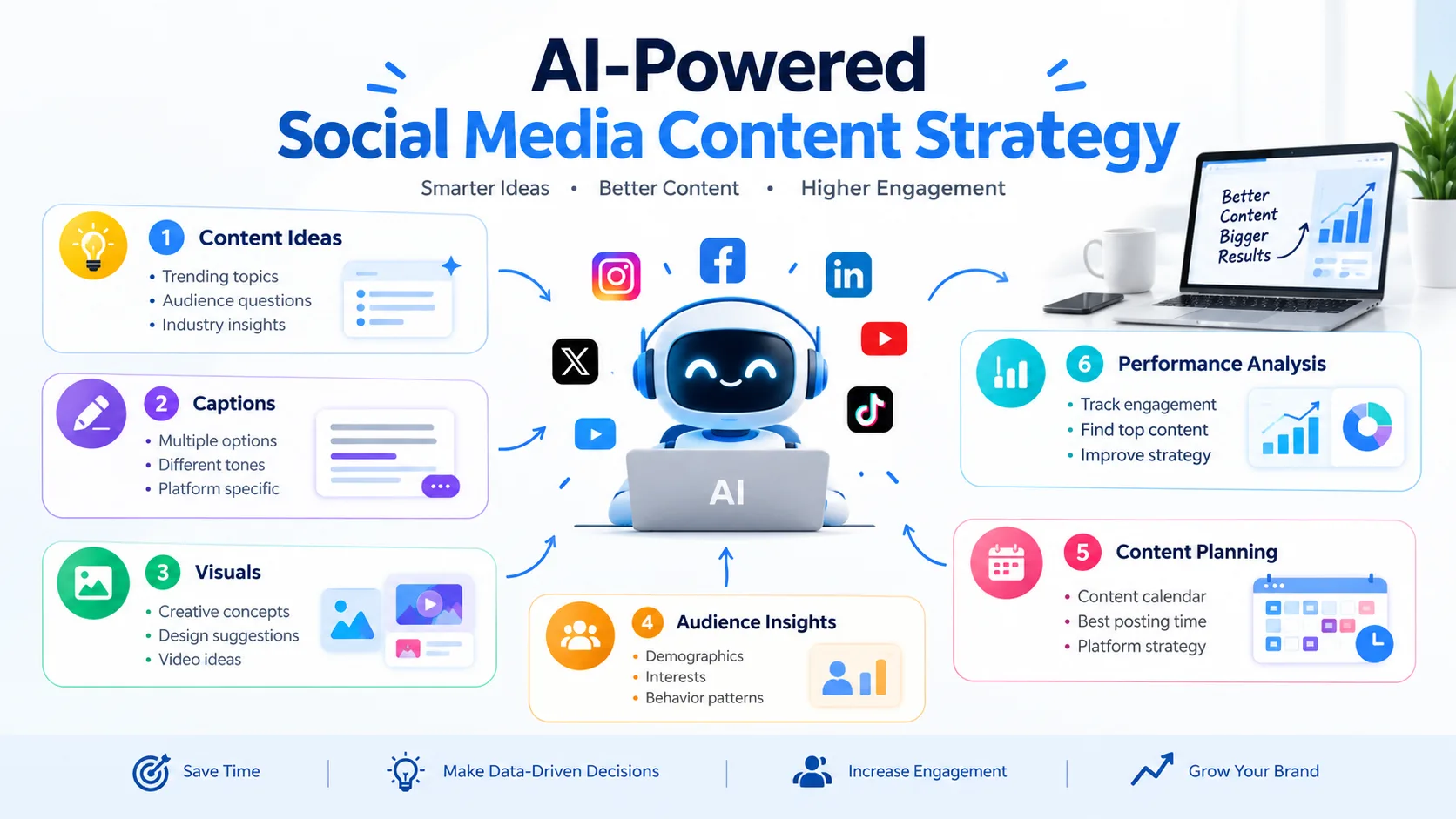
An AI-powered social media content strategy is a structured approach that uses artificial intelligence to support different parts of the social media content process. Instead of depending entirely on manual research and planning, businesses can use AI tools to assist with tasks such as generating ideas, writing captions, analyzing audiences, planning content calendars, creating visual concepts, and reviewing performance.
AI does not need to replace the social media team. Instead, it can act as a support system that reduces repetitive work and helps marketers make more informed decisions.
For example, a business may use AI to identify common questions customers ask online, turn those questions into content ideas, create several caption options, and organize them into a weekly content calendar. A human marketer can then review the suggestions, make necessary changes, add brand-specific information, and publish the final content.
This combination of AI assistance and human expertise can create a more efficient content workflow.
How Businesses Can Use AI for Social Media Content
AI can support almost every stage of social media content creation. However, each use should have a clear purpose.
1. Generate Content Ideas
Coming up with new social media ideas regularly can be challenging, especially for businesses that publish content several times a week.
AI can help generate topic ideas based on a business's products, services, audience questions, industry topics, and content goals. For example, a digital marketing company could ask an AI tool for ideas related to SEO, social media marketing, content marketing, or online advertising.
AI can also help turn one broad topic into multiple content formats. A single subject could become a short video, carousel post, educational graphic, poll, customer question, or blog promotion.
However, marketers should review these ideas before using them. Not every AI-generated idea will be relevant to the target audience or suitable for the brand.
2. Create and Improve Captions
Writing captions for every post can take considerable time. AI can help create initial caption drafts based on the topic, audience, platform, and desired tone.
For example, a business can ask AI to create a professional LinkedIn caption, a short Instagram caption, or a conversational Facebook post about the same subject.
AI can also provide different versions of a caption, such as:
- Educational
- Promotional
- Conversational
- Short and direct
- Story-based
- Question-focused
The social media manager can then select the strongest version and edit it to match the company's communication style.
The goal should not be to publish AI-generated text without checking it. Human editing is important to make the caption sound natural and authentic.
3. Develop Visual Content Ideas
Visual content plays an important role on many social media platforms. AI can help businesses develop concepts for images, infographics, short videos, carousels, and other creative formats.
For example, if a company wants to explain five SEO tips, AI can suggest a carousel structure with one tip per slide. It can also suggest visual elements, headlines, layouts, and calls to action.
AI image and design tools can further assist with creating visual drafts. However, businesses should ensure that logos, product details, brand elements, statistics, and other important information are accurate before publishing.
4. Understand Audience Insights
A successful social media strategy should be based on audience needs rather than assumptions. AI can help analyze available audience and engagement data to identify patterns.
Businesses can examine information such as:
- Content engagement
- Comments and reactions
- Video views and watch time
- Shares and saves
- Audience interests
- Demographic patterns
- Link clicks
- Content preferences
These insights can help marketers understand which topics and formats are attracting attention.
For example, if educational videos consistently receive stronger engagement than promotional posts, a business may decide to create more educational content.
AI can make it easier to identify these patterns across large amounts of data, but marketers should still consider the wider business context before changing their strategy.
AI-Powered Social Media Content Strategy: A Practical Step-by-Step Process
Businesses do not need to completely redesign their marketing operations to start using AI. A simple, structured process can make adoption easier.
Step 1: Define Your Social Media Goals
Start by deciding what the business wants to achieve.
Possible goals include:
- Increasing brand awareness
- Generating leads
- Driving website traffic
- Increasing sales
- Improving engagement
- Building a community
- Supporting customer retention
The goal should influence the type of content created and the metrics used to measure success.
Step 2: Understand Your Target Audience
Identify who the content is intended for. Consider their problems, interests, questions, preferred platforms, and buying behavior.
AI can help organize audience information and identify patterns in existing social media data. However, businesses should combine these insights with customer feedback and direct market knowledge.
Step 3: Build Content Pillars
Content pillars are the main topics a business regularly discusses on social media.
For example, a technology company might use:
- Educational content
- Product information
- Industry updates
- Customer stories
- Company insights
Once the content pillars are defined, AI can generate ideas within each category.
This helps prevent random posting and creates greater consistency.
Step 4: Create a Content Calendar
A content calendar helps businesses organize what they will publish and when.
AI can assist by turning content ideas into a structured schedule. Businesses can plan different formats and topics throughout the week or month.
For example:
| Day | Content Type | Purpose |
|---|---|---|
| Monday | Educational post | Awareness |
| Tuesday | Short video | Engagement |
| Wednesday | Customer story | Trust |
| Thursday | Industry insight | Authority |
| Friday | Product post | Conversion |
The exact schedule should depend on the audience and business rather than following a fixed formula.
Step 5: Create the First Draft With AI
Once the topic and format are decided, AI can help create the first draft.
It can assist with:
- Captions
- Headlines
- Video scripts
- Carousel copy
- Content outlines
- Calls to action
- Post variations
Providing clear instructions usually produces more useful results. The prompt should include the target audience, topic, platform, tone, content length, and objective.
Step 6: Add Human Review
This is one of the most important steps in an AI-supported workflow.
AI-generated content can contain inaccurate information, generic language, outdated claims, or wording that does not match the brand.
A human should review the content for:
- Accuracy
- Brand voice
- Grammar
- Relevance
- Facts and statistics
- Visual accuracy
- Cultural context
- Customer expectations
The final content should feel like it was created for the audience, not simply generated by a machine.
How AI Helps With Content Performance Analysis
Creating content is only one part of social media marketing. Businesses also need to understand whether their content is working.
AI can help analyze performance data from different posts and identify patterns.
Important metrics may include:
- Reach
- Impressions
- Engagement rate
- Comments
- Shares
- Saves
- Video views
- Watch time
- Link clicks
- Leads
- Conversions
For example, if a business discovers that short educational videos generate more engagement and website visits than static promotional posts, it can consider producing more videos around similar topics.
AI can also help compare different content formats, topics, headlines, posting times, and calls to action.
However, businesses should avoid focusing only on vanity metrics. A post with thousands of views may not be valuable if it produces no meaningful business outcome. Performance should always be connected to the original marketing goal.
How AI Can Improve Content Personalization
An AI-Powered Social Media Content Strategy can also help businesses create more relevant content for different audience groups. By analyzing audience behavior and preferences, AI can support better content personalization and targeting.
For example, new followers may need educational content that introduces the brand, while existing customers may be more interested in product updates, support information, or special offers.
AI can help analyze audience behavior and support segmentation. Businesses can then develop content for different customer groups instead of using exactly the same message for everyone.
Personalization should still be handled carefully. Businesses should avoid making customers feel that their personal information is being used in an uncomfortable or intrusive way.
Common Mistakes to Avoid When Using AI
AI can improve productivity, but using it without a clear process can create problems.
One common mistake is publishing AI-generated content without human review. This can lead to generic captions, incorrect information, or content that does not reflect the brand.
Another mistake is using AI for everything. Creativity, personal experience, customer relationships, and strategic judgment still require human involvement.
Businesses should also avoid creating large amounts of low-quality content simply because AI makes production faster. More content does not automatically mean better results.
Finally, marketers should not blindly follow AI recommendations. Every recommendation should be considered against the company's goals, audience, resources, and brand identity.
Measuring and Improving the Strategy
An AI-Powered Social Media Content Strategy should be reviewed regularly to understand which content ideas, formats, and messages are producing meaningful results. These insights can help businesses improve future social media campaigns.
An AI-supported social media strategy should be reviewed regularly.
Businesses can compare performance across different content pillars, formats, topics, and campaigns. AI can help identify patterns, while marketers can decide what actions should be taken.
An AI-Powered Social Media Content Strategy helps businesses review content performance, identify successful patterns, and improve future social media campaigns.
For example, if educational content consistently produces strong engagement but promotional content performs poorly, the business can examine why the difference exists. It may need to improve the offer, change the messaging, or create more content that builds trust before making a sales pitch.
Testing is also useful. Businesses can experiment with different hooks, visuals, captions, formats, and calls to action. The results can then guide future content decisions.
The strategy should remain flexible because audience preferences, social platforms, trends, and business goals can change over time.
Conclusion
An AI-Powered Social Media Content Strategy can help businesses make content creation and planning more efficient by using AI for ideas, captions, visuals, audience insights, content calendars, personalization, and performance analysis. Instead of replacing marketers,AI can reduce repetitive work and provide useful data that supports better decisions.
The strongest approach combines artificial intelligence with human creativity and judgment. Businesses should define clear goals, understand their audience, create focused content pillars, use AI to support production, review every important piece of content, and measure results against meaningful business objectives.
When used thoughtfully, AI can help businesses create a more consistent, relevant, and data-driven social media presence while keeping the human perspective at the center of the strategy.
Frequently asked questions
What is an AI-powered social media content strategy?
An AI-powered social media content strategy uses artificial intelligence to support content ideation, caption writing, visual creation, audience analysis, content planning, and performance measurement.
How can AI help create social media content?
AI can generate content ideas, draft captions, suggest visuals, create video outlines, and help marketers adapt content for different social media platforms.
Can AI improve social media engagement?
AI can analyze engagement patterns and audience preferences to help businesses identify relevant topics, content formats, and opportunities for improvement.
Which AI tools can businesses use for social media content?
Businesses can use AI writing assistants, image generation tools, design platforms, social media analytics tools, and content scheduling tools according to their needs and budget.
Why is human review important in AI-generated social media content?
Human review helps verify facts, maintain brand voice, identify unsuitable content, and ensure that captions and visuals are accurate, relevant, and appropriate for the target audience.