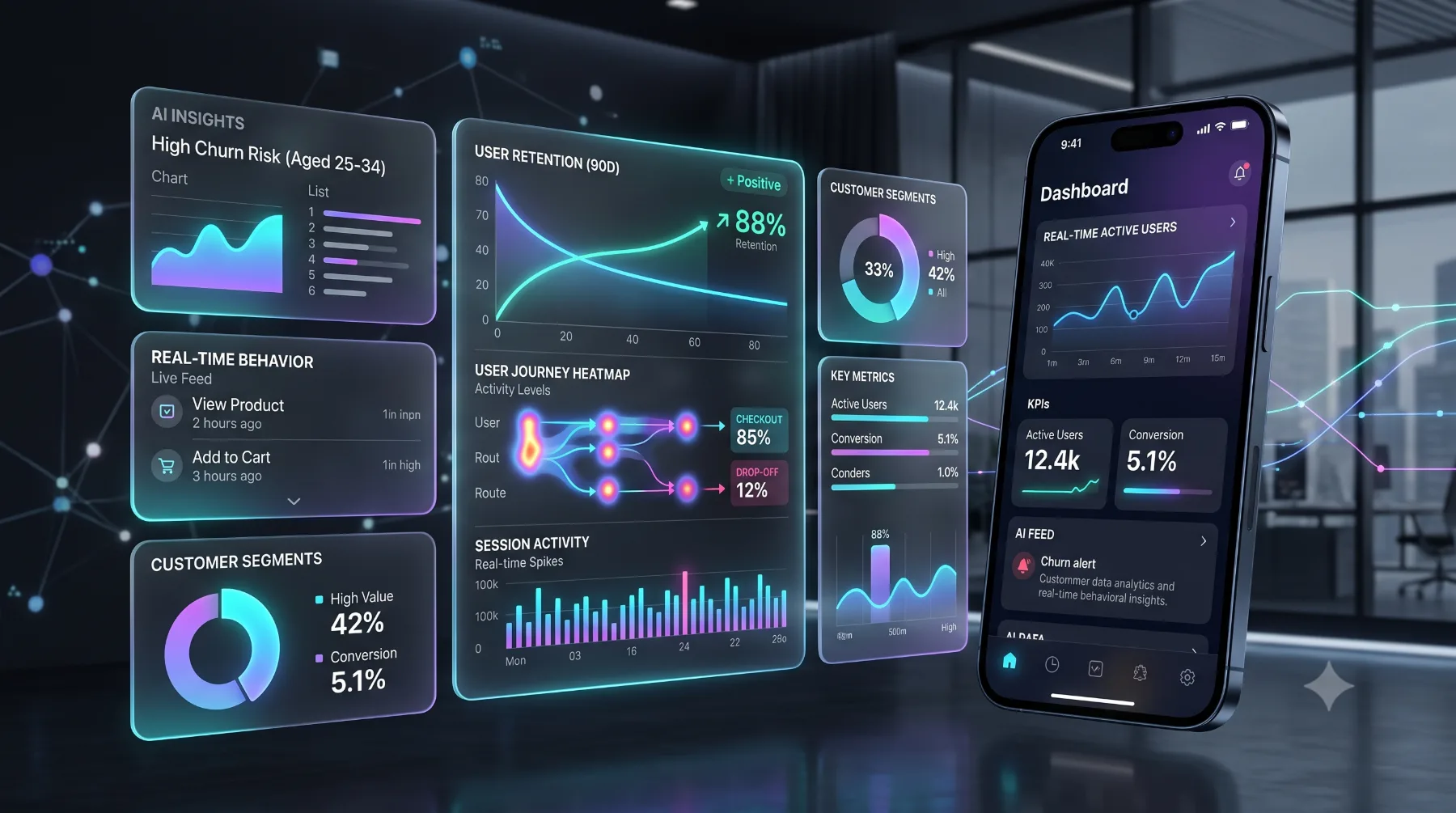
Selecting a dedicated custom app development company in Asansol empowers regional businesses to deploy high-performance mobile platforms. Modern users expect fast, tailored digital experiences that safeguard customer privacy. Integrating an AI customer data analytics and real-time behavioral insights dashboard turns active user interactions into immediate operational intelligence. Custom mobile app development gives your enterprise complete ownership over workflows, codebases, and scalable feature sets.
What a Custom App Development Company in Asansol Delivers
Local enterprises require software engineered around genuine ground-level requirements rather than generic software templates. A professional custom app development company in Asansol delivers full-lifecycle product development, crafting consumer-facing apps, enterprise utilities, and cross-platform mobile portals. When organizations operate specialized sales cycles or direct field distribution networks, standardized software fails to deliver competitive advantage.
Bespoke engineering bridges this operational gap by creating:
Consumer Engagement Apps (B2C): Native Android and iOS solutions offering swift checkouts, location-aware service delivery, and personalized loyalty programs.
Enterprise Resource Management (B2B): Internal operational applications that synchronize inventory levels, dispatch field technicians, and automate sales reporting.
Integrated Multi-Platform Portals: Mobile front-ends synced with broader web architectures, often developed alongside an experienced website development company in Asansol for omni-channel consistency.
Intelligence Dashboards: Real-time administrative consoles providing instant operational metrics, user churn warnings, and predictive purchasing patterns.
Powering Decisions: AI Customer Data Analytics and Real-Time Behavioral Insights Dashboard
The modern mobile application functions as a strategic intelligence channel. Integrating an AI customer data analytics and real-time behavioral insights dashboard equips businesses to move from backward-looking monthly reports to proactive, data-backed operational adjustments.
Event Streaming and Session Telemetry
Every touchpoint—including screen dwell duration, navigational backtrack paths, abandoned checkout funnels, and filter configurations—is ingested continuously through streaming telemetry pipelines like Apache Kafka or Firebase Analytics. Instead of parsing static end-of-day aggregates, decision-makers monitor live user trajectories across the product interface.
Predictive Modeling and Intent Scoring
Embedded machine learning algorithms evaluate live user behavioral sequences against historical customer journeys. If a shopper views an item multiple times without finishing the purchase, the behavioral intelligence module dynamically triggers contextual incentives or initiates personalized push sequences. Companies leveraging advanced media pipelines often incorporate algorithms from the best AI video generator 2026 to generate dynamic video recommendations directly inside the customer feed.
Automated Segmentation and Retention Engines
Traditional demographic cohorts are replaced with dynamic behavioral clusters. Users are grouped dynamically by transaction velocity, feature adoption rates, and drop-off risks. Automated churn-prevention engines identify declining activity early, triggering tailored retention workflows before customers disengage completely.
Strategic Features Tailored for Business App Solutions
Custom mobile software delivers complete architectural flexibility. Pre-packaged SaaS platforms restrict feature sets behind expensive licensing tiers, but bespoke development matches capabilities directly to operational realities.
| Feature Domain | Off-the-Shelf Packages | Custom Mobile App Solutions |
|---|---|---|
| Feature Domain | ||
| Workflow Alignment | Forces business to adapt to preset software rules | Adapts precisely to company workflows and team hierarchies |
| Data Architecture | Shared cloud tenancy with restricted database access | Private, dedicated database instances with custom indexing |
| ERP / Legacy Sync | Fragile webhooks or expensive third-party connectors | Native, secure API pipelines connected directly to core databases |
| User Experience | Cluttered, generic navigation with non-removable bloat | Clean, role-based interfaces designed for rapid task completion |
| Licensing Costs | Per-user recurring monthly fees that inflate with growth | Fixed capital asset with zero recurring per-seat penalties |
Research-Driven UI/UX Design for Local Audiences
Application adoption succeeds or fails at the visual interface. A product may boast robust backend infrastructure, but confusing UI/UX causes immediate abandonment. Designing applications for Tier-2 and Tier-3 industrial corridors requires balancing advanced functionality with intuitive navigation.
Visual Hierarchy and Touch Targets
Field technicians, delivery operators, and end consumers frequently operate devices on the move or under glaring sunlight. User interfaces require high-contrast color palettes, clear typographic scales, and generous touch targets (minimum 48x48 dp). Key transactional buttons remain anchored within comfortable thumb-sweep zones at the bottom of the screen.
Offline-First Architecture
Connectivity in industrial zones, distribution transit routes, and peripheral mining hubs can be intermittent. Localized UX architecture incorporates offline-first data caching via local SQLite or Realm databases. When a field user logs a collection receipt, service status, or inventory change, the interface confirms the action immediately and quietly synchronizes with central servers once network connectivity returns.
Multi-Language and Vernacular Accessibility
Serving diverse demographics requires regional language support. Integrating Bengali, Hindi, and English localization alongside iconography and voice-assisted search features ensures that all team members and customers navigate the interface confidently without formal training.
Step-by-Step Mobile App Engineering Lifecycle
Professional development teams follow a disciplined, milestone-based engineering framework to mitigate operational risks and prevent scope creep.
Strategic Discovery & Architecture Design: Analysts document core business requirements, draft user personas, map data flows, and outline cloud hosting topologies.
Wireframing & Interactive Prototyping: Designers craft clickable Figma prototypes, validating screen transitions, informational layouts, and navigational ergonomics with key stakeholders before writing code.
Frontend & Backend Engineering: Software engineers build frontend interfaces using modular frameworks while establishing secure backend REST or GraphQL microservices.
Automated & Manual Quality Assurance: Test engineers run unit tests, stress tests, security audits, and device fragmentation checks across multiple Android and iOS hardware configurations.
Production Deployment & Cloud Commissioning: Apps are packaged, cryptographically signed, and submitted to the Google Play Store and Apple App Store in full compliance with publisher guidelines.
Continuous Monitoring & Telemetry Tracking: Post-launch monitoring tools track latency, crash instances, and live telemetry to maintain optimal uptime and responsiveness.
Modern Technology Stacks for High-Performance Applications
Selecting an appropriate technical stack determines application performance, cross-platform maintainability, and long-term operating costs.
Cross-Platform Frameworks (Flutter & React Native): Allow engineering teams to maintain a unified codebase for both iOS and Android. This drastically lowers initial development capital and ensures simultaneous feature rollouts across platforms.
Native Development (Kotlin & Swift): Reserved for enterprise applications demanding raw hardware acceleration, intensive background telemetry, low-level Bluetooth/IoT integration, or heavy graphical processing.
Backend & Cloud Infrastructure: Scalable backend architectures leverage Node.js, Python (FastAPI/Django), or Go, supported by PostgreSQL and Redis caching layers deployed on AWS, Google Cloud, or Microsoft Azure.
API Security Standards: Data in transit is protected using TLS 1.3 encryption, token-based OAuth 2.0 authorization, and strict API gateway rate limits to deter automated scraping and unauthorized entry.
Cost Factors and Financial Planning for App Development
Engineering a bespoke application represents a long-term capital investment. Development budgets vary widely based on technical complexity, third-party integrations, and regulatory compliance standards.
Key variables governing cost include:
Platform Target: Choosing a cross-platform framework is generally 30% to 40% more cost-effective than building two separate native codebases for iOS and Android.
Backend Complexity: Simple CRUD (Create, Read, Update, Delete) apps require far fewer backend resources than platforms requiring real-time geolocation tracking, payment settlement engines, or predictive AI algorithms.
Regulatory & Tax Invoicing Workflows: Commercial software operating in India must generate statutory tax invoices with precise tax breakdowns. Engineering teams must understand how GST affects digital businesses in India to ensure accounting integrations run accurately.
Invoice Computation Engines: For consumer-facing platforms displaying taxes at checkout, developers must accurately program checkout calculations, such as how to calculate GST from an inclusive price or determining when to apply CGST and SGST versus IGST rules. Billing engines must also be tested for common reverse-tax equations, such as how to remove 18% GST from a total amount or parsing standard invoice figures like ₹1,180 including 18% GST — full calculation to avoid compliance penalties.
Enterprise-Grade Security and Regulatory Compliance
Data security cannot be an afterthought. High-profile data breaches and strict regulatory standards require development teams to embed defense-in-depth security principles across the software lifecycle.
Data Protection at Rest and in Transit
All database volumes storing customer credentials, transaction records, and behavioral logs must utilize AES-256 encryption. User communication between the mobile device and cloud microservices must enforce SSL pinning to thwart man-in-the-middle attacks.
Regulatory Alignment and Invoicing Precision
Enterprises handling commercial transactions across India must align customer billing interfaces with the legal standards outlined by the Goods and Services Tax Network (GSTN). Applications handling commercial billing workflows must clearly communicate tax breakdowns on the customer display, following guidelines on GST inclusive vs exclusive price: what changes on your invoice and implementing automated rules on how to calculate CGST and SGST (with IGST rules) based on buyer and seller jurisdictions.
Role-Based Access Control (RBAC)
Enterprise administrative panels enforce strict access governance. Customer support representatives, warehouse operators, and senior executives receive distinct cryptographic access tokens granting visibility only to the specific data views required for their job functions.
Long-Term Maintenance, SLA Support, and Lifecycle Management
Launching an application on the app stores is the beginning of the software lifecycle, not the end. Operating systems release major updates annually, third-party APIs update authorization standards, and consumer usage patterns shift over time.
A comprehensive Service Level Agreement (SLA) covers:
OS Compatibility Updates: Ensuring backwards compatibility when Android and iOS introduce revised privacy frameworks or notification permissions.
Performance Optimization: Routine database indexing, API caching refinement, and query optimization to preserve low latency as transaction volumes scale.
Security Patching: Ongoing vulnerability scanning, library updates, and hotfixes to counter newly discovered security exposures.
Feature Iteration: Using telemetry data from your real-time analytics dashboard to prioritize upcoming feature sprints based on actual user demand.
Conclusion
Investing in custom mobile architecture is a transformative move for growing enterprises. Partnering with an experienced custom app development company in Asansol provides your business with high-performance software tailored to regional conditions and engineered for scalable nationwide expansion. From research-backed UI/UX design and scalable backend microservices to advanced behavioral analytics and dependable post-launch maintenance, bespoke mobile app solutions furnish your enterprise with the modern operational foundation required to outpace competitors and achieve sustainable commercial growth.
Frequently asked questions
Why should my company hire a custom app development company in Asansol instead of using off-the-shelf software?
Turnkey SaaS platforms charge expensive monthly per-seat licensing fees and force your business to adapt its internal workflows to generic software constraints. Hiring a dedicated agency in Asansol delivers tailored software that matches your exact operational processes, grants complete source code ownership, and eliminates ongoing per-user subscription fees.
How much does it cost to build a custom business mobile application?
Development costs depend on project scope, target platforms (Android, iOS, or both), and architectural complexity. Basic operational utilities generally range from ₹1,50,000 to ₹3,50,000, while complex enterprise platforms featuring real-time data streaming, AI predictive engines, and ERP integrations range from ₹4,50,000 to ₹12,00,000 or more.
How does an AI customer data analytics dashboard improve app ROI?
An integrated AI dashboard transforms raw user actions into actionable operational metrics. By monitoring engagement heatmaps, purchase drop-offs, and behavioral retention patterns in real time, business owners can identify operational bottlenecks, automate personalized re-engagement campaigns, and measurably increase customer lifetime value.