Choosing the right mobile app can be an important decision for any business. Some businesses need an app built around their exact processes, while others simply need a quick and affordable solution. The right choice depends on your budget, business goals, required features, security needs, and expected growth. Custom apps offer more control, flexibility, and room for future growth, while ready-made apps can be faster and more affordable to launch. The right choice depends on your budget, business goals, required features, security needs, and expected growth.
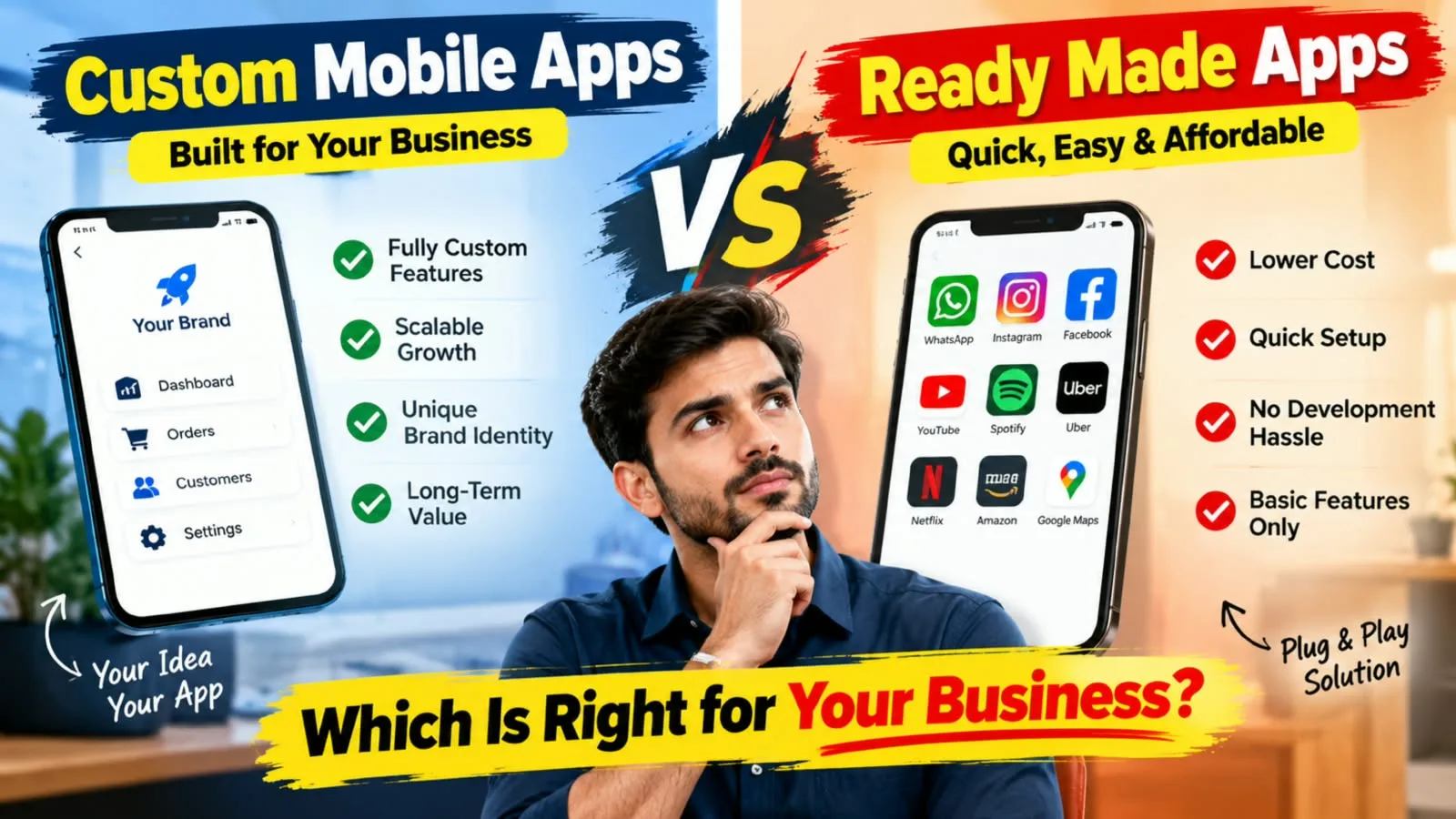
What Are Custom Mobile Apps?
A custom mobile app is developed specifically for a particular business. Instead of using a fixed structure, the development team creates the app according to the company's requirements, users, workflow, and branding.
For example,
a retail business may want an app with product management, customer accounts, online payments, order tracking, loyalty rewards, and personalized offers. A custom app can be designed to include these features in the way the business needs them.
Custom development also gives businesses more control over the user experience. The design, navigation, features, integrations, and backend systems can all be planned around specific business requirements.
This option is usually useful for businesses that have unique processes or need an app that can grow with them over time.
What Are Ready-Made Apps?
Ready-made apps are pre-developed solutions that businesses can start using with limited changes. These apps are generally designed for a specific type of business or common business requirement.
For example,
a small business may use a ready-made e-commerce app instead of developing an online shopping application from the beginning. The business can usually add its logo, products, colors, and other basic information before launching.
The biggest advantage is speed. Since most of the development work has already been completed, businesses can get their app ready much faster than building one from scratch.
Ready-made apps can also be more affordable, making them attractive to startups and small businesses with limited budgets.
However, they normally come with certain limitations. Businesses may not be able to change every feature or workflow according to their exact needs.
Custom Mobile Apps vs Ready-Made Apps: Key Differences
When comparing Custom Mobile Apps vs Ready-Made Apps, businesses should look beyond the initial development cost. Factors such as customization, scalability, security, maintenance, and development time can have a major impact on the long-term value of the app.
Cost
Cost is often one of the first things businesses consider.
Ready-made apps usually have a lower initial cost because the core application has already been developed. Depending on the provider, businesses may pay a subscription, licensing fee, setup fee, or other recurring charges.
Custom mobile apps normally require a larger initial investment. Developers need to plan, design, develop, test, and launch the application specifically for the business.
However, a lower initial cost does not always mean a lower total cost. A ready-made app may require additional payments for premium features, integrations, updates, or higher usage limits.
Custom development can cost more at the beginning, but businesses have greater control over what they pay for and what features they actually need.
Customization
Customization is one of the biggest differences between the two options.
With a custom app, almost every part of the application can be designed around the business. This includes the user interface, features, workflows, notifications, payment systems, and third-party integrations.
Ready-made apps generally offer predefined features. Some providers allow basic customization, such as changing colors, logos, content, or certain settings. However, deeper changes may not be possible.
If your business has a unique way of working, custom development may provide a better fit.
Features and Functionality
Ready-made apps usually provide common features that many businesses need. This can include user registration, product listings, booking systems, payments, notifications, analytics, or basic customer management.
For a business with standard requirements, these features may be enough.
Custom apps, on the other hand, can be built with specific functionality. Businesses can choose which features to include and how those features should work.
This does not mean a custom app should contain every possible feature. Adding unnecessary functions can make an app difficult to use and increase development costs. A good development strategy focuses on features that solve real customer or business problems.
Scalability
Scalability means the ability of an app to handle future growth.
A ready-made app may work well when a business is small. But as the number of users, transactions, products, or business operations increases, the available features and technical limitations may become a problem.
Custom apps can be designed with future growth in mind. Developers can create an architecture that allows new features, integrations, and users to be added later.
For businesses expecting rapid growth, this flexibility can be especially useful.
Development Time
Development time is another major difference.
Ready-made apps can usually be launched quickly because the basic product already exists. A business may only need to configure the application and add its own content.
Custom mobile app development takes longer because the application needs to be planned and developed from the beginning. The process may include research, UI/UX design, coding, testing, security checks, and deployment.
If a business needs to launch quickly and has standard requirements, a ready-made solution can be practical. If the business can wait for a more specialized solution, custom development may offer greater long-term benefits.
Security
Security should be considered carefully when choosing an app solution.
Ready-made app providers are responsible for maintaining the core application and fixing common security issues. However, businesses have less control over the underlying system.
When comparing Custom Mobile Apps vs Ready-Made Apps, security requirements can be considered during the development process. Developers can implement suitable authentication, access controls, data protection, secure APIs, and other security measures based on the application's needs.
However, custom development does not automatically make an app completely secure. Regular updates, testing, monitoring, and proper maintenance are still necessary.
Businesses handling sensitive customer or financial information should give security a high priority when selecting an app solution.
Maintenance and Updates
Every mobile app needs maintenance after launch. Operating systems change, devices are updated, security risks evolve, and users may request new features.
With a ready-made app, the provider usually handles much of the technical maintenance. This can reduce the workload for a small business.
The downside is that the business has to depend on the provider's update schedule and policies.
With a custom app, the business has more control over updates and improvements. However, it also needs a development team or maintenance partner to handle technical work.
This makes maintenance an important factor when calculating the long-term cost of an application.
Simple Comparison: Custom vs Ready-Made Apps
| Factor | Custom Mobile App | Ready-Made App |
|---|---|---|
| Cost | Higher initial investment | Usually lower |
| Customization | Very high | Limited To Available option |
| Features | Built around business needs | Predefined features |
| Scalability | Easier to plan for growth | Depends on provider |
| Development Time | Longer | Faster |
| Security Control | Greater control | Depends on provider |
| Maintenance | Business manages or outsources it | Usually handled by provider |
| Integrations | Can be built as required | May have limitations |
| Branding | Fully customizable | Usually basic customization |
| Best For | Growing or unique businesses | Small businesses with standard needs |
Which Option Is Better for Small Businesses?
There is no single answer for every small business.
A small company with a limited budget and simple requirements may benefit from a ready-made app. For example, If the main goal is to provide customers with basic booking, ordering, or information features, a pre-built solution may be enough.
On the other hand, a small business with a unique business model may benefit from custom development. If the company expects significant growth or needs special integrations, investing in a custom app from the beginning can make more sense.
The decision should be based on actual business requirements rather than simply choosing the cheapest option.
When Should You Choose a Custom Mobile App?
A custom app can be a better choice when your business needs features that are not available in standard solutions.
It can also make sense when you need integration with existing business software, customer databases, payment systems, inventory tools, or internal platforms.
Businesses that expect a large number of users may also prefer custom development because the application can be planned around expected growth.
Another reason is customer experience. If the app is an important part of how customers interact with your business, having complete control over the interface and user journey can provide an advantage.
Custom development is particularly suitable when the app is expected to become a major part of the business rather than just an additional digital tool.
When Should You Choose a Ready-Made App?
A ready-made app can be a good option when speed and affordability are the main priorities.
If your business only needs common features and does not have complicated workflows, there may be little reason to spend heavily on custom development.
It can also be useful for testing an idea. A startup may launch a ready-made solution to understand customer demand before investing in a fully customized product.
Ready-made apps can reduce development time and technical workload, especially for businesses that do not have an in-house development team.
However, it is important to check the provider's pricing, support, security practices, customization options, data ownership, and upgrade policies before making a decision.
Think About Long-Term Business Goals
Choosing an app should not only be about what the business needs today. It is also important to think about where the business wants to be in the next few years.
A ready-made app may be perfect for current needs but become restrictive as the business grows. Similarly, a custom app may provide more features than a small business actually needs at the beginning.
Businesses should consider expected users, future features, budget, technical resources, customer expectations, and the importance of the app to their overall business strategy.
It can also help to start with a clear list of must-have features instead of trying to build everything at once.
How to Make the Right Decision
Before selecting an app development approach, ask a few simple questions:
- What is our current budget?
- How quickly do we need the app?
- Do we need unique features?
- How much customization do our customers require?
- Will the number of users grow significantly?
- Do we need integrations with other business systems?
- How important is data security?
- Who will manage maintenance and updates?
- Will the app become an important part of our business?
The answers can make the decision much clearer.
If most requirements are standard and the priority is launching quickly, a ready-made app may be the practical choice. If the business needs flexibility, unique functionality, and long-term scalability, custom development may be more suitable.
Conclusion
Choosing between custom mobile apps and ready-made apps depends on your business goals, budget, timeline, features, security requirements, and future plans. Ready-made apps are generally faster and more affordable, while custom apps provide greater flexibility, control, and scalability. There is no universally better option. Businesses should first understand their current requirements and future growth before making a decision. The right mobile app is the one that solves real business problems while providing a useful and reliable experience for customers.
Frequently asked questions
What is the difference between a custom mobile app and a ready-made app?
A custom mobile app is built specifically for a business's requirements, while a ready-made app comes with pre-built features and limited customization options.
Is a custom mobile app more expensive than a ready-made app?
Yes, custom mobile app development usually has a higher upfront cost because the app is designed and developed specifically for the business. Ready-made apps generally have lower initial costs but may include recurring subscription fees.
Which is better for business growth: custom or ready-made apps?
Custom apps are generally better for businesses that expect long-term growth because they can be designed to support new features, users, integrations, and changing business requirements.
How long does it take to develop a custom mobile app?
The development time depends on the app's features, complexity, integrations, testing, and platform requirements. A simple app can take less time, while a complex business application may require several months.
Are custom mobile apps more secure than ready-made apps?
Custom apps can provide greater control over security because businesses can define their authentication, data protection, access controls, and other security requirements. However, both types require regular security updates and maintenance.
Can a ready-made app be customized for a business?
Yes, many ready-made apps allow basic customization such as branding, colors, content, and selected features. However, businesses may face limitations when they need unique workflows or advanced integrations.
How do I choose between a custom mobile app and a ready-made app?
Consider your budget, development time, required features, customization needs, security requirements, maintenance resources, and future growth plans. Choose a ready-made app for standard needs and faster deployment, or a custom app when flexibility and scalability are important.