1. How Does Google Ads Pricing Work in India?
Google Ads does not have one fixed rate like a newspaper advertisement. The cost can change from one search to another. In CPC campaigns, you pay when someone clicks your ad, and your actual CPC can be lower than your maximum CPC bid.
Before starting a campaign, a business should understand the difference between budget, CPC and actual advertising spend.
What Is CPC in Google Ads?
CPC means Cost Per Click. It is the amount paid for a click on your advertisement.
For example, suppose a business gets 100 clicks and the average CPC is ₹30.
100 clicks × ₹30 = ₹3,000
This is only an example. The actual CPC can be lower or higher depending on the auction, keyword and competition.
Google also allows advertisers to set a maximum CPC bid in campaigns that use CPC bidding.
Is There a Fixed Google Ads Price in India?
No. There is no single fixed Google Ads price India rate for every business.
For example, a local service keyword may have different competition from a high-value keyword related to finance, insurance, education or software.
This is why businesses should research their own keywords instead of using one average CPC for every campaign.
2. What Factors Affect Google Ads Cost in India 2026?
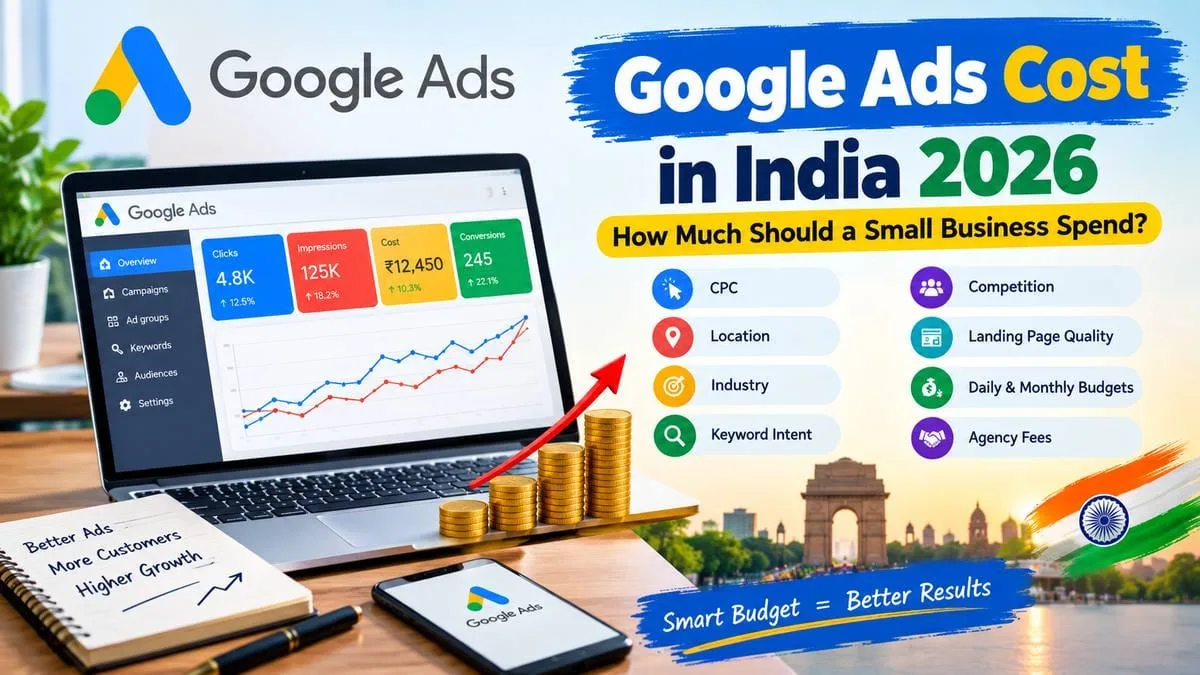
The Google advertising cost India businesses see can change because of several factors. Understanding these factors helps you create a more realistic budget.
Keyword and Search Intent
Keywords with strong buying intent can be more competitive.
For example:
- “What is digital marketing?” has informational intent.
- “Digital marketing company near me” has stronger business intent.
- “Buy website development service” can show even stronger commercial intent.
The more advertisers compete for valuable searches, the more difficult it can be to get clicks at a low price.
Industry and Competition
Different industries can have very different CPC ranges. High-value industries may have advertisers willing to pay more for a potential customer.
For example, a customer for a business loan or insurance product may be worth much more to a company than a simple low-value purchase. Because of this, CPC can vary widely.
A September 2026 estimate from upGrowth gives broad Indian Search CPC ranges from around ₹10 for some lower-cost terms to much higher amounts for competitive finance and insurance keywords. These are third-party estimates, not Google-set prices, so businesses should check their own Keyword Planner data before deciding a budget.
Location and Landing Page Quality
Location can also affect campaign costs. A campaign targeting one small city may behave differently from a campaign targeting many large cities across India.
Your landing page also matters. If someone clicks an ad and reaches a slow, confusing or unrelated page, the campaign may not perform well.
- A useful landing page should:
- Match the advertisement
- Explain the service clearly
- Work well on mobile
- Load quickly
- Have an easy contact or enquiry option
3. How Much Should a Small Business Spend on Google Ads?
There is no universal Google Ads monthly budget that works for every small business. The right amount depends on the business goal, average customer value, competition and expected conversion rate.
Google allows advertisers to set an average daily budget. For most campaigns, Google says the monthly charging limit is generally the average daily budget multiplied by 30.4. Daily spending can vary, but the monthly limit applies.
Example of a ₹500 Daily Budget
Suppose a business sets an average daily budget of ₹500.
Illustrative monthly calculation:
₹500 × 30.4 = ₹15,200
This can be a starting test budget for a small local campaign, depending on the CPC and competition.
For example, if the average CPC were ₹25, ₹15,200 could theoretically generate around 608 clicks before considering other factors. Actual clicks will vary because CPC is not fixed.
Example of a ₹1,000 Daily Budget
A business with a larger target area may choose an average daily budget of ₹1,000.
₹1,000 × 30.4 = ₹30,400
This gives the campaign more room to collect click and conversion data.
However, spending more money does not automatically mean getting better results. The keywords, advertisement, landing page and conversion tracking also need attention.
Example of a ₹2,000 Daily Budget
A business with a wider target market may test around ₹2,000 per day.
₹2,000 × 30.4 = ₹60,800
This is an illustrative media budget only. It does not include agency management fees, creative work or other marketing costs.
4. Google Ads Charges vs Agency Management Fees
One common mistake is to treat the advertising budget and agency fee as the same cost. They are different.
Google Ads charges are related to the advertising spend in the Google Ads account. An agency management fee is what you pay a marketing agency or professional for managing the campaign.
What Is Google Ads Ad Spend?
Ad spend is the money used for showing your advertisements and getting eligible interactions such as clicks, depending on the campaign type and bidding model.
For example:
Google Ads budget = ₹30,000/month
This means ₹30,000 is planned for advertising spend. Taxes and billing details should be checked separately in the account.
Google says advertisers control their average daily budget and can change it when needed.
What Is an Agency Management Fee?
An agency may charge separately for services such as:
- Campaign setup
- Keyword research
- Ad copy
- Campaign monitoring
- Conversion tracking
- Reporting
- Campaign optimization
Agency pricing is not fixed by Google. It can be a fixed monthly fee, a percentage of ad spend, or another agreed pricing model.
A 2026 third-party Indian pricing guide gives agency-management examples ranging from fixed monthly fees to percentage-based models, but these figures vary greatly by agency and service level.
Simple Example of Total Marketing Cost
Suppose:
Ad spend = ₹30,000/month
Agency fee = ₹10,000/month
Then:
Total planned marketing cost = ₹40,000/month
Here, ₹30,000 is the advertising budget and ₹10,000 is the management cost.
Always ask an agency clearly: “Is your fee separate from my Google Ads budget?”
5. How to Know If Your Google Ads Campaign Is Working
Looking only at clicks is not enough. A campaign can receive many clicks but still fail to generate useful enquiries or sales.
The goal should be to understand what happens after the click.
Check Clicks, CPC and Conversions
Important metrics include:
Clicks: How many people clicked your advertisement.
CPC: How much you paid on average for each click.
Conversions: How many people completed an important action, such as submitting a form, calling the business or making a purchase.
For example:
If you spend ₹10,000 and receive 200 clicks:
Average CPC = ₹10,000 ÷ 200 = ₹50
If 20 of those visitors become leads:
Cost per lead = ₹10,000 ÷ 20 = ₹500
This gives a much better picture than looking at clicks alone.
Check Lead Quality
Not every conversion has the same value.
Imagine two campaigns:
Campaign A: 30 leads, but most are not interested.
Campaign B: 15 leads, but many are serious customers.
The second campaign may have a different business value even though it has fewer leads.
That is why businesses should check lead quality, not only lead quantity.
Check Landing Page Performance
After clicking an advertisement, users should quickly understand:
- What the business offers
- Why they should choose the service
- How much information they need to provide
- How to contact the business
A clear landing page can make the advertising journey easier for visitors.
6. How to Control Google Ads Cost and Avoid Wasting Budget
A good campaign does not simply increase the budget. It also tries to use the existing budget carefully.
Google recommends starting with a budget you are comfortable with and monitoring campaign performance.
Start With a Focused Location
If you operate only in one city, you may not need to target the whole country.
For example, a local salon in Durgapur may first focus on customers in its service area instead of showing ads across India.
This can help the business use its budget more specifically.
Choose Keywords Carefully
Do not add every keyword related to your business.
Focus on keywords that match your actual service and customer intent.
For example, a website development company may focus on searches related to website development services rather than broad searches such as “website meaning.”
Keyword Planner can provide estimates for clicks, impressions and average CPCs to help with planning.
Improve Ads and Landing Pages
A clear advertisement should match the landing page.
For example:
Ad: Website Development Company in Durgapur
Landing Page: Website Development Services in Durgapur
When the message is consistent, users can understand the offer more easily.
7. Google Ads Monthly Budget: Which Budget Can a Small Business Start With?
A practical starting budget should match the business size and goal. The following examples are illustrative planning ranges for September 2026, not guaranteed performance levels.
Business situation Illustrative monthly ad spend
- Small local test ₹10,000–₹15,000
- Local service campaign ₹15,000–₹30,000
- Growing small business ₹30,000–₹60,000
- Wider or competitive campaign ₹60,000+
These amounts are not official Google recommendations. They are simple planning examples. Actual results depend on CPC, competition, targeting, conversion rate and business economics. Third-party 2026 Indian pricing research also shows that recommended budgets can vary significantly by industry.
When a Smaller Budget Can Make Sense
A smaller budget can be useful when you are testing:
- One location
- A small group of keywords
- One main service
- A new landing page
- A new advertising message
The aim is to collect useful data before making bigger changes.
When a Larger Budget May Be Needed
A larger budget may be needed when:
- CPC is high
- Competition is strong
- You target multiple cities
- You have many products or services
- You want more conversion data
But increasing the budget should come after checking campaign performance.
Think About Cost Per Customer
Instead of asking only “How much should I spend?”, ask:
“How much can I afford to spend to get one new customer?”
For example, if a customer gives your business ₹10,000 in profit, a campaign with a ₹500 cost per qualified customer may need to be evaluated differently from a campaign with a ₹5,000 cost per customer.
The correct target depends on your business numbers.
Conclusion
Google Ads Cost in India 2026 does not have one fixed number. Your actual cost can change because of CPC, keyword intent, industry competition, location, budget and landing page quality.
For a small business, starting with a controlled budget can make it easier to understand campaign performance. A budget of ₹10,000, ₹20,000 or ₹30,000 can mean very different things in different industries, so the number of clicks alone should not decide whether a campaign is successful.
The better approach is to track CPC, conversions, cost per lead, lead quality and customer value. Keep Google Ads spend separate from agency fees, review the campaign regularly, and increase the budget only when the campaign data supports the change.
Important: All pricing examples in this article are illustrative and based on information available in September 2026. Google Ads costs can change over time, so check your own Google Ads account and Keyword Planner before setting a final budget.
Frequently asked questions
What is the average Google Ads cost in India in 2026?
There is no single average price that applies to every business. CPC can vary by keyword, industry, location, competition and search intent. Third-party 2026 estimates show a wide range, so businesses should use their own keyword data for planning.
What is a good Google Ads monthly budget for a small business?
A small business can start with an illustrative test budget such as ₹10,000–₹30,000 per month, depending on its industry and target location. This is not a guaranteed recommendation. The business should choose a budget it can comfortably test and monitor.
Does Google Ads have a minimum daily budget in India?
Google does not set one universal minimum daily budget for all advertisers. Advertisers choose an average daily budget based on their goals and what they are comfortable spending.
Is Google Ads cost separate from agency fees?
Yes. Google Ads advertising spend and an agency's management fee are separate costs. An agency may charge for campaign setup, keyword research, monitoring, reporting and optimisation.
How can I reduce Google Ads cost?
You can work on targeting, keyword selection, advertisement quality, landing page quality and conversion tracking. The goal should not simply be the cheapest click; it should be getting useful traffic and conversions within a sensible business budget.