Search engines rely on complex algorithmic signals to evaluate websites, making it essential for webmasters and marketers to understand the most important SEO factors for ranking well. Securing sustainable organic visibility requires moving far beyond old tactics like repetitive keyword placement. Instead, sustainable growth comes from balancing user-focused content quality, robust technical architecture, mobile usability, and authoritative backlinks. Mastering these foundational elements ensures your online assets consistently earn search engine trust, attract qualified organic visitors, and convert engaged readers.
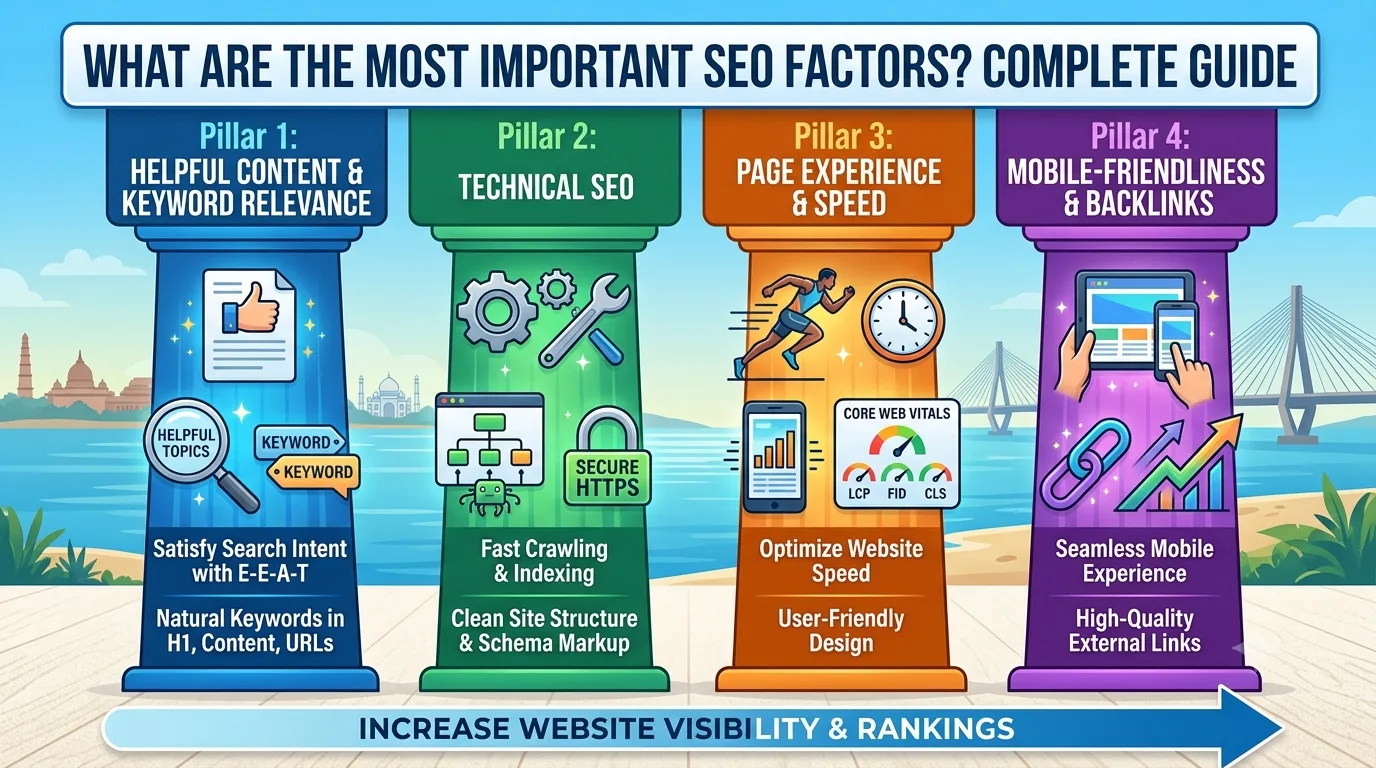
Helpful Content and Search Intent Alignment
At the center of search engine ranking systems is a commitment to satisfying the searcher's goal. Algorithms are engineered to reward original, well-researched content that solves problems directly rather than thin material created solely to rank for search queries.
Demonstrating Real E-E-A-T
Quality rater guidelines focus on Experience, Expertise, Authoritativeness, and Trustworthiness (E-E-A-T). Search systems favor pages that exhibit:
First-Hand Experience: Clear, original demonstrations, direct testing, real-life examples, or unique case studies.
Subject-Matter Expertise: Editorial authority backed by verified author credentials, clear editorial standards, and transparent authorship.
Topical Authority: Comprehensive coverage across a cluster of related topics, rather than isolated, generic articles.
Foundational Trust: Secure browsing, accurate source citations, and clear contact and ownership details.
Satisfying User Intent
Every search query carries a distinct motivation: informational (seeking knowledge), navigational (finding a specific brand), commercial (comparing options), or transactional (ready to purchase). Content that holds top rankings satisfies the specific intent immediately. Readers should never feel compelled to return to search results to find answers missing from your article.
Strategic Keyword Relevance and On-Page SEO
While search algorithms use sophisticated natural language processing (NLP) to grasp semantic context, strategic keyword integration remains essential for indexing.
Smart Keyword Placement
Modern on-page optimization is about relevance and structure, not density:
Heading Structure: Organize your content hierarchy with logical subheadings to break down topics into readable subsections.
Title Tags and Meta Descriptions: Craft compelling titles (between 40 and 60 characters) and meta descriptions (120 to 155 characters) that include primary keywords and encourage clicks.
Semantic Terms and Synonyms: Incorporate related entities, secondary keywords, and natural variations across the text to demonstrate topical depth to crawlers.
Technical SEO and Crawlability
Technical SEO ensures that search engine spiders can discover, crawl, render, and index your content without obstruction.
Indexation, Canonicalization, and Site Structure
A solid technical foundation keeps your site clean and understandable for automated crawlers:
Robots.txt & XML Sitemaps: Ensure your sitemap is updated and submitted in Google Search Console, while blocking low-value or sensitive scripts via
robots.txt.Canonical Tags: Implement self-referential canonical tags on distinct pages to avoid duplicate content dilution.
Clean URL Hierarchy: Use descriptive, lowercase slugs with hyphens (such as
/most-important-seo-factors) rather than messy query strings.Structured Data: Implement schema markup (such as
Article,FAQPage, andOrganization) to help search engines understand context and generate rich snippets in search results.
Build a Strong Technical Foundation
When evaluating technical priorities, foundational site health always comes first. Investing in modern development frameworks ensures clean HTML, optimized rendering pipelines, and proper responsive design across all devices. If you are building a modern digital presence or redesigning legacy platforms, partnering with an experienced website development company in Asansol can streamline your technical architecture, asset minification, and database efficiency right from the start.
Essential Technical Checklist
| Component | Function | Best Practice |
|---|---|---|
| Component | ||
| HTTPS Security | Encrypts user data | Standard SSL certificate across all routes |
| Crawl Budget | Conserves crawler resources | Eliminate redirect loops and broken 404 links |
| Mobile Viewport | Adapts layout dynamically | Responsive CSS without horizontal scroll |
| Schema Markup | Clarifies page entities | JSON-LD formatted structured data |
Page Experience and Core Web Vitals
User experience directly impacts organic performance. Through Google's Page Experience signals and Core Web Vitals, performance metrics serve as measurable ranking factors. For official technical documentation, review the Google Search Central ranking guidelines.
The Three Pillars of Core Web Vitals
Largest Contentful Paint (LCP): Measures perceived loading speed. Your main hero element or content block should render within 2.5 seconds of page load.
Interaction to Next Paint (INP): Assesses visual responsiveness and interface latency. The page must respond to user interactions (clicks, taps, keystrokes) in under 200 milliseconds.
Cumulative Layout Shift (CLS): Measures visual stability. Dynamic shifts in elements as images or ads load should maintain a score below 0.1 to avoid accidental clicks.
Website Speed and Performance Optimization
Page speed directly influences both bounce rates and conversion rates. Search engines prioritize fast-loading pages because modern users abandon sluggish websites.
Key Strategies for Faster Load Times
Image Compression: Convert images to modern formats like WebP or AVIF and specify explicit
widthandheightdimensions to prevent layout shifts.Code Minification: Minify CSS, JavaScript, and HTML bundles, while deferring non-critical scripts.
Browser Caching & CDNs: Implement aggressive browser caching and distribute assets across global content delivery networks (CDNs).
Server Response Time: Keep Time to First Byte (TTFB) low through quality hosting, optimized database queries, and lightweight backend architectures.
Backlinks and Off-Page Authority
High-quality backlinks can help strengthen a website’s authority and credibility. A backlink functions as an external vote of confidence from one domain to another.
Quality Over Quantity
Modern link building focuses entirely on relevance and trust:
Domain Relevancy: A single link from an established, industry-relevant publication carries significantly more value than dozens of links from generic blogs.
Editorial Naturalness: Earn links organically through original data reports, tools, insightful guides, and expert roundups rather than link schemes or reciprocal rings.
Anchor Text Diversity: Use natural, descriptive anchor text variations rather than repeated, exact-match commercial keywords.
Mobile-Friendliness and Mobile-First Indexing
Search engines index and rank the mobile version of a website first. Having a desktop site that looks great while your mobile site is slow or broken will directly hurt your rankings.
Delivering an Exceptional Mobile Experience
Responsive Layouts: Utilize fluid grids and flexible images that scale seamlessly across smartphones, tablets, and desktops.
Touch Targets: Ensure interactive buttons, navigation links, and form fields are properly spaced to prevent mis-clicks.
Parity of Content: Ensure your mobile version contains the exact same high-value text, images, structured data, and meta tags as the desktop version.
Internal Linking and Site Architecture
An intentional internal linking structure distributes link equity across your domain while helping search bots discover and contextualize related pages.
Connecting Contextual Content Hubs
Businesses managing commercial invoicing or financial workflows must track tax liabilities alongside digital marketing. In online transactions, knowing how GST affects digital businesses in India helps maintain regulatory compliance while optimizing ecommerce operations. Likewise, integrating innovative digital workflows, such as selecting the best AI video generator in 2026, allows modern marketing teams to produce high-engagement multimedia assets that boost dwell time and reduce bounce rates.
Conclusion
Understanding what are the most important SEO factors empowers businesses and creators to build a balanced, resilient organic growth strategy. By combining comprehensive, people-first content with strong technical health, fast Core Web Vitals, intuitive mobile design, and high-quality backlinks, you create an exceptional user experience that search algorithms consistently reward with higher rankings and sustained traffic.
Frequently asked questions
Which single SEO factor is the most important for rankings?
There is no single factor that guarantees success on its own. While high-quality, helpful content is the absolute prerequisite, it must be supported by technical crawlability, mobile responsiveness, fast load speeds, and authoritative backlinks.
How quickly do SEO optimizations improve search rankings?
SEO is an ongoing investment. While technical bug fixes can yield improvements in a matter of days or weeks, ranking for competitive terms usually takes anywhere from three to six months as search engines recrawl pages, measure user engagement, and recalculate link equity.
Are Core Web Vitals more critical than content quality?
No. Content relevance and depth remain the primary determining factors for rankings. However, when multiple pages offer equally helpful content on a topic, Core Web Vitals and page experience serve as crucial tie-breakers that determine which site takes the top spot.