Social media marketing involves many regular tasks, such as finding content ideas writing captions, scheduling posts understanding the audience answering customers, and checking performance. Doing all these tasks manually can take a lot of time every day. How AI Can Save Time in Social Media Marketing is especially useful for businesses that want to manage these tasks faster while still keeping their content useful and relevant.
AI can work like a digital assistant for marketers. It can help with repetitive tasks, organize information, suggest ideas and provide useful insights from social media data. For example a small business owner can use AI to create content ideas for an entire week instead of spending hours thinking about what to post. However AI should support human work rather than completely replace human creativity and judgment.
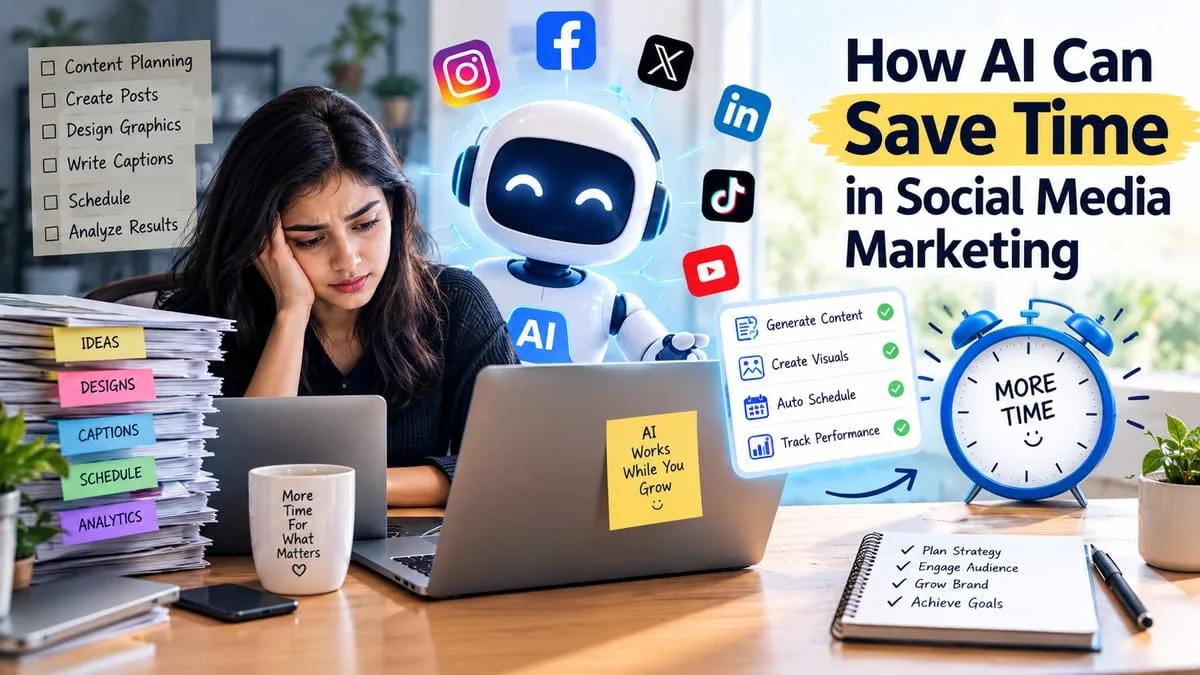
Ways AI Can Save Time in Social Media Marketing
AI can save time at different stages of social media marketing, from planning content to analyzing the results. How AI Can Save Time in Social Media Marketing becomes easier to understand when we look at the everyday tasks that marketers usually have to handle manually.
Instead of starting every task from zero, marketers can use AI to create a first draft, organize ideas, identify patterns, and summarize information. This allows them to spend more time on strategy, creativity, and communication with their audience.
AI Helps Generate Social Media Content Ideas
Coming up with new content ideas regularly can be challenging. A social media manager may need to create posts for several platforms while keeping every post useful and interesting for the target audience.
AI can make this process much faster by suggesting ideas based on a business, industry, audience or marketing goal For example, a small clothing business can ask an AI tool for 15 Instagram content ideas. It may suggest styling tips product information, customer questions, seasonal content, behind-the-scenes posts, and educational topics.
AI can also help turn one main topic into several smaller content ideas. This makes it easier to maintain a regular posting schedule without constantly starting the brainstorming process again.
Turn One Topic Into Multiple Content Ideas -
One useful feature of AI is its ability to create different content ideas from one topic. For example a business may have a blog post about healthy eating. AI can turn that topic into an Instagram carousel, a short video idea, a LinkedIn post, a simple caption, and several educational posts.
This is a practical example of How AI Can Save Time in Social Media Marketing because marketers do not need to create every piece of content separately. One original idea can become several pieces of content with small changes for different platforms.
The marketer can then choose the most useful ideas and add personal experience examples, or brand information. This keeps the content from sounding completely automated.
AI Can Make Caption Writing Faster
Writing captions can take more time than expected, especially when a business publishes several posts every week. AI can create caption drafts based on the topic, platform, audience, and preferred tone.
For example,
a restaurant launching a new dish can give AI basic information about the dish and ask for three caption ideas. The marketer can choose one draft and edit it to make it sound more natural and suitable for the brand.
AI can also create different types of captions, such as informative, friendly, professional or promotional. This gives marketers a useful starting point instead of writing everything from a blank page.
However, AI-generated captions should always be reviewed before publishing. AI may sometimes use generic language or include information that is not correct. A human can check the details and add the brand's own style.
AI Makes Social Media Scheduling Easier
Posting regularly is important for social media marketing, but managing a content calendar manually can become repetitive. When a business manages multiple platforms, marketers have to decide what to publish, where to publish it, and when to publish it.
AI-powered scheduling tools can help organize posts and suggest suitable posting times using available engagement data. They can also help identify empty spaces in a content calendar and suggest different content types.
For example,
a marketing agency managing several clients can use AI-assisted scheduling to organize posts for the coming week. The marketer can review the suggested schedule instead of manually arranging every post from the beginning.
Human judgment is still important because campaigns, product launches, holidays, and current events may require changes to the schedule.
AI Helps With Audience Research
Understanding the audience is a major part of social media marketing. Marketers need to know what their audience likes, what questions they ask, what problems they have and what type of content gets their attention.
AI can help analyze large amounts of available information more quickly. It can identify repeated questions common topics, audience interests, and patterns in engagement.
For example,
a software company may notice that many followers are asking how small businesses can use AI. AI can help identify this repeated interest and suggest related content topics, such as AI automation, productivity tools, customerservice, and content creation.
This reduces the amount of time marketers spend manually checking comments, messages, surveys and other audience information.
AI Can Speed Up Customer Responses
Social media has also become an important customer service channel. Customers may ask questions about prices, products, delivery, availability, features, or services through comments and direct messages.
AI can help create quick responses to common questions. For example, if customers frequently ask about delivery times, an AI system can suggest a response using information provided by the business.
AI can also help organize customer messages into categories. Questions about pricing, complaints, product information, and general inquiries can be separated so that the right person can handle them.
Human review is especially important for complaints sensitive situations and unusual customer requests. AI can make responses faster, but people should make the final decision when a conversation requires personal attention.
AI Can Help Analyze Social Media Performance
Checking social media performance manually can take considerable time. Marketers may need to review reach, impressions, clicks, engagement, follower growth, video views, and other metrics across different platforms.
AI can help summarize this information and identify important patterns. Instead of looking at every number separately, marketers can use AI to understand which posts performed well and which types of content received less attention.
For example,
AI may help a marketer notice that educational carousel posts received more saves than promotional posts during a particular period. The marketer can then consider creating more educational content.
AI can also summarize weekly or monthly reports, making it easier for marketers to understand their results. However, the actual data should still be checked before important marketing decisions are made.
AI Can Automate Repetitive Social Media Tasks
Many social media tasks are repetitive rather than creative. These can include organizing content ideas creating different versions of text, preparing content calendars, summarizing reports, categorizing comments, and checking basic performance information.
AI automation can reduce the manual work involved in these activities. This gives marketers more time to work on campaign ideas, creative concepts, brand strategy, and customer relationships.
For example,
a marketer can use AI to prepare a weekly social media report. Instead of manually collecting every metric and writing a summary, the marketer can review an AI-generated report and focus on understanding what the numbers mean.
Practical Example of Using AI in Social Media Marketing
Consider a small online clothing business launching a new collection.
The marketing team first asks AI to generate content ideas for the launch. From those ideas, they select topics for product posts, styling tips, short videos, and customer-focused content.
Next, AI helps create caption drafts for each post. The marketer reviews and edits them to match the company's tone. A scheduling tool is then used to organize the posts throughout the week.
During the campaign, AI can also helpidentify common customer questions. If several customers ask about delivery or product sizes, the team can prepare clear answers.
After the campaign, the marketer can use AI to summarize the performance data and identify which posts received the most engagement.
In this example, AI does not run the entire campaign by itself. Instead, it reduces repetitive work and gives the marketing team more time to focus on creative decisions and customer needs.
Human Review Is Still Important
AI can save time, but it should not completely replace human judgment. AI tools can sometimes make mistakes, misunderstand instructions, produce repetitive content, or provide incorrect information.
Human review is especially important when dealing with brand messaging, facts, customer complaints, sensitive topics, and promotional claims. Marketers should check AI-generated content before publishing or sending it to customers.
The best approach is to use AI for speed and human experience for quality. AI can provide ideas, drafts, summaries, and suggestions, while people can decide what is actually suitable for the business and its audience.
How to Use AI Without Losing Your Brand Voice
Saving time should not mean making every social media post sound the same. If a business publishes only generic AI-generated content, its social media presence may lose its unique personality.
Businesses can give AI clear information about their brand voice, target audience, preferred language, and communication style. They can also provide examples of previous posts to help create more suitable drafts.
For example,
a professional financial company may prefer a clear and educational tone, while a fashion brand may use a more casual and energetic style.
Marketers should also add their own experiences, examples, opinions, and brand-specific information. These details help make AI-assisted content more useful and authentic.
Conclusion
AI can reduce a large amount of repetitive work in social media marketing. It can help marketers generate content ideas, write caption drafts, organize schedules, research audiences support customer responses, and analyze performance.
How AI Can Save Time in Social Media Marketing ultimately depends on using AI as a helpful assistant rather than a complete replacement for people. When marketers combine AI's speed with human creativity, fact-checking, and decision-making, they can manage social media more efficiently while keeping their content useful, accurate, and connected to their audience.
Frequently asked questions
How can AI save time in social media marketing?
AI can save time by helping with content ideas, captions, scheduling, audience research, customer responses, and performance analysis.
How does AI help with social media scheduling?
AI can help organize content calendars and suggest suitable posting times based on available audience and engagement data.
Can AI help businesses understand their social media audience?
Yes, AI can analyze available audience data to identify common interests, questions, topics, and engagement patterns.
How does AI help with social media customer service?
AI can suggest quick responses to common customer questions and help categorize messages so marketers can handle them more efficiently.
Why is human review important when using AI for social media?
Human review helps check accuracy, maintain brand voice, remove generic content, and make sure posts are appropriate for the target audience.