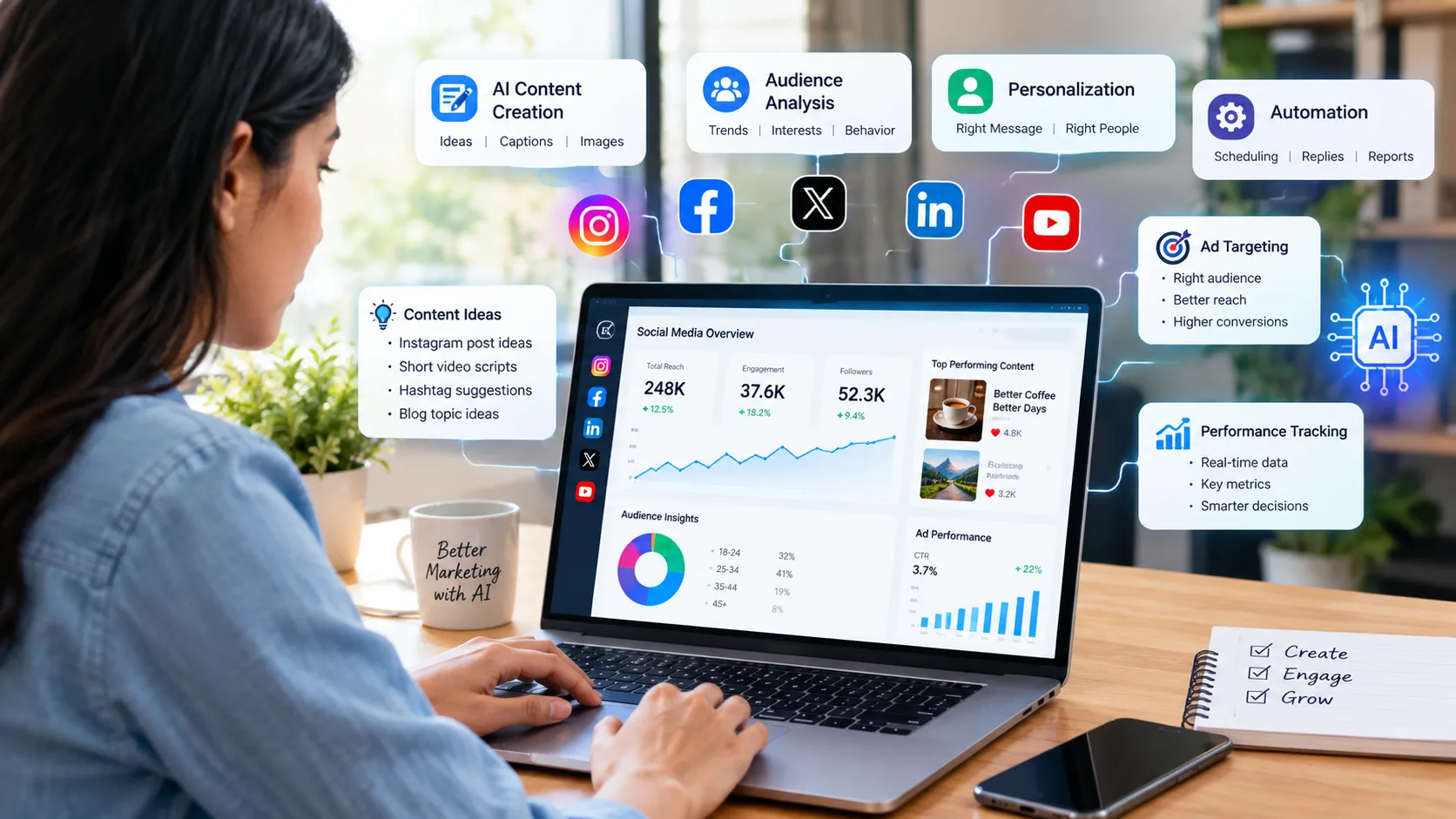
What Is AI in Social Media Marketing?
AI is changing social media marketing by helping businesses handle tasks that once required more human time and effort. AI in social media marketing means using artificial intelligence tools to help with tasks such as writing captions, creating images, finding audience patterns, answering common questions, scheduling posts, improving advertisements, and studying campaign results. Benefits of AI for Social Media Marketing
AI does not simply replace a social media manager. Instead, it works more like a smart assistant. It can process information quickly, suggest ideas, and identify patterns that may be difficult to notice manually.
A simple example
Imagine a clothing store wants to promote a new collection on Instagram. A marketer may use an AI tool to suggest five caption ideas, identify which type of customers interact most with similar posts, and create different ad versions for different audiences.
The marketer still decides which message fits the brand. This combination of technology and human judgment is important.
AI is becoming more useful because social platforms produce huge amounts of data every day. Likes, comments, views, clicks, shares, and purchases can all provide signals about what people are interested in.
Key Ways AI Is Changing Social Media Marketing
One of the clearest ways to understand this change is by looking at the everyday work of marketers. AI is moving social media from a mostly manual process toward a more data-driven and personalized approach.
Faster content creation
Creating social media content takes time. Marketers need ideas for posts, captions, short videos, headlines, product descriptions, and visual concepts. AI can help generate first drafts and creative ideas in seconds.
For example, a restaurant can give an AI tool information about a new weekend offer. The tool may suggest Instagram captions, Facebook post ideas, short video scripts, and calls to action.
AI also helps marketers adapt one idea for different platforms, formats, and audiences.
Better content ideas
AI can study previous content and help identify patterns. If short educational videos receive more engagement than ordinary image posts, an AI tool may suggest creating more videos around similar topics. Businesses can use these suggestions as starting points and then choose ideas that fit their audience, products, and brand voice.
AI for Audience Analysis and Personalization
Understanding this change starts with seeing how audience data can guide better content. AI can examine large amounts of audience and engagement data much faster than a person can.
Finding audience patterns
AI tools can help marketers identify patterns such as
Which posts get the most engagement
What time audiences are most active
Which topics attract more attention
Which audience groups respond to certain content
Which content leads to website visits or enquiries
For example, a local fitness business may discover that beginner workout videos receive more saves and shares than advanced workout posts. The business can then create more beginner-friendly content.
Personalized content
Personalization means showing people messages that are more relevant to their interests or actions. AI can help businesses create different versions of content for different audience groups.
A skincare brand, for example, might create separate messages for people interested in dry skin, oily skin, or general skincare tips. The basic brand message remains the same, but the content can be adjusted to match each audience.
Meta has also described how AI is being used to personalize content and ad recommendations based on interactions across its platforms.
AI Automation, Ad Targeting, and Customer Support
AI is especially useful for repetitive tasks, advertising, and customer communication. AI can help automate some of this work allowing marketers to focus on strategy and creative decisions.
Automating everyday tasks
AI-powered tools can assist with tasks such as:
Scheduling and organizing content
Suggesting captions and hashtags
Sorting comments or messages
Generating content variations
Identifying common customer questions
Creating basic reports
Recommending follow-up actions
For example, an online store may receive the same questions about delivery, payment, and returns every day. An AI-powered assistant can help answer simple questions while a human handles unusual or sensitive issues.
Smarter social media advertising
Advertising is another area where AI is becoming important. Instead of asking marketers to manually choose every targeting option, advertising systems can use machine learning to find people who are more likely to take a desired action.
Meta's Advantage suite, for example, uses automated tools for campaign targeting and delivery.
AI can also help create different versions of an advertisement and compare how audiences respond. A business might test different images, headlines, or offers and then use performance data to improve the campaign.
Better targeting does not automatically mean better marketing. The offer, creative quality, landing page, and customer experience still matter.
AI-powered customer conversations
AI can also support customer service on social platforms. It can help answer common questions, guide customers to useful information, and organize incoming messages.
For example, a travel company could use an AI assistant to answer basic questions about booking times or available services. A human team member can then take over when the customer has a complex request.
Benefits of AI for Social Media Marketing
The growing use of AI offers several practical benefits for businesses of different sizes. The impact of AI is not only about new technology; it is also about making everyday marketing work more efficient. marketing strategy
Saves time
AI can complete repetitive tasks quickly. A marketer can use that saved time for strategy, customer research, creative planning, and relationship building.
Supports better decisions
AI can process large amounts of information and highlight patterns. This can help marketers understand which content is performing well and where changes may be needed.
Google Analytics also uses machine learning and automated insights to help users identify unusual changes and emerging trends in their data.
Makes personalization easier
Creating separate messages for different audience groups can be difficult manually. AI can help marketers adjust content based on interests, behavior, and previous interactions.
Helps small businesses compete
A small business may not have a large marketing team. AI tools can help one or two people handle tasks that would otherwise require more time and resources.
Improves testing
AI can help marketers create and compare different content or ad variations. Instead of depending on one idea businesses can learn from real audience responses and improve future campaigns.
Why Human Review Still Matters
The use of AI does not remove the need for human judgment. AI can be useful, but it is not perfect. It can make mistakes, misunderstand context, repeat outdated information, or create content that sounds too general.
Check facts and brand voice
Every AI-generated caption, article, image, or customer reply should be reviewed before publishing. A human should check whether the information is correct and whether the message matches the company's tone.
For example, an AI tool may create a funny caption for a serious healthcare business. The sentence may be grammatically correct, but it may not fit the brand.
Protect trust and originality
Social media users can notice when content feels copied, repetitive, or overly automated. Businesses should use AI to support original thinking rather than publish large amounts of generic content.
Human experience also matters when responding to complaints, sensitive questions, or important customer feedback. These situations require understanding, empathy, and judgment.
Use AI as an assistant, not the whole strategy
A practical approach is simple:
Set the marketing goal.
Give AI clear information and context.
Use AI to generate ideas or analyze data.
Review and improve the output.
Publish the final version.
Measure the results.
Use what you learn to improve the next campaign.
This approach keeps technology useful while keeping people in control of the brand.
Grow Your Business With Smarter Digital Marketing
Want to use AI, social media, SEO, websites, and online advertising to grow your business? TZAP Marketing can help you build a stronger digital presence with practical digital marketing solutions.
Ready to grow your business online? Contact TZAP Marketing today and discuss your digital marketing goals with our team.
Conclusion
How AI Is Changing Social Media Marketing is really about making marketing faster, more data-driven, and more personalized. AI can help businesses create content, understand audiences, automate routine tasks, target advertisements, and track performance. But successful social media marketing still needs human ideas, careful review, creativity, and genuine communication. Businesses that use AI as a helpful assistant rather than a complete replacement for people can make better use of the technology while keeping their social media presence useful and trustworthy.
Frequently asked questions
Can AI create social media posts?
Yes. AI can help create captions, post ideas, scripts, headlines, and visual concepts. Human review is important before publishing.
Can AI understand a social media audience?
AI can analyze engagement and other available data to identify patterns in audience behaviour. It can help marketers understand what types of content perform well.
Does AI replace social media marketers?
Not completely. AI can automate repetitive work and support analysis, but marketers are still needed for strategy, creativity, brand decisions, communication, and human review.
How does AI help with social media ads?
AI can help with audience targeting, campaign delivery, creative variations, and performance analysis. The exact features depend on the advertising platform.
Is AI-generated social media content always better?
No. AI-generated content can save time, but quality depends on the instructions, data, editing, and human judgment behind it.
What is the main benefit of using AI in social media?
The main practical benefit is efficiency. AI can help businesses create, analyze, personalize, automate, and improve social media work faster while marketers focus on decisions that require human judgment.