Performance marketing
is a way for businesses to track what their ads achieve, from clicks and customer enquiries to sales.
For example, an online store can track how many people buy shoes after clicking an ad. This helps the business understand whether its advertising is bringing results.
But how does performance marketing work? Which channels do businesses use, and how can they measure success? 🤔
🚀 Let’s explore it step by step in simple English.
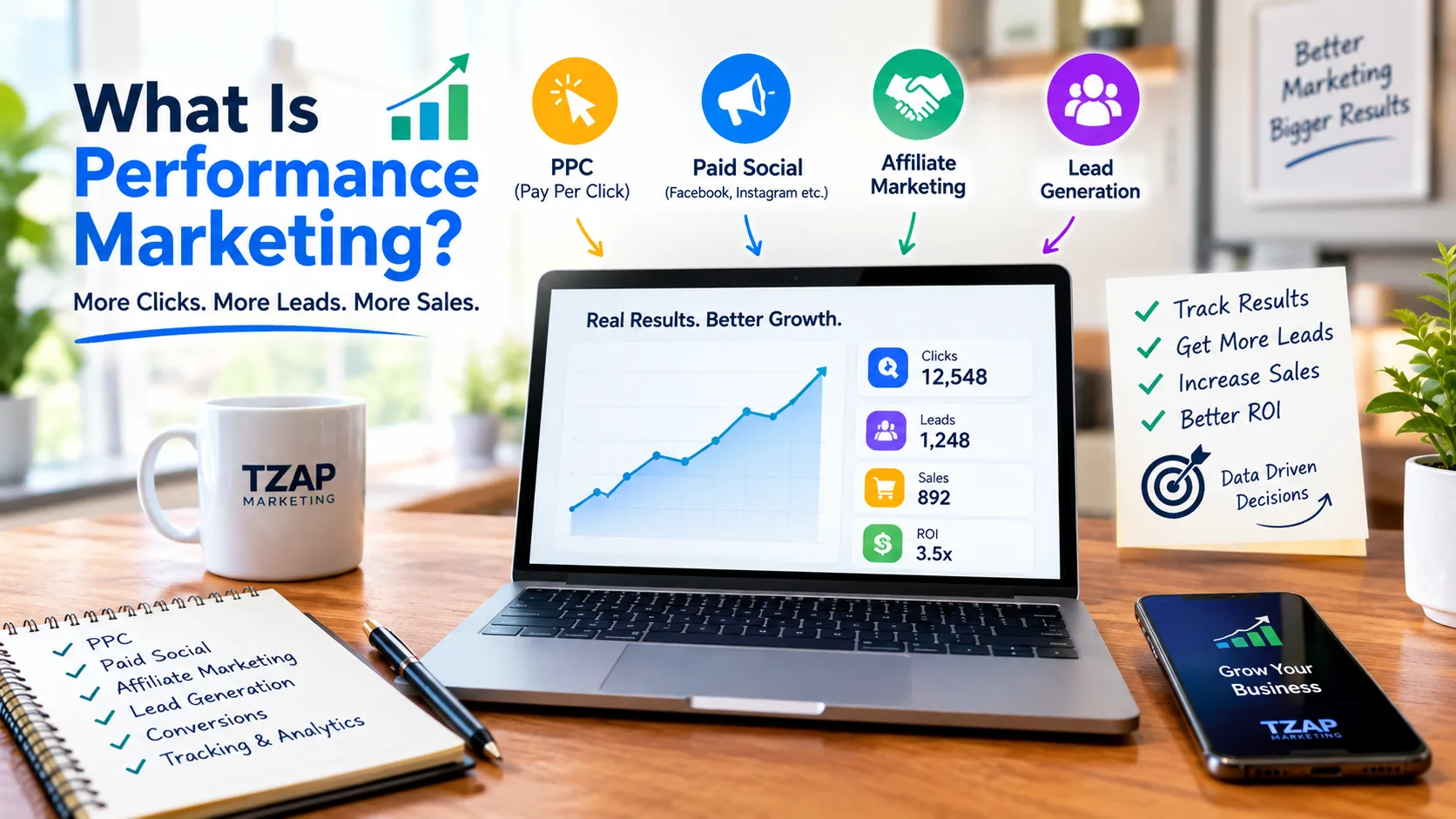
How Does Performance Marketing Work?
Performance marketing focuses on measurable actions such as clicks, leads, conversions, or sales, so businesses can evaluate campaign results and spending.
For example, a business may want people to:
✅ Click an ad
✅ Fill out a form
✅ Buy a product
✅ Sign up for a service
The business tracks these actions to understand how well its campaign is working.
The process is simple. Let’s break it down! 👇
1. 🎯 Set a Goal
Decide what you want to achieve, such as more sales, leads, app downloads, or website visits.
2. 📢 Choose a Channel
Choose a suitable platform, such as Google Ads, paid social media, or affiliate marketing.
3. 📝 Create Your Campaign
Prepare your ad, message, target audience, and landing page.
4. 📊 Track the Results
Measure clicks, enquiries, purchases, and other important actions.
5. 🔧 Improve Your Campaign
Use the results to improve your ads and manage your spending.
Example: How Much Does Each Lead Cost?
Imagine a business spends ₹5,000 on ads and gets 25 enquiries.
Here is the simple calculation:
💰 ₹5,000 ÷ 25 enquiries = ₹200 per enquiry
Now, the business can check whether these enquiries turn into customers and whether the campaign is worth continuing or improving.
Why Do Businesses Use Performance Marketing?
It helps businesses:
✅ Track campaign results
💰 Understand advertising costs
🎯 Find which channels bring leads or sales
📢 Compare different ads
📈 Make better marketing decisions
One important thing to remember: Getting clicks or enquiries does not always mean making a profit.
Businesses must also consider their costs, service quality, conversion rates, and how much value each customer brings.
👉 The goal is not just to get more clicks. It is to turn marketing results into real business value.
PPC Marketing: Pay-Per-Click Advertising
PPC stands for Pay-Per-Click. It is a type of online advertising where businesses generally pay when someone clicks their ad.
Google Ads is a common example of PPC advertising.
How Does PPC Work?
Imagine you run a website development company in Asansol. 💻
You create a Google ad for people searching for website development services.
When someone searches for a related service, your ad may appear in the search results.
If they click your ad, you may have to pay for that click.
You can then track whether the visitor contacts your business or requests a quote.
Where Can Businesses Use PPC?
PPC can help businesses:
✅ Get relevant website visitors
📩 Receive customer enquiries
🎁 Promote special offers
🛍️ Sell products online
🔎 Reach people searching for specific services
How Can You Improve PPC Results?
Start with a clear goal and a budget you can manage. 💰
Then follow these steps:
- ✅ Choose relevant keywords.
- ✍️ Write clear and useful ad messages.
- 🌐 Send visitors to a helpful landing page.
- 📊 Track calls, forms, and purchases.
- 🛑 Pause ads that waste money.
- 🧪 Test different messages and offers.
Remember: More clicks do not always mean better results. Your ads should attract people who are likely to take the action your business wants.
Paid Social Media: Reach the Right Audience
Have you ever seen an ad while scrolling through Instagram or Facebook?
That is one example of paid social media marketing.
Businesses pay to show ads on platforms such as Facebook, Instagram, and LinkedIn.
Search ads often reach people looking for something specific. Social media ads can introduce a product or service to people while they browse.
How Do Paid Social Ads Work?
A business creates an ad using an image, video, or written message.
It then selects an audience and a campaign goal.
Depending on the campaign, the ad may aim to get:
- 🌐 Website visits
- 💬 Messages
- 📝 Lead form submissions
- 🛍️ Product purchases
- 📲 App installs
- 👀 Brand awareness
For example, a clothing store can run Instagram ads to promote a new collection. It can then track website visits and purchases linked to the campaign.
What Makes a Social Media Ad Useful?
A good ad should quickly tell people what you offer and why it matters.
Try these simple tips:
✅ Use clear images or videos.
✍️ Keep the message easy to understand.
🎯 Focus on one main offer.
👉 Add a clear action, such as Shop Now, Learn More, or Contact Us.
🌐 Make sure the landing page matches the ad.
Track More Than Likes 📊
Likes and comments can show interest, but they do not always lead to sales.
Check the results that match your goal:
- 💰 Cost per lead
- 🛒 Cost per purchase
- 📈 Conversion rate
- 💵 Revenue from the campaign
- 🎯 Return on ad spend (ROAS)
These numbers help you understand whether your campaign is supporting your business goals.
Affiliate Marketing and Lead Generation
Affiliate marketing and lead generation help businesses reach potential customers and measure useful actions.
But how do they work? Let's understand both.
What Is Affiliate Marketing?
Affiliate marketing is a method where a person or website promotes a company's product or service using a special tracking link.
If someone buys through that link, the affiliate may earn a commission under the agreed terms.
Example: A blogger writes about website hosting tools and includes an affiliate link to a hosting service.
When a reader buys through that link, the blogger may receive a commission. 💰
Businesses can use affiliate marketing to reach new audiences and pay partners based on an agreed model.
What Is Lead Generation?
Lead generation means finding people who may be interested in your product or service.
A lead could be someone who:
📩 Fills out a contact form
📞 Requests a call
💼 Asks for a quote
📅 Books an appointment
💬 Requests more information
For example, a digital marketing company offers a free website review through an online ad.
Interested business owners fill out a form with their contact details. The company can then follow up with them.
How Can Businesses Improve Lead Quality?
Getting many leads is not enough if most people are not interested in buying.
To attract more relevant leads:
- ✅ Explain your offer clearly.
- 📝 Ask only useful questions on forms.
- 🎯 Target relevant audiences.
- ⚡ Respond to enquiries quickly.
- 📊 Track which leads become customers.
🔒 Privacy matters too. Collect personal information responsibly and explain how it will be used.
Conversions, Tracking and Performance Measurement
Imagine your ad gets 1,000 clicks but only a few people contact your business.
Are those clicks enough to call the campaign successful?
Not necessarily. You need to track what people do after clicking. 👇
What Is a Conversion?
A conversion is an action that matters to your business.
For example:
- 🛍️ Buying a product
- 📝 Submitting an enquiry form
- 📅 Booking an appointment
- 📞 Calling a business
- ✉️ Signing up for a newsletter
- 📲 Downloading an app
Before launching a campaign, decide which actions you want to measure.
Important Performance Marketing Metrics
| Metric | What It Means |
|---|---|
| Click-through rate (CTR) | The percentage of ad impressions that result in clicks |
| Cost per click (CPC) | The average cost of each click |
| Conversion rate | The percentage of visitors who complete the desired action |
| Cost per lead (CPL) | The average cost of generating a lead |
| Cost per acquisition (CPA) | The average cost of gaining a customer or another defined acquisition |
| Return on ad spend (ROAS) | Revenue attributed to ads compared with ad spend |
These numbers help you understand where your advertising budget is going.
For example, one campaign may bring many clicks but very few enquiries.
You may need to improve the audience, ad message, or landing page.
Use Tracking Tools
Businesses can use tools such as:
📊 Google Analytics
🎯 Google Ads conversion tracking
📱 Reporting tools available on advertising platforms
Set up tracking before launching your campaign whenever possible. Otherwise, it may be difficult to understand what happened.
Check your results regularly, but avoid making major changes based on very little data.
How to Build a Performance Marketing Strategy for Your Business
You do not need to use every marketing channel at once.
Start with the goal that matters most to your business.
Choose the Right Channel
Your choice depends on what you sell and how your customers find you.
| Channel | Main Purpose |
|---|---|
| Google Ads | Reach people searching for relevant products or services |
| Paid social media | Introduce offers and reach selected audiences |
| Affiliate marketing | Promote products through partners |
| Lead generation campaigns | Collect enquiries from potential customers |
Some businesses may benefit from using more than one channel.
However, each campaign should have a clear purpose.
Set a Budget and Test Carefully
Decide how much you can afford to spend.
Start with a controlled budget and review the results before increasing your spending.
Do not judge a campaign only by clicks.
Check:
✅ How much you spend on leads
✅ How many leads become customers
✅ How much revenue the campaign generates
Remember, a lead is not always a sale.
Your sales process and follow-up can also affect the final result.
How TZAP Marketing Can Help
Managing ads, tracking results, and improving a website can take time, especially when you are also running a business.
TZAP Marketing provides services across Google Ads, Meta Ads, SEO, social media, websites, applications, AI, and automation. 💻
For example, paid ads can bring visitors to a landing page, while conversion tracking helps measure enquiries and sales.
These activities can be planned together to support your online growth.
The right strategy depends on your business goals, target audience, budget, and current marketing setup.
Conclusion
So, What Is Performance Marketing? It is a way to plan, measure, and improve digital marketing campaigns using results such as clicks, leads, conversions, and sales.
Here are the main methods to remember:
- 🎯 PPC advertising: Reach people through paid clicks.
- 📱 Paid social media: Promote offers and reach audiences.
- 🤝 Affiliate marketing: Work with partners who promote your products.
- 📩 Lead generation: Attract people interested in your business.
- 📊 Performance tracking: Understand results and advertising costs.
You do not need to do everything at once.
Start with one clear goal, choose a suitable channel, and track the actions that matter to your business.
Use the results to improve your campaigns instead of spending money without knowing what works.
The goal is not just to get more clicks. It is to understand how your marketing contributes to real business results.
📚 Want to Learn More?
If you want to explore more about AI, marketing, and business, these guides may help:
👉 How to Grow a Business With Marketing: A Practical Guide
👉Small Business Ideas With Big Potential for New Entrepreneurs to Start
👉 Best Business Ideas for the Future
👉Business Ideas You Can Start With Low Investment
Frequently asked questions
What is performance marketing in simple words?
Performance marketing is a type of digital marketing where businesses pay for measurable results, such as clicks, leads, sales, or conversions.
What are the main types of performance marketing?
The main types include PPC advertising, paid social media, affiliate marketing, and lead generation campaigns.
How does performance marketing work?
Businesses run online campaigns, track their results, and measure metrics such as clicks, conversions, cost per lead, and return on ad spend (ROAS).
Is performance marketing suitable for small businesses?
Yes. Small businesses can start with a limited budget, target specific audiences, and track campaign results to understand how their advertising money is being spent.
How can TZAP Marketing help with performance marketing?
TZAP Marketing can help businesses plan and manage Google Ads, Meta Ads, lead generation campaigns, and performance tracking to measure marketing results.