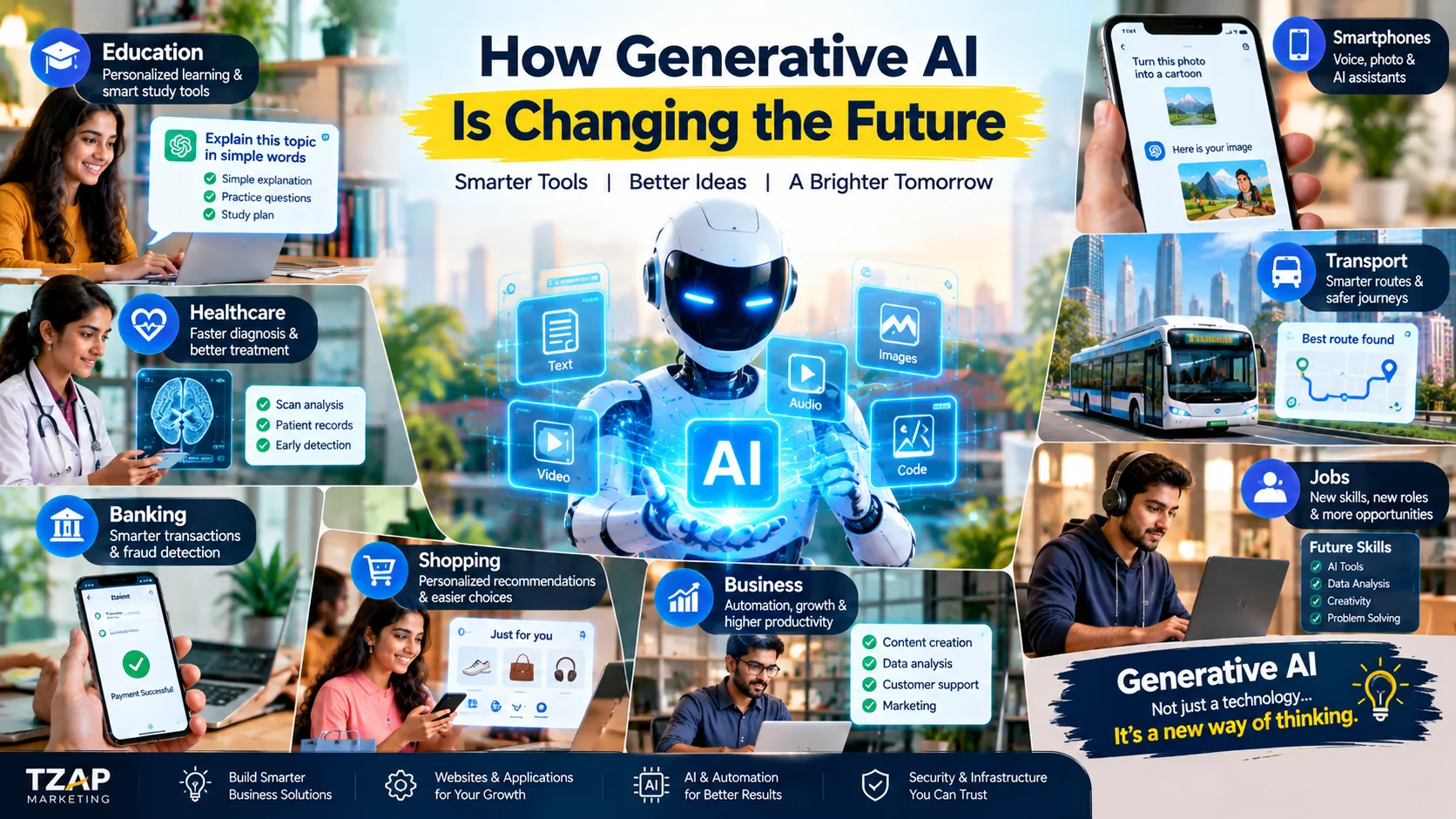
In this article, we will explore how Generative AI could change work, education, businesses, creativity, healthcare, cybersecurity, software development and everyday life — and what people should do to prepare for the future
What Is Generative AI?
Generative AI is a type of AI that can create new content from the information it has learned.
It can create:
✅ Text
✅ Images
✅ Audio
✅ Videos
✅ Computer code
✅ Summaries
✅ Translations
For example, you can ask:
“Write a short description for a pair of running shoes.”
AI can create a draft in seconds.
You can also ask:
“Explain photosynthesis to a Class 5 student.”
AI can make the explanation simpler and easier to understand.
This is what makes Generative AI useful for students, creators, workers and businesses.
But AI is not always correct. It can misunderstand a question or give information that sounds right but is actually wrong.
👉 Always check important AI-generated information before using it.
How Generative AI Is Changing the Future of Work
Generative AI could change the way people work. 💼
Many jobs include simple and repetitive tasks, such as:
✅ Writing simple emails
✅ Making basic reports
✅ Summarising documents
✅ Creating first drafts
✅ Finding information
✅ Organising data
✅ Answering common questions
AI can help workers complete some of these tasks faster.
But this does not mean AI will replace every worker.
A more likely change is that people will use AI as a work tool.
For example:
✅ A marketer could use AI to create headline ideas and then improve them.
✅ A programmer could use AI to create a first version of code and check it.
✅ A customer support worker could use AI to prepare a reply before sending it.
This means future workers may need two types of skills:
Professional skills + AI skills
👉 Learning how to use AI properly could become an important part of many jobs.
AI Could Change the Skills People Need
As AI becomes more common at work, knowing how to use AI could become a useful skill. 💡
But AI prompts alone are not enough.
People will still need to understand their own work.
For example:
✅ A marketer should understand marketing before using AI.
✅ A doctor needs medical knowledge when using AI-assisted tools.
✅ A financial professional needs financial knowledge before using AI-generated analysis.
Human skills will also remain important:
✅ Communication
✅ Creativity
✅ Critical thinking
✅ Problem-solving
✅ Decision-making
✅ Teamwork
✅ Industry knowledge
If you want to learn more about careers and skills, read our guide AI Jobs in India by 2030: Skills, Careers & Future Opportunities.
👉 The key idea is simple: AI skills can support professional skills, but they cannot replace the need to understand the work itself.
Businesses Can Create More Content With Less Manual Work
Businesses create different types of content every day. 🏢
For example:
✅ Social media posts
✅ Blog ideas
✅ Product descriptions
✅ Emails
✅ Advertisements
✅ Presentations
✅ Customer messages
✅ Video scripts
Generative AI can help create the first draft of this content.
This can save time, especially for small teams.
For example, a small business owner can give AI details about a new product and ask it to create:
(i)Product description
(ii)Social media post
(iii)Email
(iv)Video script
The owner can then check, edit and improve the content before using it.
👉 AI can speed up content creation, but businesses should not publish AI-generated content without checking it.
You can learn more about this use case in AI Customer Support for Small Business.
AI Customer Support for Small Businesses:
Good content still needs correct information, a clear purpose and human review.
1. Customer Support Could Become Faster
Customer support is another area where Generative AI can help. 💬
Businesses often receive the same questions again and again:
“What are your delivery charges?”
“Where is my order?”
“What are your working hours?”
“How can I return this product?”
AI can help answer simple questions quickly.
A human employee can then handle questions that need more attention.
This creates a simple combination:
AI for simple questions + humans for complex problems.
For small businesses, this can be useful because they may not have a large support team.
You can learn more about this use case in How AI Can Help Local Businesses.
👉 But businesses should always check AI responses. An incorrect answer can frustrate customers and reduce trust.
2. Education Could Become More Personal
Generative AI could make learning more personal. 📚
In a normal classroom, many students may learn the same topic in the same way.
AI can explain the same topic in different ways.
For example, a student can ask:
“Explain gravity with a simple example.”
If they still do not understand, they can ask AI to explain it in easier words.
AI can also help create:
✅ Practice questions
✅ Flashcards
✅ Short summaries
✅ Study plans
✅ Writing suggestions
✅ Language translations
Students can also explore useful AI tools for studying, research and daily learning. If you want to see some practical options, check our guide Best AI Tools for Students in India 2026 .
This could make learning more flexible.
But AI should not become a shortcut for learning.
Students still need to understand, think and check information.
Teachers are also important because they provide human guidance, classroom interaction and personal support.
👉 AI can support teachers and students, but it does not replace the human side of education.
3. Generative AI Could Change Creative Work
Writers, designers, video creators, musicians and other creative people are already using Generative AI. 🎨
AI can help them create ideas, make drafts and try different styles.
For example, a YouTube creator could use AI for:
✅ Video ideas
✅ Scripts
✅ Titles
✅ Thumbnail ideas
✅ Voiceovers
✅ Captions
✅ Translations
A designer could also use AI to create different design ideas before making the final version.
But this does not mean all creative work will become automatic.
Creative work still needs experience, storytelling, creativity and human decisions.
👉 AI can help creators work faster, but the final idea and creative direction can still come from the human.
4. AI Could Help Developers Build Software
Generative AI is also changing how developers build software. 💻
AI coding tools can help developers:
✅ Write code
✅ Explain code
✅ Find possible errors
✅ Create tests
✅ Write documentation
✅ Understand unfamiliar code
This can make some development tasks faster.
But AI-generated code is not always correct or secure. Developers still need to test the code and understand what it does.
They also need to check whether the code fits the project and works as expected.
👉 AI can act like a coding assistant, but developers still need technical knowledge and human judgment.
5. Healthcare Could Use Generative AI Carefully
Healthcare is another area where Generative AI could help. 🏥
But this is a sensitive field, so AI needs to be used carefully.
AI could help with:
✅ Summarising medical information
✅ Organising patient records
✅ Supporting research
✅ Preparing patient communication
✅ Helping professionals review information
The important word is support.
AI-generated medical information should not automatically be treated as medical advice.
Healthcare decisions can be serious, and AI can sometimes make mistakes.
Privacy is also important because medical information is sensitive.
👉 The future of AI in healthcare will depend on careful testing, privacy, safety and human oversight.
6. Cybersecurity Will Change With AI
Generative AI could also change cybersecurity. 🔐
Security teams can use AI to:
✅ Analyse large amounts of information
✅ Summarise security alerts
✅ Find possible threats
✅ Support security operations
But AI can also create new risks.
For example, attackers could use AI to create more convincing scam messages or harmful content.
This means security teams may also need AI tools to find and respond to new threats.
It could create a continuous cycle:
Better AI tools → New attacks → Better security tools → New attacks
However, AI cannot replace basic security practices.
Businesses still need:
✅ Strong passwords
✅ Access controls
✅ Regular software updates
✅ Data backups
✅ Security awareness
👉 AI can support cybersecurity, but businesses still need strong security practices and human oversight.
If you want to learn more, read AI Cybersecurity Explained: How AI Is Changing Online Security.
7. Robots Could Bring AI Into the Physical World
Generative AI is mostly used in software, but AI could also become more connected with robots. 🤖
Robots need to understand their surroundings and decide what to do.
Future AI systems could help robots understand spoken instructions and interact with people more naturally.
For example, someone could tell a robot:
“Take this box to the storage area.”
The robot would need to understand the instruction, identify the box and find the right place.
Humanoid robots are still an emerging technology, and their widespread use is not guaranteed.
AI-powered robots could eventually be used in areas such as:
✅ Factories
✅ Warehouses
✅ Healthcare
✅ Other physical work environments
If you want to learn more, read Humanoid Robots in India: The Future of AI Robots.
👉 The combination of AI and robotics could bring intelligent systems from screens into the real world.
What Could Generative AI Mean for the Future?
It is difficult to predict exactly how Generative AI will change the future.
Some changes are already happening, while others are still possible.
Generative AI could affect many areas:
✅ Businesses may use AI for more automation.
✅ Workers may use AI as a daily assistant.
✅ Students may get more personalized learning.
✅ Creators may make content in more formats and languages.
✅ Developers may use AI more often when building software.
✅ Customer support may combine AI with human workers.
✅ Robots may become more closely connected with advanced AI.
But the future also brings important questions.
Will AI Create More Jobs or Remove More Jobs?
The answer may be different for each industry and type of work.
Some tasks could become automated, while new roles and skills may also develop.
Will AI Always Give Correct Information?
No.
AI can sometimes produce incorrect or misleading information.
That is why important AI-generated information should be checked before it is used.
Will Everyone Benefit Equally?
Not necessarily.
Access to technology, internet infrastructure, education and AI skills can affect who benefits from these changes.
Will Businesses Still Need Humans?
Yes.
Even with more automation, businesses still need people to:
✅ Make important decisions
✅ Understand customers
✅ Build relationships
✅ Solve complex problems
✅ Take responsibility for important outcomes
The future of AI is not something we can know with certainty.
A better way to think about Generative AI is not to ask:
“What will definitely happen?”
Instead, ask:
“What could happen, and how can we prepare?”
👉 The future of Generative AI will depend not only on what AI can do, but also on how people and businesses choose to use it.
How Generative AI Is Changing the Future: What Should We Do Now?
The best way to use AI is not to use it for everything.
Start with a real problem.
For example:
✅ If a business spends hours answering the same customer questions, test AI customer support.
✅ If employees spend too much time making basic reports, try AI-assisted reporting.
✅ If a student finds a topic difficult, use AI as a learning assistant.
✅ If a creator spends too much time preparing drafts, use AI to speed up the first stage.
Then check the results.
Ask yourself:
✅ Did it save time?
✅ Was the output accurate?
✅ Did it reduce the workload?
✅ Did it create any new problems?
✅ Does a human still need to review the result?
This simple approach can help people and businesses use AI in a practical way.
👉 Use AI to solve a real problem, check the results and keep human review where it matters.
How Generative AI Is Changing the Future for Businesses
For businesses, the biggest opportunity may not be replacing people.
It may be helping people work better and faster.
A small team using the right AI tools could handle more research, content, customer communication and routine tasks than before.
But AI alone is not enough.
Businesses still need:
✅ Good products
✅ Good customer service
✅ Accurate information
✅ Strong security
✅ Human decision-making
✅ Clear processes
✅ Responsible AI use
This is where digital marketing and AI can work together.
For example, a business could use AI to research content ideas and create a first draft. But SEO strategy, customer understanding and human editing are still important.
TZAP Marketing works with businesses in India across digital marketing, websites and applications, AI and automation, and security and infrastructure.
For a business exploring AI, the better starting point is usually a real business problem, not simply buying the newest AI tool.
👉 Find one problem, test one suitable AI solution and measure the result before expanding its use.
Final Thoughts
How Generative AI Is Changing the Future is not simply about machines doing everything humans do.
It is about how people and technology may work together in new ways.
Generative AI can create text, images, audio, video and code. It can help businesses handle repetitive tasks, support creators, assist students and make many digital tasks easier.
But AI also has limits. It can make mistakes and create new risks. People still need to check important information, protect sensitive data and understand how AI is being used.
The future will not depend on AI alone.
It will also depend on how people use AI, which skills they develop and how responsibly businesses use the technology.
For readers and business owners, preparing for this future can start with a few simple steps:
✅ Learn the basics of AI
✅ Find useful ways to apply it
✅ Test one tool at a time
✅ Check the results
✅ Keep human judgment where it matters
Generative AI is changing the future, but humans will still play an important role in deciding how that future develops.
Frequently asked questions
What is Generative AI?
Generative AI is a type of artificial intelligence that can create content such as text, images, audio, video and code from user instructions.
How is Generative AI changing businesses?
It can help businesses with content creation, customer support, research, software development, marketing and other repetitive tasks.
Will Generative AI replace jobs?
Some tasks may become automated, while other jobs may change and new roles may appear. The impact will depend on the industry, job and level of AI adoption.
How can small businesses use Generative AI?
Small businesses can start with practical uses such as customer support, content drafts, research, translation, data summaries and repetitive office work.
What is the future of Generative AI?
Generative AI could become more common in business, education, software, creative work, customer service and other areas. The exact impact remains uncertain.