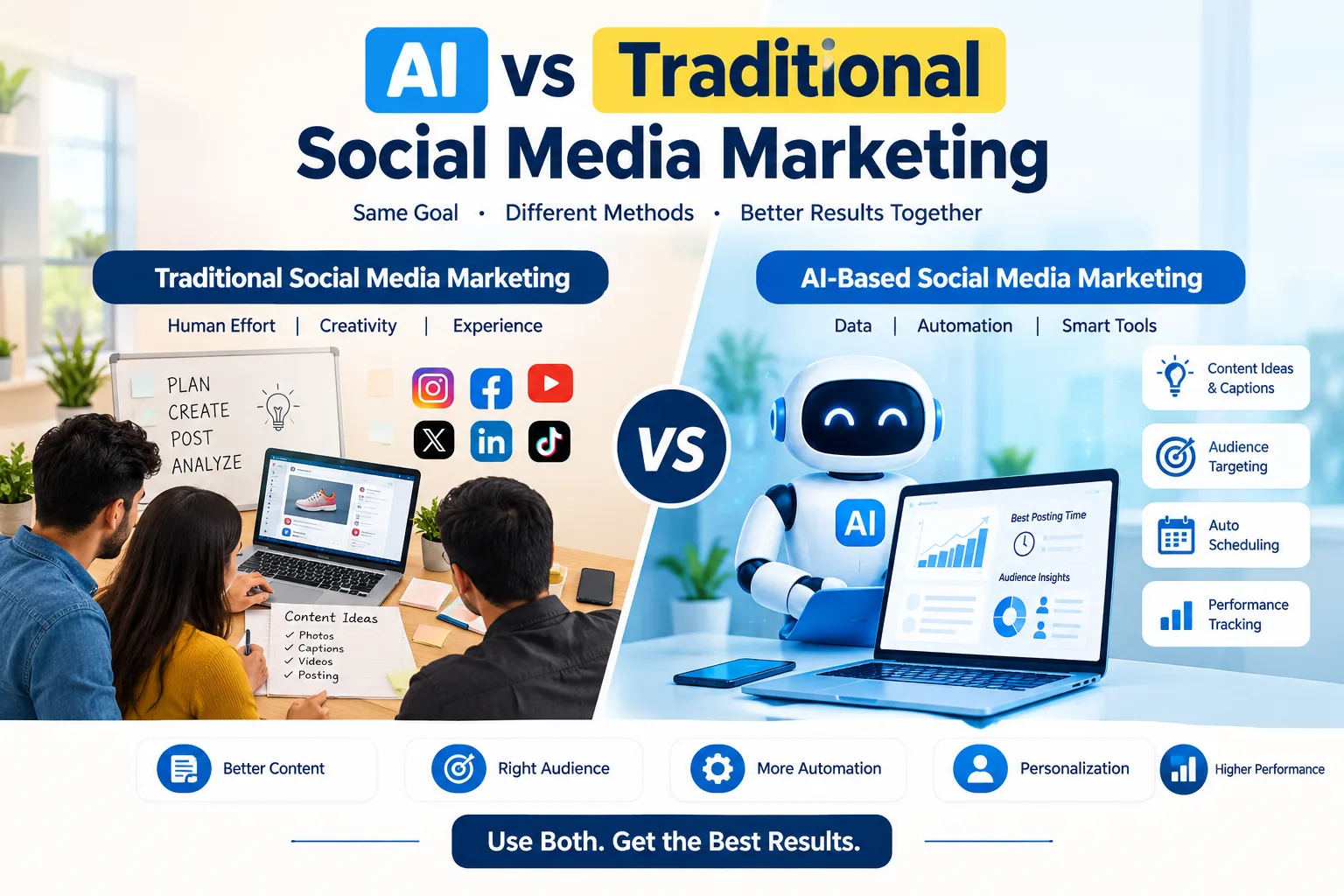
What is Traditional Social Media Marketing?
In traditional social media marketing, most of the marketing tasks are handled by the human team itself.
The team creates the idea for the post, writes the caption, prepares images or videos and then posts it on social media.
The team uses customer feedback, comments, previous campaigns and its own experience to understand the audience.
Simple Example
Suppose a clothing shop wants to promote its new collection on Instagram.
The marketing team will take photos of the clothes, write captions, and post them. After posting, the team will check for likes, comments, shares, and customer messages.
Human experience and creativity play an important role in this approach.
What is AI-Based Social Media Marketing?
In AI-Based Social Media Marketing, smart technology is used to make various marketing tasks easy and fast.
This technology can help analyze large amounts of data. This can help businesses understand what types of content audiences are engaging with, what times of day have better engagement, and which customers are showing interest in a particular product.
This does not mean that the need for humans ends.
Human creativity, brand understanding and final decision-making are still important.
AI vs Traditional Social Media Marketing: Main Differences
The main differences between AI-based and traditional social media marketing can be understood through the following factors:
| Heading 1 | Heading 2 | Heading 3 |
|---|---|---|
| Factor | Traditional Social Media Marketing | AI-Based Social Media Marketing |
| Content Creation | Mostly handled by the marketing team | AI can assist with ideas and content drafts |
| Audience Analysis | Based on research and experience | Uses data and audience patterns |
| Automation | More tasks are handled manually | Repetitive tasks can be automated |
| Personalization | Mostly created manually | AI can help deliver more relevant content |
| Speed | Slower | Faster |
| Human Creativity | High | Requires human review |
The main goal of both approaches is the same: to deliver the right message to the right audience. The difference mainly lies in the method of working.
Traditional marketing focuses more on human effort, experience, and creativity. AI-based marketing makes greater use of data, automation, and smart tools.
Let us understand the important differences with simple examples. readmore
1. Content Creation
In traditional marketing, the work of creating content is done by the marketing team.
The team selects the topic, writes captions, designs images and creates videos.
This may take more time, but the human team can understand the brand's personality and story better.
Smart tools in an AI-based approach can help create content ideas, captions, headlines, and different content versions. readmore
Example
A restaurant has to make 10 posts for Instagram.
In the traditional method, the team will create the idea and caption of each post themselves.
Using an AI-based approach, the smart tool can quickly suggest multiple ideas and caption drafts. The marketing team can then edit them to finalize the brand's image.
2. Audience Targeting
Targeting the right audience is very important in social media marketing.
In traditional marketing, the team selects the audience based on customer research, results from previous campaigns, surveys, and personal experience.
AI-based systems can help understand different customer groups by analyzing available data.
Example
Suppose a sports shoes company sells running and fitness products.
The marketing team can select the target audience by looking at the data of previous customers.
Smart tools can help identify different audience groups by analyzing customer behavior and campaign data.
3. Automation
In traditional marketing, many tasks have to be done manually.
Like publishing daily posts, checking comments, viewing messages and preparing reports.
With the help of automation, some repetitive tasks can be scheduled in advance.
Example
A small business can prepare social media posts for the entire week on Sunday.
After scheduling the posts, they can be automatically published at the selected time.
This reduces the need for the marketing team to manually post every day.
But important customer complaints and serious messages should be checked by a human team member.
4. Personalization
The interest of every customer is not the same.
Someone may like shoes, someone may like jackets and someone may like sports equipment.
In traditional marketing, the team can prepare personalized content by looking at the customer's previous interactions and interests.
AI-based systems can help show relevant content to different audience groups by analyzing customer behavior and available data.
Example
An online clothing store that has both men's and women's clothing.
If a customer repeatedly views men's products, the business can focus on showing that customer content related to men's clothing.
This allows the customer to get more relevant information.
5. Customer Engagement
On social media, customers don't just view posts. They comment, ask questions, and even send direct messages.
In the traditional approach, the social media manager manually reads and replies to comments and messages.
Smart systems can help provide basic answers to common questions.
Example
Customer asks:
“How many days will it take for delivery?”
If the business has set up automated responses to common questions, customers can get basic information quickly.
But if the customer asks about a refund, complaint or any complicated problem, then the human team should handle the conversation.
6. Performance Tracking
In traditional marketing, the team can manually check the results of the campaign.
Numbers like likes, comments, shares, clicks, website visits and sales are seen.
Today social media platforms themselves also provide analytics data.
AI-based analytics tools can help analyze large amounts of data and identify useful patterns.
Example
Suppose the business published 20 Instagram posts in a month.
The team can check which posts got the most engagement.
If videos get a better response than images, the business may focus more on video content in the future.
Benefits of Traditional Social Media Marketing
The biggest benefit of traditional marketing is human creativity.
Humans play an important role in understanding customer emotions, brand story and local audience.
Human thinking is useful in storytelling, creative campaigns and sensitive customer communication.
An experienced marketer can decide what type of language a brand should use.
Benefits of AI-based social media marketing
The major benefit of AI-based marketing is speed and data handling.
Smart tools can help generate content ideas, reduce repetitive tasks, analyze data, and organize marketing workflows.
If a business needs a lot of content ideas, these tools can make the brainstorming process faster.
But it is important to check the final content through a human team.
How to use both approaches together?
Businesses don't necessarily have to choose just one approach between traditional and AI-based marketing.
Both can be combined.
Suppose a clothing brand wants to launch a new product.
First of all the marketing team will understand the product and target customers.
After that, content ideas and caption drafts can be taken from smart tools.
The marketing team will edit those ideas according to the brand language.
Posts can be scheduled.
Performance data will be checked after the campaign.
If a particular type of content gets a better response, the team can use that information to plan the next campaign.
In this approach, technology provides speed and humans handle creativity and final decisions.
What is useful for small businesses?
Small businesses usually have limited budget and small marketing team.
Therefore, it is important for them to save time.
A small business can create a basic social media strategy and rely on smart tools for tasks like content ideas, scheduling, and analytics .
Example
Suppose there is a local bakery.
The bakery team can take photos of the cakes and products themselves.
Smart tools can help with captions and post ideas.
Posts can be scheduled.
By checking business analytics at the end of the month, you can see which type of content customers liked the most.
This allows small teams to use their time better.
In which tasks is human approach necessary?
It is not right to rely on automation for every marketing task.
Human judgment is important in tasks like creating brand identity, handling important complaints, responding to sensitive topics and taking major marketing decisions.
If the automated reply does not properly understand the customer's question, the customer may become unhappy.
Therefore, using smart technology as a helpful assistant can be a practical approach.
How to avoid common mistakes?
Some common mistakes should be avoided in social media marketing.
1. Creating content without understanding the audience
Simply posting daily isn't enough. Content should be tailored to the interests of your target audience.
2. Just looking at likes and followers
Likes may be important, but businesses should also look at clicks, leads, sales, and customer response.
3. Leaving everything to automation
Automation can save time, but important conversations should be checked by humans.
4. Publishing content without checking it
Content created with smart tools should be checked for facts, language, and brand message before publishing.
The Future of Social Media Marketing
Social media marketing is continuously changing.
Businesses now have access to more data about their customers and campaigns. Additionally, various smart tools are available to make marketing tasks easier.
But basic marketing principles are still important.
Businesses will need to understand their audience, create useful content, communicate well with customers, and measure campaign results.
In the future, businesses can manage their social media strategy by combining human creativity and smart technology.
Social Media Marketing with TZAP Marketing
TZAP Marketing helps businesses build a strong online presence on social media.
The focus here can be on content creation, audience targeting, and performance tracking.
Using modern smart tools along with traditional marketing can improve the marketing process.
Businesses can create a social media strategy and content plan based on their goals.
The right strategy can help brands effectively reach customers.
Conclusion
If we understand AI vs Traditional Social Media Marketing in simple words, then in traditional marketing, the role of human effort, creativity and experience is more, whereas AI-based marketing helps in making different marketing tasks faster by using data, automation and smart tools.
Both approaches can be useful.
The traditional method is helpful for creativity, storytelling, and personal communication. The AI-based approach can help with content ideas, data analysis, personalization, and repetitive tasks.
Businesses can combine both approaches. Technology can make routine tasks easier, while humans can handle brand identity, customer relationships, and final decisions.
Frequently asked questions
What is the difference between AI and traditional social media marketing?
AI-based marketing uses smart tools, automation and data analysis, while traditional marketing mainly depends on human creativity, research and manual work.
Is AI better than traditional social media marketing?
Both approaches have different uses. AI can help with automation and data analysis, while traditional marketing is useful for creativity, storytelling and personal communication.
How can AI help with social media marketing?
AI can help businesses create content ideas, understand audience behavior, personalize content, automate tasks and track campaign performance.
Can businesses use AI and traditional marketing together?
Yes. Businesses can use smart tools for repetitive tasks and data analysis while their marketing team handles strategy, creativity and customer communication.